
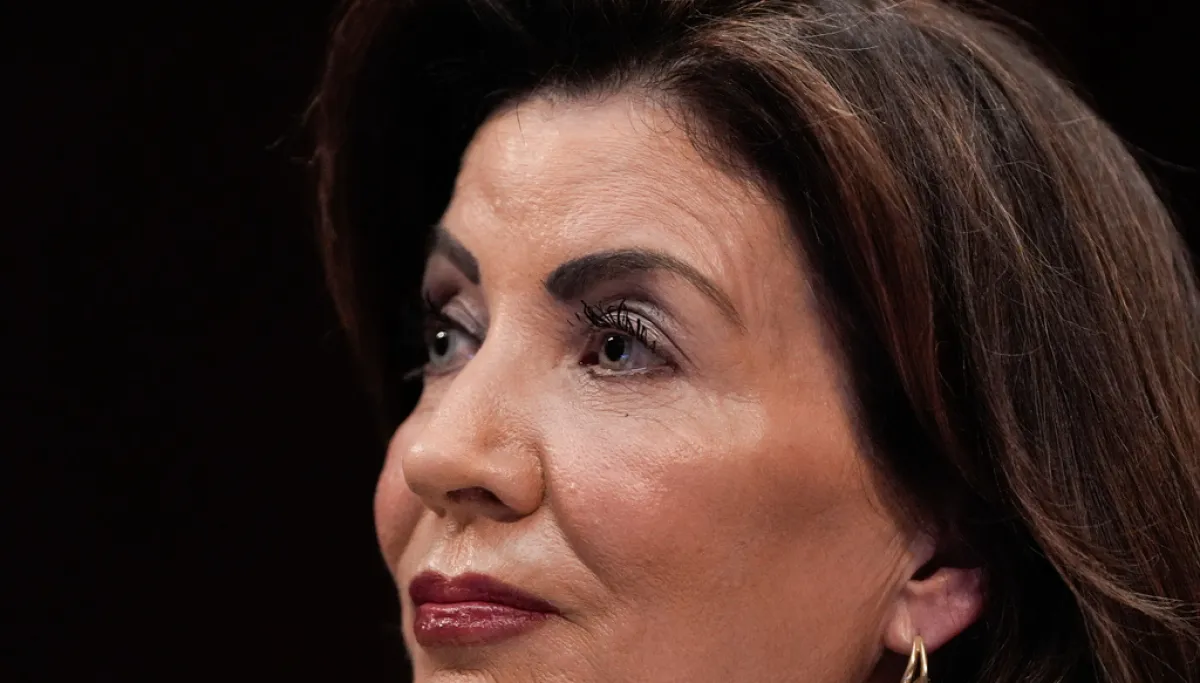
In her fight to remain relevant in New York, Gov. Kathy Hochul is reportedly negotiating a deal to lower the retirement age for certain public-sector workers — including teachers and nurses — to 55. And who will pay for this $1.5 billion scheme to hand out earlier retirements to government employees, floated at a time when most Americans are working longer and harder just to keep their heads above water? Not the people receiving these benefits, of course, but New York taxpayers.
Despite the language of Democrats in New York — all battling to outpace Zohran Mandani’s radicalism — this isn’t free money, or “found” savings, or a budget reshuffle. It’s yet another so-called redistribution of wealth from the public to a politically favored class of workers.
What makes matters worse is that many public employees in New York already enjoy the ability to retire at 55 with generous pensions. This proposal would only expand that privilege even further, at a time when the state is grappling with an ever-expanding budget crisis.
One problem here is that retirement benefits in the public sector are seen as an entitlement, if not a human right. Why does this differ so much from the private sector, where retirement (and especially early retirement) is more of a luxury earned through decades of disciplined saving and investment? Well, it’s because public-sector labor unions own the Democratic Party, particularly in states such as New York. They fund campaigns, mobilize voters, and shape policy, and in return, they get what they want: higher pay, richer benefits, and now, earlier retirement. All while the people left with the bill — taxpayers — are locked out of the room.
But there’s something deeper here that goes beyond labor union corruption and budget insanity. In a truly free society, there should be no such thing as a government-imposed retirement age, especially in the public sector. Individuals should be free to decide when they retire, based on their own financial planning, health, and personal circumstances. If you want to retire at 45 and you can afford it, go ahead. If you want to work into your 70s, that should be your choice, too.
What we’re seeing in New York flips that principle on its head. It’s not individuals choosing when they can retire based on their own circumstances, but the state driving earlier retirement by shifting the cost onto others.
But even if we accept the premise that retirement ages are necessary, this decrease in the retirement age makes absolutely no sense. When Social Security was introduced under President Franklin D. Roosevelt almost a century ago, the “full retirement age” was set at 65, above the life expectancy for both men and women at the time.
Today, according to the Centers for Disease Control and Prevention, life expectancy in the United States is now almost 80 years (and more than 81 for women). In less than a hundred years, we’ve gone from taxpayer-funded retirement covering a minority of Americans who lived beyond a certain point to covering people for more than a decade.
The fact is that, on average, people are healthier, more active, and more capable of working longer than ever before. The logical response to this reality would be to raise retirement ages, not lower them. And yet, in pursuit of a labor union utopia, we’re ignoring this reality and pretending that a 55-year-old today is the equivalent of a 65-year-old in 1935.
ECONOMY ADDED 178,000 JOBS IN MARCH: THE KEY FACTS AND FIGURES
The fact that Tom Cruise is 63 should debunk that idea fairly quickly.
Ian Haworth is a syndicated columnist. You can find his work on Substack.