
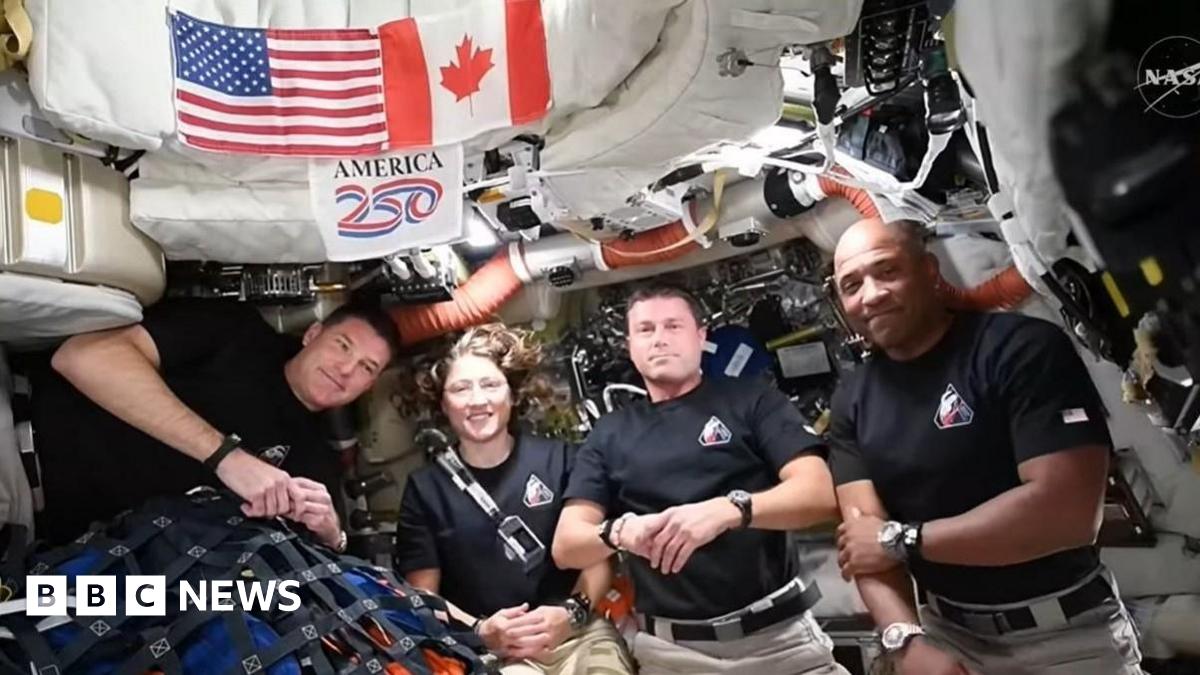
Astronauts prepare for total solar eclipsepublished at 01:07 BST
01:07 BST
 Pallab Ghosh
Science correspondent
Next up, the astronauts will witness a total solar eclipse.
On our planet, total eclipses happen when the Moon’s shadow sweeps across a narrow strip of ground, briefly turning day to twilight.
This time the Moon’s shadow will not fall on the Earth, but on the Orion spacecraft.
Orion is parked in just the right spot so that the Moon blocks the Sun from the crew’s view, revealing the star’s pale outer atmosphere – the corona – as a shimmering halo around a darkened lunar disc.
Cameras have been set up at the windows to capture the stages of the event, from the first “bite” out of the Sun to the moment of totality and the delicate “diamond ring” effect as sunlight peeks round the edge.
What makes this sight even more striking is what hangs nearby.
Off to one side, the Earth is still visible – a small, glowing globe, partly in shadow, its cloud systems and continents just about discernible.