
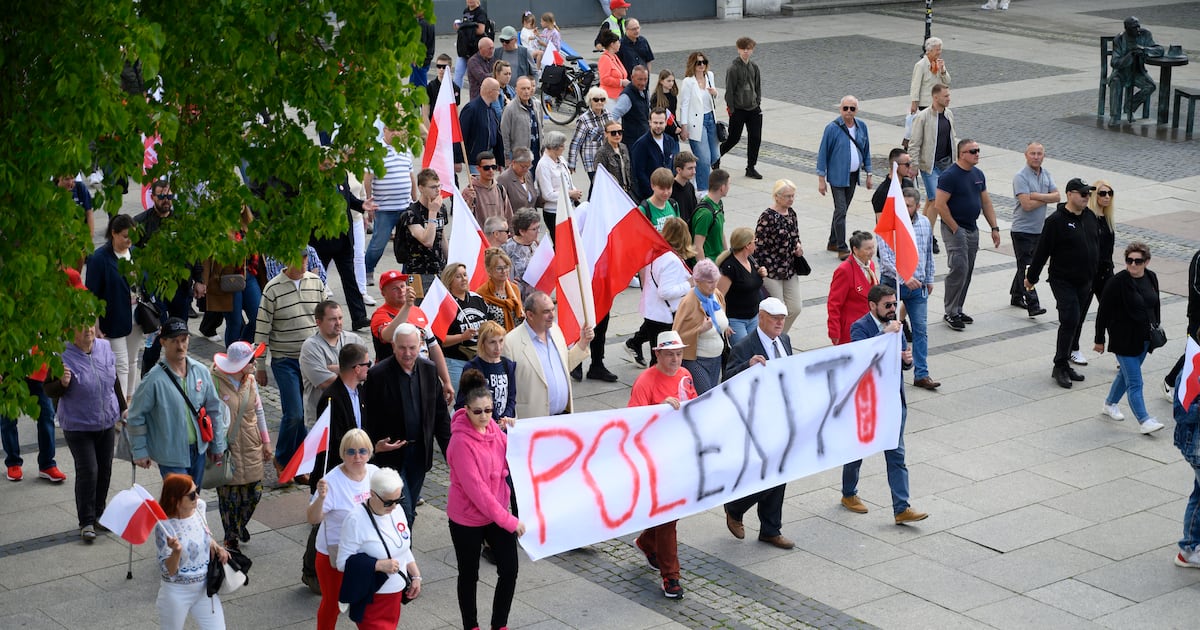
Warsaw is thriving. Poland’s economy is consistently one of the fastest growing in Europe. If Ireland is the poster child of the European Union’s early expansion 53 years ago, Poland is the big success story of the union’s 2004 enlargement eastward.
So, why is the country talking about “Polexit”?
Prime minister Donald Tusk recently warned that Poland’s departure from the EU was a “real threat”. He said the right-wing nationalist opposition, Law and Justice (PiS), as well as more extreme far-right forces, wanted to take Poland out of the union.
That has been read as an early attempt by Tusk to make key parliamentary elections next year a vote on Poland’s EU future. He is perhaps hoping that by turning the campaign into a quasi-referendum on membership, he can shore up his base against surging Eurosceptic forces.
Some opinion polls show a spike in support for Polexit, a trend that has spooked pro-EU politicians.
“I remember how this country looked before the European Union and I think most of the people here, no matter if they are pro-Polexit, or anti-Polexit, they just don’t remember how it was and how much everything changed,” says Blazej Tokarski, a theatre director who stops to talk during a walk through central Warsaw.
It would be a “disaster” if Poland ever voted to break away from the EU, he says. “But I think it is quite possible,” he adds. “I think people take many things for granted, that we can travel, that we are not [a] second-class country any more.”
Politics in the country is bitterly divided between two evenly-matched camps. On one side, Tusk’s Civic Coalition of centre-right and centrist parties who are in government. On the other, Law and Justice, the populist opposition who are aligned to the president.
Law and Justice were in power for eight years between 2015 and 2023. During that time, the party pursued a nationalist and conservative vision for the country, bringing them into regular conflict with Brussels.
The European Commission sanctioned PiS for undermining the rule of law, attacking LGBTQ+ rights and stacking the judiciary with political allies.
Tusk’s return as prime minister more than two years ago was hailed as a major win for liberal pro-European politics.
The centre-right leader has been hamstrung ever since and blocked from pushing through his domestic agenda by successive conservative presidents.
Poland’s constitution allows the president a lot of latitude to delay and veto legislation. The former president, Andrzej Duda, a Law and Justice man, didn’t hesitate to use those powers after Tusk wrested control of the government back from the hard right.
That’s why so much stock was put on new presidential elections last year. The vote was a chance for Tusk to get one of his allies into the job to break the deadlock.
Karol Nawrocki, a hard-right populist backed by PiS, narrowly beat Rafal Trzaskowski, the Warsaw mayor and pro-EU candidate. The result was a setback for Tusk’s administration.
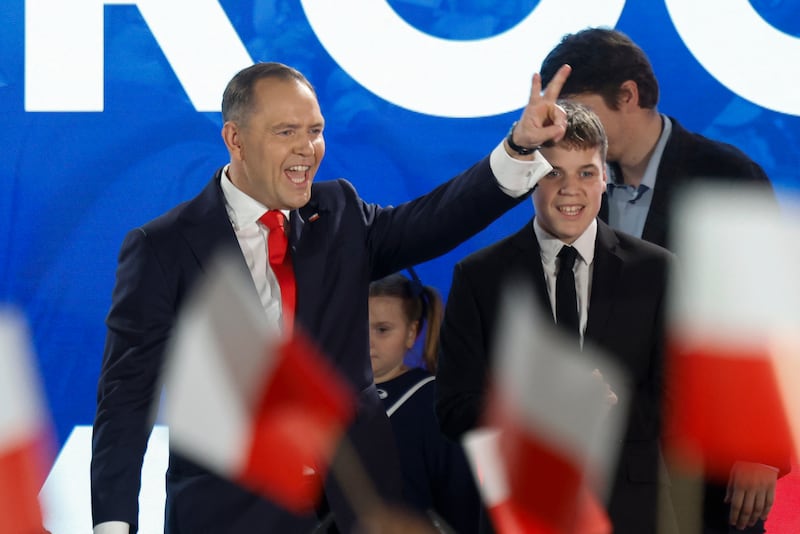 Karol Nawrocki was supported by Poland’s right-wing Law and Justice (PiS) party in his successful run for the presidency last year. Photograph: Wojtek Radwanski/AFP via Getty Images
Nawrocki has exercised his veto powers even more liberally than his predecessor since taking office. Recently, he intervened to block Poland from drawing down €43 billion in cheap EU loans to spend on defence.
Tusk’s strategy has been to paint the obstruction and Eurosceptic tendencies of the right-wing opposition as a gift to Moscow. That plays into very real concerns in Poland that Vladimir Putin won’t stop in neighbouring Ukraine, should Kyiv fall.
Detailed preparations are being made by Polish military planners to defend the country from a Russian invasion.
Anti-tank trenches have been dug and landmines stockpiled in strategic sites along Poland’s border with Kremlin-ally Belarus, to deploy in the event of an attack from the east. The plan hinges on buying the Polish army enough time to fully mobilise by slowing down a hypothetical Russian attack. A few days can be the difference.
The incursion of Russian drones into Polish territory last September, and large-scale “war game” training exercises in Belarus the same month heightened anxieties here.
Michał Wawrykiewicz, a politician from Tusk’s Civic Coalition, says the Russian invasion of Ukraine had underlined why Poland should “cement” itself firmly among its European allies. “Society is fully aware that our security is in the West, not only Nato but the European Union,” he says.
Even those favourably inclined to the idea of leaving the EU recognise breaking away would not be possible for some time. Poland is one of the big winners out of the EU’s €2 trillion budget. The country is a huge beneficiary of “cohesion” funding for regional development and CAP agriculture subsidies.
The experience of Brexit proved to be a visible exercise in economic self-harm. The referendum also showed people sometimes cast their vote on emotion, instead of a sober economic analysis of the decision in front of them.
Law and Justice might want to hollow out the power of the EU institutions and re-entrench the primacy of national capitals in policymaking, but they showed no interest in following the UK out of the door during their last stint in government.
PiS is nervous about being outflanked by more extreme far-right forces, such as the Confederation party, and Korona, a vehicle of pro-Polexit extremist politician Grzegorz Braun.
Wawrykiewicz, a lawyer-turned-MEP, says Law and Justice basically wanted EU funds without EU rules.
The populist party saw itself returning to government to again become a “black sheep” inside the union, antagonising the commission and flouting EU court rulings, the Tusk ally says.
“They don’t want any restrictions coming from Brussels. They want to treat the European Union as a cash machine without any obligations,” he says.
Common rules concerning asylum seekers and refugees come in for the fiercest criticism from the right.
Marcin Butrym and other anti-immigration campaigners are collecting signatures for a petition from passers-by outside a busy metro station in Warsaw, beside the looming Palace of Culture and Science.
The hardline group, Border Defence Movement, has organised citizen patrols along the Polish-German border, claiming Berlin is pushing illegal migrants into Poland.
“The European Union wants us to take migrants who won’t work here, who will be just sitting and taking our money,” says Butrym.
New EU-wide reforms coming into force this June are a raw point of tension. The changes will toughen up Europe’s asylum system, making it easier for governments to quickly rule on claims and deport rejected asylum applicants.
However, the pact includes a burden-sharing mechanism to alleviate pressure on “frontline” countries such as Greece, Italy and Spain.
Other EU member states can either agree to take in transfers of asylum seekers or make financial contributions into a “solidarity” fund, to help countries under strain from higher numbers of arrivals.
Tusk has said Poland will refuse to accept any transfers of asylum seekers under the pact, or make financial payments to other EU states. A showdown between Warsaw and Brussels probably won’t come to a head this year, though.
Poland has been given an initial pass on its burden-sharing obligations because it was assessed as being under migratory pressure itself.
Russia has been accused of enticing migrants from Africa and Asia to Moscow and Minsk, then transporting them to the Belarusian-Polish border and guiding them across, turning migration into a weapon to pressurise European governments.
Tusk is aware fears about increased flows of asylum seekers into the country will be a potent line of attack from the populist opposition.
“We would like to keep Poles in Poland,” Butrym says. “We are open to other nations, but we don’t want to do what the European Union says.”
What does he think about Tusk? Butrym laughs and smacks a fist into the palm of his other hand, then theatrically stamps his foot and mimics kicking someone on the ground.
“For now, it’s not possible to leave, but in the future, if European Union will do everything wrong, maybe we could think about leaving,” he says.
Anxiety about immigration stretches far beyond the right-wing political fringes. It is also in the capital, a liberal bubble.
“We are open for everybody, but we just want Poland to stay like Poland,” says Karol Oskroba, a welder from Warsaw, who travels around Europe for work regularly.
 Karol Oskroba in central Warsaw. Oskroba is a welder who travels around Europe for work regularly. Photograph: Jack Power
“We got a lot of EU funds [for] Poland but I believe for me personally, we don’t like the rules they are pushing to our country,” he says.
Oskroba, who isn’t a supporter of Tusk or the populist right, says preserving Poland’s culture is important to him. “I travelled during the last two years and I can see how it looks in Germany, the Netherlands. I’m quite happy how it looks in Poland,” he says.
Tusk seems confident that making EU membership an election issue will ultimately hurt Law and Justice and help him.
Uncorking that particular bottle and hurling the genie right into the middle of domestic politics is a risk. The genie might prove uncontrollable once released. Just ask David Cameron.