
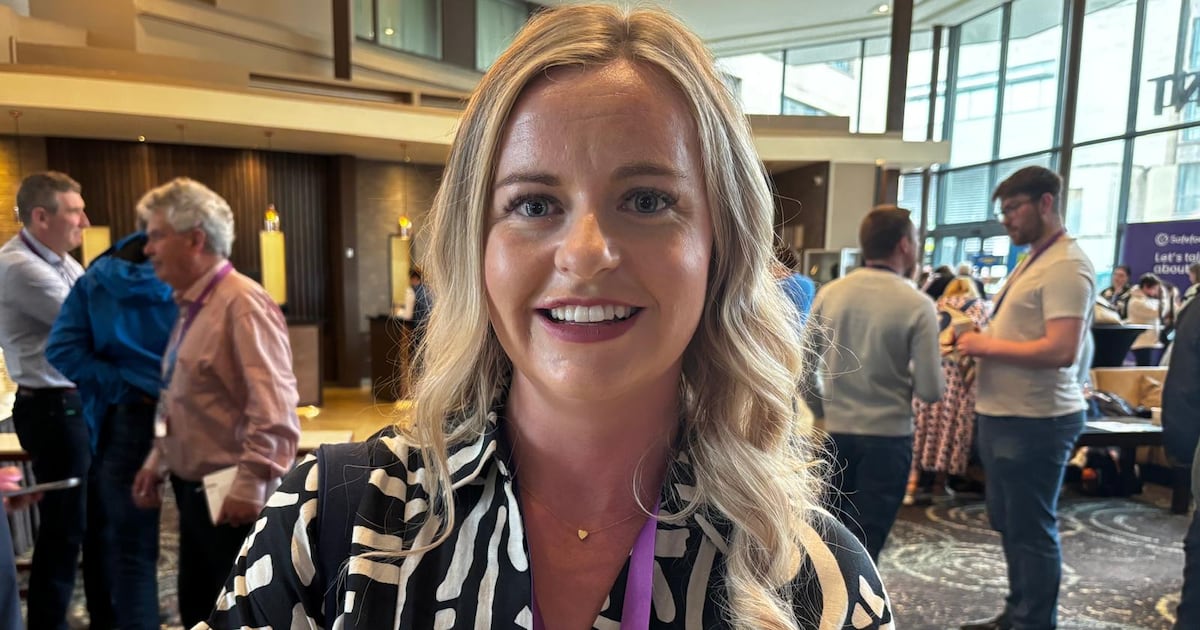
Sophie Cole knew there were risks involved when taking up a role as a special-education teacher, but she felt the job was her calling.
About 3½ years ago, the then 27-year-old, from Carrigaline, was teaching in a school in Cork and suffered a life-changing injury.
She went to clean up some water spilt by a student, who had complex special needs and was aged about 10. She rested her hand on the side of a table to support herself while kneeling down, but the child grabbed her hand and “slammed” it against the steel table.
The pain was intense and Cole initially assumed she had broken something, but over the following months it became clear her injury was more serious.
“I was left with Complex Regional Pain Syndrome and it has changed my life,” she says.
“My ability to work was taken from me. I don’t have the use of my left hand. I’ve had four major spinal cord surgeries.
“It has shattered my independence; I lost my ability to drive, to take part in all my physical activities.”
At one point, a hospital consultant told Cole she would not work again, and she struggled to believe it.
On the day the incident happened, Cole says she was told by the school, where she worked as a special needs assistant before retraining as a teacher, that she would be put on assault leave, which provides full pay. However, that payment only lasted for three months.
Cole then worked her way through the 183 days of sick leave teachers are entitled to during a four-year period, partly at full pay and partly at half pay.
“I was lucky at that stage because I hadn’t had any time off sick before,” she says. “But after it was gone, I had to depend on the State’s sick pay, €220 a week, and when that ran out, I had to apply for invalidity benefit.”
Cole says it felt “incredible to be applying for invalidity at 30″, and her application was initially refused.
“There was a spell where I had no income and we were getting married. I had all the medical expenses. But that [invalidity benefit] is what I get now. It’s €250 a week.”
She is at pains to say she does not blame the child who caused the injury for the position in which she finds herself.
“Every day you could face a kick, a hit, a bite, a scratch. It becomes part of your daily routine,” she says. “You don’t put any blame on the children. This is their form of communication. But there are huge flaws in the system, in the provision of support for students, the under-resourcing of staff.”
Cole has had an implant in her back to reduce the transmission of pain signals, but it only stops about 30 per cent of them. Now, she is expecting her first child, which has meant coming off the more powerful pain relief.
“I’ve been on OxyContin, Ketamine,” she says before listing several other drugs.
Support, she says, has been patchy, but she credits Fine Gael Cllr Jack White and Labour Senator Laura Harmon for having campaigned on her behalf. Harmon has introduced the Education (Leave for Injuries) Bill into the Seanad with the intention of supporting teachers like Cole.
There are plenty of them, says Cole, many of whom made contact after she posted about her experience on Instagram.
Research compiled by the Irish National Teachers’ Organisation (INTO) suggests that less severe incidents than Cole’s are far from exceptional, with 96 per cent of special education teachers having experienced physical aggression. Some 41 per cent of teachers in general reported being hurt and requiring more than first aid.
Minister for Education Hildegarde Naughton was supportive of Cole when they met, she says. And she hopes a motion on the issue passed at the INTO’s conference in Killarney this week will add to the union’s impetus on the issue.
“There’s a huge guilt around leaving the classroom, and I wanted to get back to teaching because it gave me purpose, but the system, as it is, is broken,” says Cole. “There needs to be more support.”