
Flying into Rome on the night of Ireland’s recent World Cup qualifier against the Czech Republic, I was in urgent need of an Irish bar. By the time a friend and I got off the airport bus, there were only 10 minutes left in Prague and Ireland were hanging on 2-1. Then, under pressure, like the Irish defence, we made a tactical mistake.
From a previous visit to Rome, I remembered there was a pub called the Flann O’Brien just a few minutes away by taxi. When we got there, sure enough, it was full of football fans. But on closer inspection, they were all Italian, staring at multiple television screens, none of which featured our game.
Trying to explain this to a barman was further confused by the fact Italy were playing Northern Ireland. “That’s the wrong Ireland,” I told the barman, who looked bemused, as well he might.
Another comic writer, not Flann but Oscar, came to mind. Having one Ireland involved in a World Cup qualifier might be considered unfortunate; two seemed like carelessness. But when the Czechs equalised in Prague, it at least gave the barman an extra half hour to find our channel from the “about a thousand” (his estimate) available.
The pub was emptying now: Italy had won. By the time we found the right channel (sort of – it was Sky and they were alternating between ours and the Welsh qualifier, which also involved teams in red and white, heightening the confusion), we were the only customers watching football.
It was too late when I remembered the most authentic Irish pub in Rome, which would probably have RTÉ. I’m referring to The Fiddler’s Elbow. Ironically, I had been there some years ago during a Flann O’Brien conference – none of which involved the Flann O’Brien pub – but somehow forgot it.
Oh well. I know my confusion in Rome had nothing to do with Ireland’s late loss of focus in Prague, just as I know my driving the wrong way for a pub did not help the Czechs win the penalty shootout. Still, on the well-known principle that even TV-watching fans can influence the outcome of games by, for example, going to the toilet at key moments, I do feel vaguely responsible.
***
I was in the Eternal City for an interview and book reading at the Casa della Cultura Irlandese, located in a room of the Pontifical Irish College.
This magnificent building, commanding a street corner near the Colosseum, in a garden lined with orange trees, is the last Irish priest-training college in mainland Europe. It also hosts occasional Hiberno-Italian cultural events like this, curated by artist Eve Parnell.
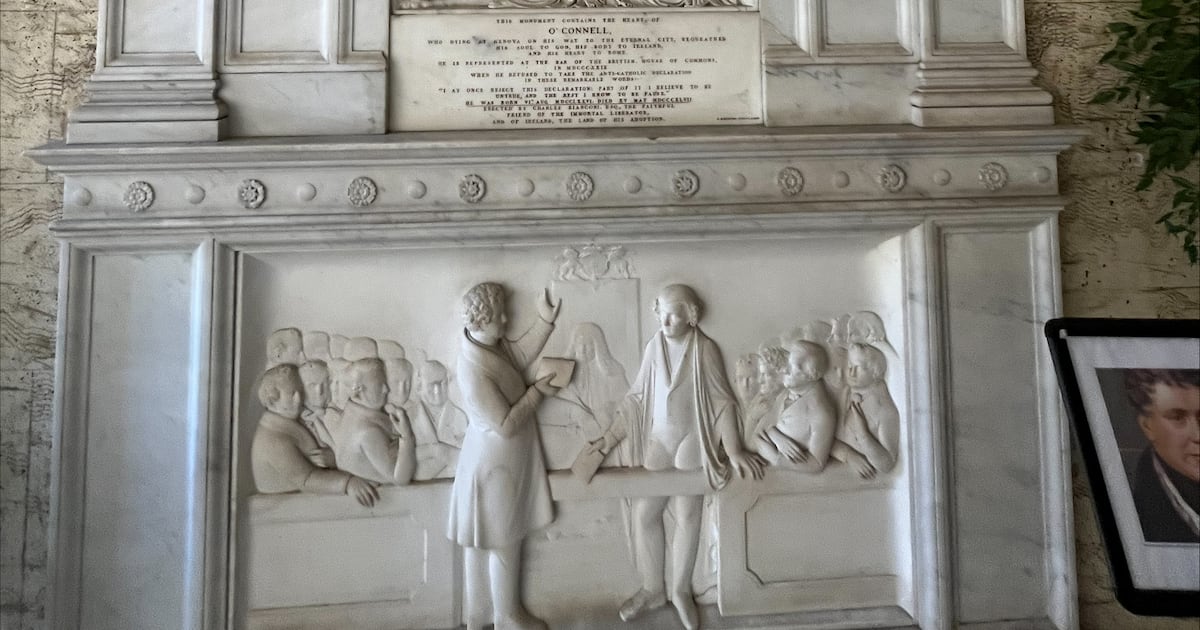
Arriving for a rehearsal the next day, I was impressed by a marble plaque that implied we would be performing in – or near – the presence of Daniel O’Connell’s heart. Alas, this was not quite true.
The heart O’Connell famously bequeathed to Rome did once reside in a recess behind the plaque, when both were in the old Irish College, then situated across the city at the church of Sant’Agata dei Goti. By the time the college relocated in the 1920s, however, the heart had gone missing. Its whereabouts remain uncertain.
Between rehearsal and main event, we had time to explore the neighbourhood, which includes the Scala Sancta (“Holy Stairs”), an extraordinary phenomenon that had somehow passed me by until now.
A flight of 28 marble steps leading to a church, this ancient stairway is believed to have originated as the entrance to Pontius Pilate’s praetorium in Jerusalem, and so to have been ascended by Jesus on the way to his trial.
According to tradition, the steps were brought to Rome in the fourth century, since when they have been worn down by countless penitents, who must climb them on their knees.
Hugh O’Neill did it during his Roman exile. So, 100 years earlier, did Martin Luther, while expressing some doubt about the supernatural powers conferred by the ritual, said to include releasing souls from purgatory.
A later pilgrim, Charles Dickens, was disgusted by the spectacle, which on his visit included schoolboys knee-racing each other to the top and a man who cheated by using an umbrella (on a day it wasn’t raining) to propel himself along.
“I never, in my life, saw anything at once so ridiculous, and so unpleasant,” Dickens harrumphed.
I’m not sure if the stairway’s reputed powers ever extended to influencing football matches, but if I’d arrived a day earlier I might have done the knee-climb anyway, just to be on the safe side. In the event, I walked up to the church, which you can do via an adjoining set of steps.
Oh well, again. Rome was lovely. As for the football, like many fans, my consolation is that I didn’t really want to go to a World Cup in the US anyway. The event will be overpriced, overblown and over there. As with Daniel O’Connell and the plaque recess, my heart wouldn’t have been in it.