
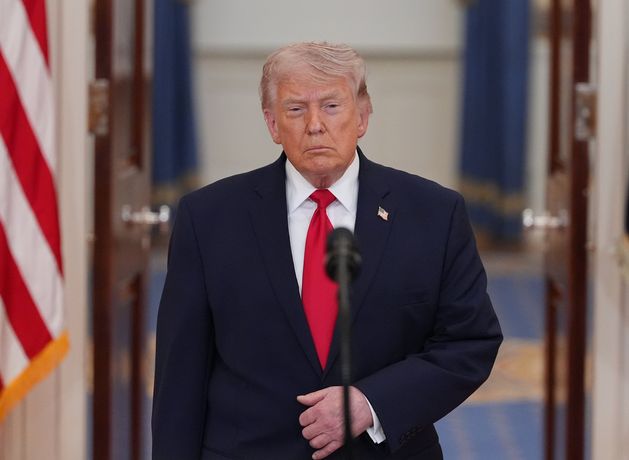
Coalition leaders meeting to discuss the country’s energy supplies but rule out any more immediate support for energy crisis, as fate of global economy will be decided by Trumps next move
Tánaiste Simon Harris, who is also the finance minister, has said that the decisions that will be made by the US government overnight will have “profound global economic impact in one direction or another” as he condemned “outright” President Trump’s “collective punishment” against Iranian civilians.
“That’s the level of volatility. They say a week used to be a long time in politics. Now 20 minutes, and a Truth Social post is,” he said.
He rejected the idea that the government has adopted a “wait and see approach” in relation to the energy crisis and pointed to the €250m in energy supports provided last month, and said the situation is “under review.”
In the wake of nationwide go-slow protest clogging up major roads, the Tánaiste said “people are really feeling the challenge here. People are worried, people are anxious, people are stressed. There’s absolutely no doubt about that”.
However, Mr Harris did not say there was any further imminent support for people when it comes to rising fuel prices, and said that the government were directly engaging with farmers and hauliers on specific supports.
The leaders of the Coalition and other key ministers are meeting tomorrow to get a full briefing on the state of Ireland energy supply and “stress test various scenarios.”
Mr Harris said: “the country is in a reasonably good position in terms of security of supply.
“I think it’s true to say that our level of reserves may be higher than many other countries, and that’s not in any way to be complacent.”
He said the government will be looking at “demand management measures” around energy usage and how households can be helped to make their homes more energy efficient.
The government has established an Oil Security of Supply group who will be updating the government leaders tomorrow.
The chief economist at the department of finance John McCarthy said that the idea that the war in Iran will only have a “short sharp shock [to the economy] has receded”.
He said that the “hangover effects” of the war in Iran and the damage to energy infrastructure including refineries will be felt for longer than previously anticipated.
“Even if it finished tomorrow, there would be still some hangover effects. I think a kind of worst case scenario would involve a kind of stagflationary type of world. I’m not just talking about Ireland. I’m talking about the global economy.”
He said this is where there will be stagnant growth and inflation alongside it.
“Even in the best case scenario, all roads lead to higher inflation. It’s a case of the scale of the impact on inflation.”
Mr McCarthy said that if the war ended imminently there is “very substantial destruction to energy infrastructure in the Gulf” that will not come back on stream “anytime soon”.
The Tánaiste said: “This is not 2008, we have full employment. We have a growing economy, and crucially, we have public finances that are managed in a way that gives us options.”
He said that the Irish economy is still expected to grow this year, but he added that “there’s no doubt” there will be higher inflation this year.
Mr Harris said the level of inflation to be expected will “very much depend” on the decisions made in the hours and days ahead on the outcome of the conflict in Iran.
Mr McCarthy said the government’s balance sheet “is in a much better position” to deal with this economic shock than it was in 2008, and he added that household balance sheets and the accounts of small and medium enterprises are also in a “better position than they were in 2007 and 2008″.
“They have the capacity to smooth the shock. So I’m not for any in any way dismissing this sort of the scale of the shock. It could be a difficult shock,” Mr McCarthy said.
The minister for public expenditure Jack Chambers said the government is not considering introducing energy credits or universal supports for households in response to the energy crisis.
He said the government’s energy supports after the war in Ukraine cost €10bn over three years, “the scale of that was difficult to unwind.”
The Tánaiste criticised President Donald Trump’s threats to wipe out Iranian civilisation.
“The idea of any form of collective punishment against innocent civilians is clearly outside all international norms and international law,” he said.
He added that some of the language from President Trump in recent days was also “unacceptable”.
Mr McCarthy said the government is carrying out modelling on different economic situations, one he said was a “very severe scenario” where oil prices average at $150 per barrel.
Ministers were asked about fossil fuel alternatives as a result of the Middle Eastern crisis — and said nuclear power could be considered.
The Tánaiste said there is no ideological objection to Ireland embracing nuclear power, while minister Jack Chambers said it could alter the affordability question.
The only attempt to build a nuclear power plant in Ireland — at Carnsore Point in Co Wexford — was defeated by people power in the 1970s.
Ministers Harris and Chambers were commenting against background reports of ministers discussing the possible use of nuclear energy in recent weeks.
“I think it’s too easy in Ireland to say we have a form of energy that people are against when we have energy supply and energy security issues,” Mr Harris said.
Mr Harris added: “I don’t profess to be an expert in this area, and we have put a lot of time and energy into trying to develop offshore renewables. But we do have to approach this with an open mind.”
Mr Chambers said he had a similar attitude, but ended up sounding much more positive about the advantages of going nuclear, particularly when it comes to consumers and the cost of living. Arguments against it were decades old and “in a very different world.”
“We should have a debate and a public discussion on nuclear energy,” he said.
“It is something being positively embraced across many European economies, and it is a clear backstop of energy security for many economies.”
He added: “It is a very different context now from the 1990s when it was banned. We know from economists and experts how it could form part of our energy mix (in Ireland) going forward.” This suggests the Government has taken inputs from stakeholders on the issue, with a small but vocal group emerging in recent years to advocate for nuclear power in Ireland.
While there would could continue be an emphasis on renewables, nuclear energy did offer a lot of benefits, “particularly on the affordability question in the long term,” Mr Chambers said.
“But the Tánaiste is also correct. If we were to positively approach that question, it is only something that could be delivered in the medium to long term, and there are other short-term priorities that we must focus on,” he said.
“But excluding ourselves from that policy discussion, when nearly every other European country, and countries across the world in fact is appropriately addressing nuclear as part of their energy mix, I think we should do likewise — and we shouldn’t exclude it because of an argument from twenty or thirty years ago in a very different world.
“We know the concentration of risks that are there when you are relying solely on the Straits of Hormuz for energy. I think we should have any open policy consultation about it and hear from respected voices on either side.
“Every other country in Europe is having that discussion, and we should do likewise.”
Aisling Moloney and Senan Molony