
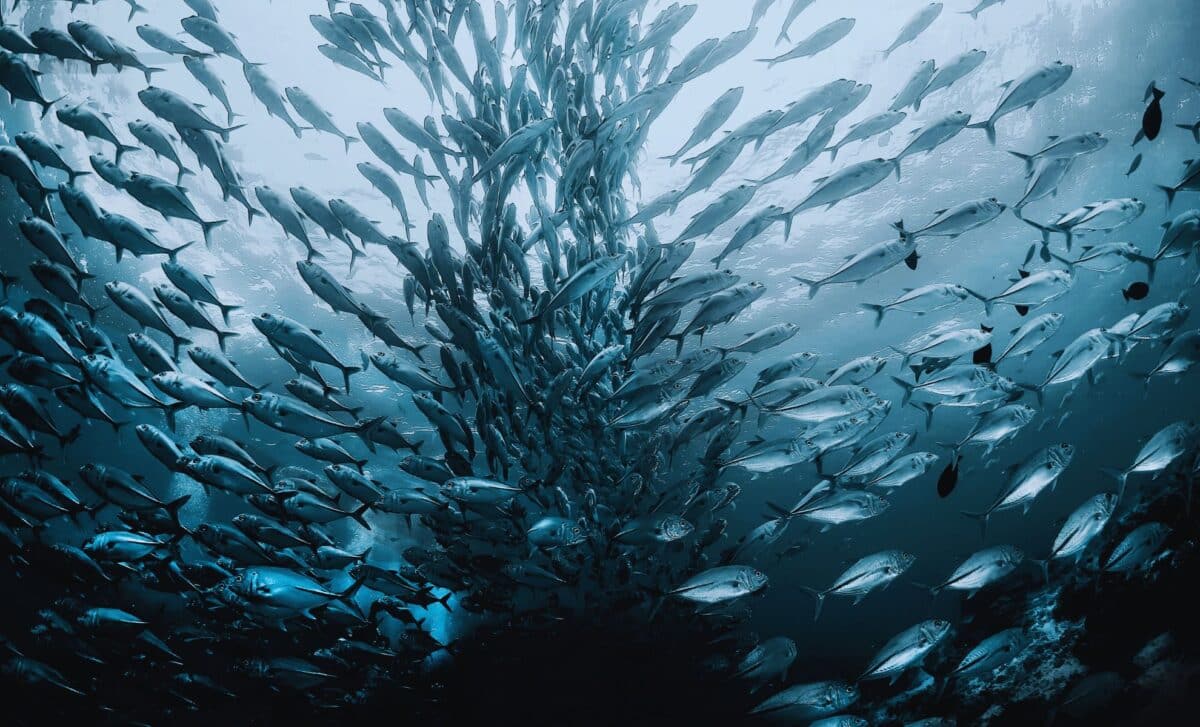
More than 10 million fish were eaten in just a few hours off the coast of Norway, in what scientists describe as the largest marine predation event ever recorded. Captured using advanced acoustic technology, the scene shows how quickly things can spiral in the ocean.
It all happened during the February spawning season in the Barents Sea, when capelin gather in massive numbers to reproduce. Instead of a routine cycle, the dense gathering turned into a feeding frenzy for Atlantic cod.
According to researchers from MIT and Norwegian teams, the event offers a rare, real-time look at how predator and prey interact on a massive scale. Their findings were published in Nature Communications Biology.
A Shoal That Became A Signal For Predators
As described by the research team, the capelin formed a dense shoal extending over 10 kilometers. This aggregation followed a known behavioral pattern: once a critical density is reached, the fish align and move as a single, coordinated unit. According to Nicholas Makris, who led the study:
“That’s not an issue for a healthy population with many spatially distributed population centers or ecological hotspots.”
He added that dense formation acted like a signal flare in the ocean. It drew in huge numbers of cod, which quickly organized themselves for a coordinated attack. The team used the Ocean Acoustic Waveguide Remote Sensing (OAWRS) system to follow the action. This technology picks up sound differences between species, since fish swim bladders resonate differently. Cod produce lower tones, while capelin produce higher ones.
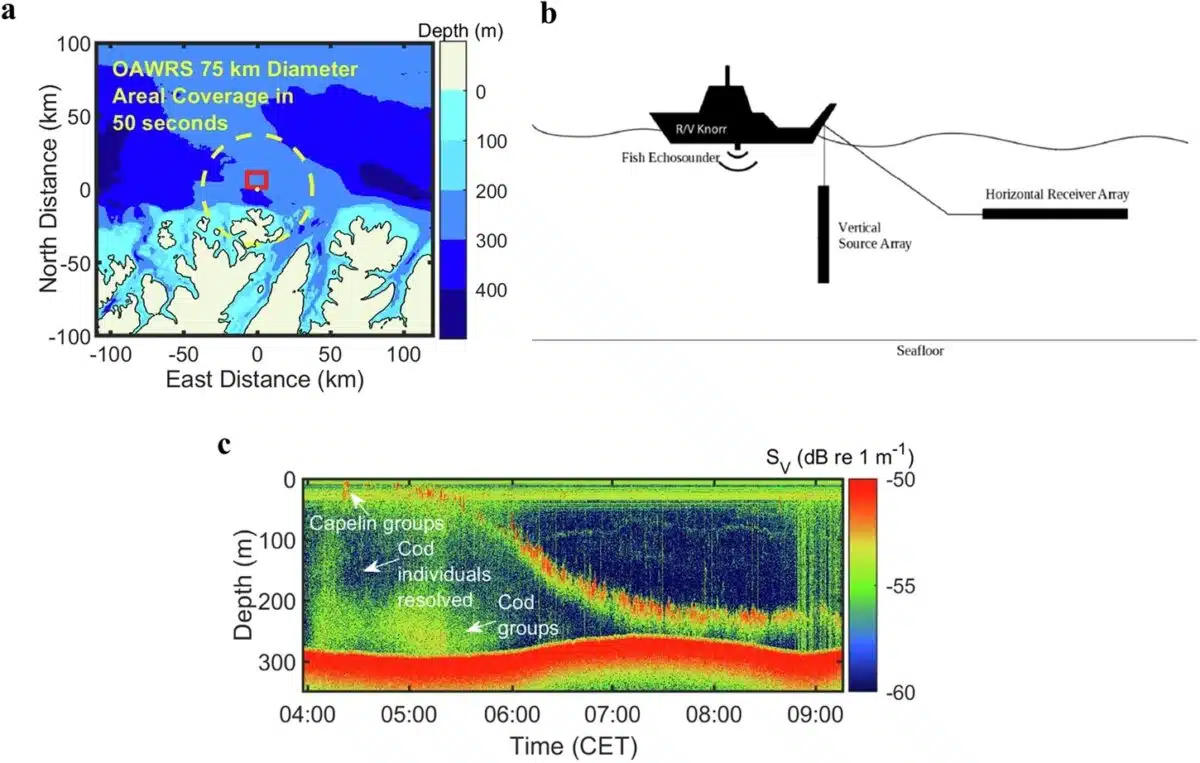 Overview of the OAWRS acoustic sensing system and observed predator-prey dynamics in the Barents Sea. Credit: Communications Biology
This Massive Feeding Event Happened in Minutes
Once the cod arrived, things moved fast. As explained in the latest research, about 2.5 million cod converged and consumed over 10 million capelin in just a few hours. In a press release published in MIT News, Makris said that :
“What we’re finding is capelin have this critical density, which came out of a physical theory, which we have now observed in the wild,” He noted. “If they are close enough to each other, they can take on the average speed and direction of other fish that they can sense around them, and can then form a massive and coherent shoal.”
Based on the study, this is the first time scientists have been able to observe such a large interaction across such a wide area in real time.
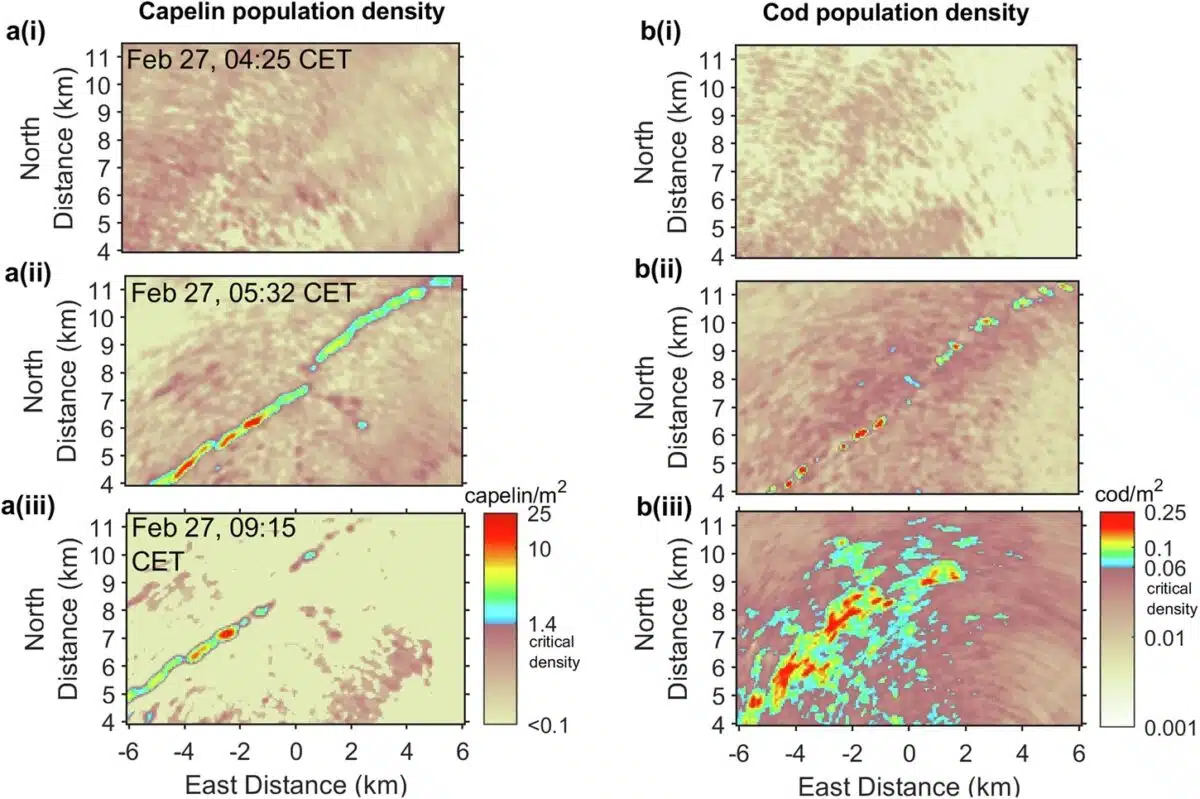 Capelin fish and cod densities during the predation event. Credit: Communications Biology
A Key Fish Species Facing Growing Pressure
Even if the numbers are striking, the researchers say this shoal only represented about 0.1% of the total spawning capelin population in the region. Still, capelin are a keystone species. They play a major role in feeding cod and other predators. And there’s a bigger issue in the background.
As reported in the study, as Arctic ice retreats, capelin fish have to travel farther to reach their spawning grounds. That longer journey makes these fish more exposed, and could increase the chances of events like this happening again.
Makris also pointed out something worth noting. When one of these massive shoals disappears, it can sometimes signal deeper problems. This is why tools like OAWRS matter. They give scientists a way to detect changes before they become more serious.