
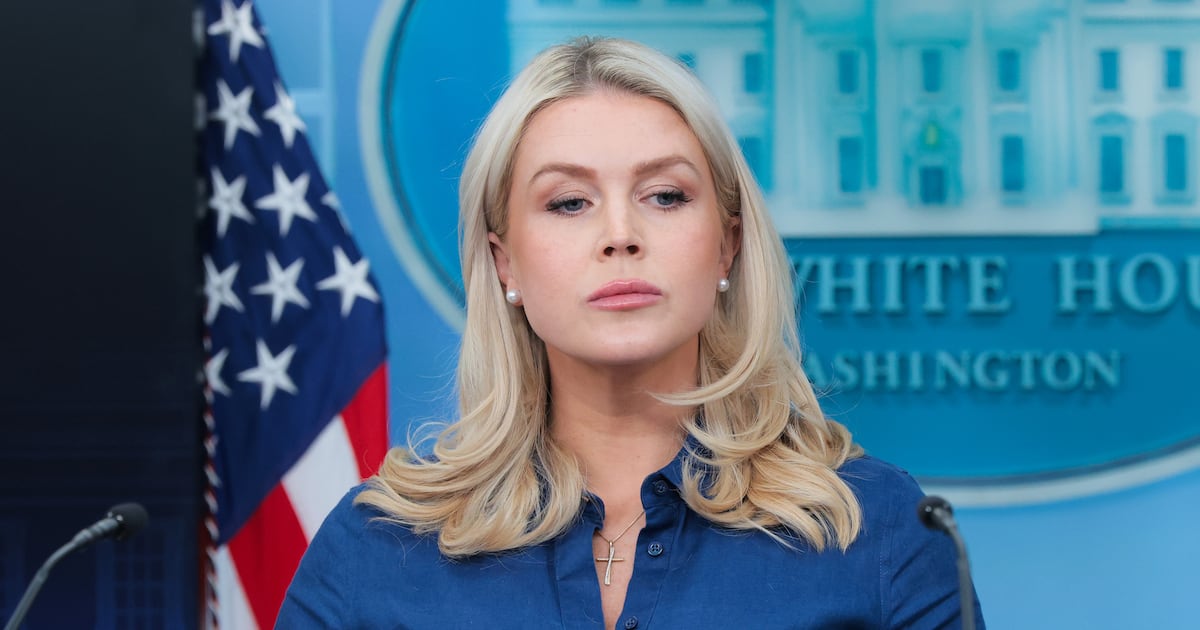
Since assuming the role of youngest White House press secretary in the history of the republic, Karoline Leavitt has mastered the art of getting her retaliation in first. It can be a grimly fascinating spectacle to see the 28-year-old open her briefings in the James Brady press room with addresses that will, more often than not, carry stern rebukes for political correspondents with decades of experience behind them, in the tone of an exasperated mathematics teacher whose dud class has bombed out on an elementary test again.
On Wednesday, she delivered a critique of the US media’s willingness to swallow Iranian statements as incontrovertible proof of anything, during a lunchtime briefing in which the troubling, uneasy meaning of president Donald Trump’s grotesque Tuesday morning declaration that Iranian “civilisation will die” floated around the fringes of the usual quick-fire Q&A format.
Trump’s last-minute decision, on Tuesday evening, not to go code red with his threat to eviscerate Iran’s civic structures was greeted with global relief – except in the Knesset. But throughout Wednesday, it created other questions. How far would the United States have gone in its bombing campaign on Iranian infrastructure? Did Trump mean what he said or was it, as some Republicans quickly spun, merely an extreme version of Trump’s fabled deal making, starting with hardball, impossible demands and threats and working back from there? And if the United States is threatening to obliterate an entire civilisation, then what has the country become in its 250th year?
At one stage, Leavitt pursed her lips when asked to consider the view that the US has been “a moral leader for most of its history” – an abiding US conceit that has, in any case, come under intolerable pressure in recent decades.
“How can the president claim that America can ever have the moral high ground if he is threatening to destroy a civilisation?” Leavitt was asked.
She reiterated Iran’s historic vows of death to America and its record of atrocities against US military.
“The president absolutely has the moral high ground over the Iranian terrorist regime and for you to suggest otherwise is frankly insulting.”
Even before she chose questions from the room, Leavitt had this to say about the Tuesday night live reporting of Iran’s claims that Washington had agreed to consider its 10-point plan. That plan, Leavitt said, was “literally thrown in the garbage by president Trump and his negotiating team.”
“Many outlets in this room have falsely reported on that plan as being acceptable to the United States. With the president’s deadline fast approaching, the regime acknowledged reality to the negotiating team. They put forward a more reasonable and entirely different condensed plan to the president and his team. President Trump and the team determined the new modified plan was a workable basis on which to negotiate and to align it with our own 15-point plan.”
Later in the afternoon, Trump hosted Nato secretary general Mark Rutte in the Oval Office. The meeting was marked as closed, but usually that means nothing: Trump likes to throw the doors open to the cameras, as though a meeting hasn’t really taken place unless a potential global audience can tune in to watch it. Not this time. Trump remained elusive all through Wednesday even as conflicting stories emerged about whether the Strait of Hormuz was indeed open. Later, in a television interview, Rutte pleaded lack of immediate knowledge when asked what he knew about the vital shipping passage.
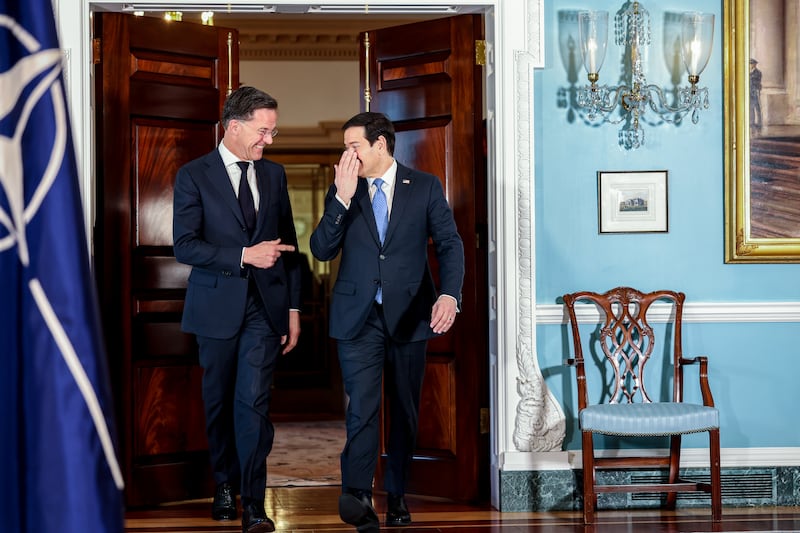 Mark Rutte, secretary general of Nato, and Marco Rubio, US secretary of state, prior to a meeting in Washington DC. Photograph: Valerie Plesch/Bloomberg
The effectiveness and cleverness of Rutte’s unabashed public lionising of Trump through a period when the US president growls and grouses about leaving Nato will be properly judged after this volatile chapter has reached a definitive conclusion. Rutte conceded that Trump is “clearly disappointed” with European allies but offered the hopeful suggestion that this had been a meeting between friends. “We like each other and I really admire his leadership,” he said. Trump seems to find something soothing, or pleasing, in Rutte’s unflappable Dutch evenness of mood and constant flattery. And the Nato leader opted to stay unbendingly neutral when asked for his view on Trump’s “civilisation will die” comment.
“What I want you to know is that I support the president and I know large parts of Europe do when it comes to taking out large parts of Iran’s capacity to export chaos to the region, to Europe, to the whole world. They are one of the main enablers to Russia’s war effort in Ukraine. There is an existential threat to Israel if they will get their hands on nuclear capability.”
The lack of clarity over Hormuz in Washington did nothing to dispel the general assumption that the Iranians are controlling the waterway, something that Trump’s wild Easter Sunday message – “Open the f***in’ strait, you crazy b*****ds” – unintentionally conceded anyway. If the president was, in his own special way, acknowledging that the Iranians had the power to open the strait, then he was clearly accepting that they had assumed the power to shut it down to all but favoured traffic.
Meanwhile, the breathtakingly unscripted day-by-day trajectory of the entire crisis was neatly summed up by the confusion over whether Lebanon was included in the ceasefire, as Israeli bombs on over 100 alleged Hizbullah command centres killed 182 people and wounded hundreds more. It fell to vice-president JD Vance to concoct some sort of excuse when questioned on the airport tarmac on his way to lead the US negotiations with Mohammad Bagher-Ghalibaf, the speaker of Iranian parliament.
“I think this comes from a legitimate misunderstanding. I think the Iranians thought that the ceasefire included Lebanon. And it just didn’t. We never promised that.”
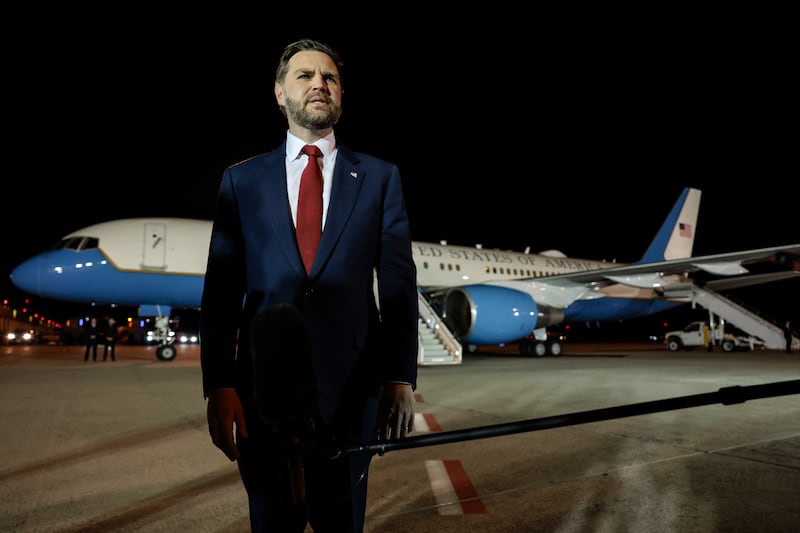 US vice-president JD Vance at Budapest Ferenc Liszt International Airport on Wednesday night. Photograph: Jonathan Ernst-Pool/Getty Images
Forgetting to iron out the status of an entire country in a ceasefire agreement offers a vivid snapshot of the behind-the-curtains chaos. Vance said that Israel is agreeable to “check themselves a little bit in Lebanon” in order for negotiations for a peace deal to begin.
“Again, the president of the United States is saying that unless the Iranians do the right thing it is going to have some serious consequences for the regime. We obviously don’t want the people of Iran to suffer but we have a lot of leverage the president could use. That’s why it is important for the Iranians to be negotiators in good faith.”
[ Can JD Vance save Viktor Orbán from electoral defeat?Opens in new window ]
The phrase carried echoes of the early rationale the US had offered for attacking Iran six weeks ago: that the Islamic Republic had not been genuine in its talks during the early weeks of 2026. That had been the excuse for careering into a military campaign that resulted in the early, sensational news that Ayatollah Ali Khamenei had been among those killed in the first wave of strikes before giving way to a strategic stalemate despite the relentless barrage totted up by Karoline Leavitt on Wednesday, with more than 13,000 Iranian targets struck.
This war, or “excursion”, has also led to death and misery for many ordinary people across the Gulf and, now, to this strange perilous ceasefire, held together with the diplomatic equivalent of Scotch tape and set against the disturbing, unerasable backdrop of Donald Trump’s nihilistic warning to all of Iran.