

This post was sponsored by Victorious. The opinions expressed in this article are the sponsor’s own.
Improving search visibility across traditional and AI search requires evolving our methods and updating how teams work together to improve outcomes.
Content teams and SEO teams have always needed each other. But with AI search raising the bar on entity authority, the cost of operating in silos has never been higher. This framework is how you close that gap.
In This AEO Framework
Why AEO Makes SEO & Content Collaboration Non-Negotiable
Historically, content and SEO teams have both pursued organic visibility, though they often worked independently. While it’s always been ideal for these teams to collaborate effectively, with answer engine optimization (AEO), it’s more critical than ever that they work together to strengthen a site’s entity associations and improve its retrieval opportunities.
What Is AEO?
AEO, which is also called generative engine optimization (GEO), is the process of improving a website’s content and technical foundations to make it easier for AI crawlers to read and extract content. AEO aims to improve brand citations and mentions and requires SEO and content teams to work together to improve entity targeting, semantic associations, content quality, content comprehensiveness, and content structure, among other things.
Without entity-level coordination, brands may fail to gain traction in AI search surfaces and lose AI citation and mention opportunities to competitors. Let’s break it down. AI Overviews (those AI generated snippets at the top of Google search results) cite websites that demonstrate concentrated authority (backed by external sources) on specific entities. Websites with consistent messaging around their core services and products backed by external corroboration like backlinks and PR mentions appear in knowledge panels and other search features. So, when content depth and external link validation operate independently, sites miss retrieval opportunities across AI-powered search.
Entities provide the framework for this collaboration. When content and SEO strategies align around building authority for the same entities, teams can execute coordinated work that strengthens both content comprehensiveness and external validation.
How Entities Provide a Shared Framework
Entities are distinct concepts that search systems can uniquely identify and connect. Unlike keywords, entities are semantic concepts with attributes and relationships. “Customer onboarding” as an entity connects to “user adoption,” “product activation,” “time to value,” and “customer success.” To get cited, brands need to build entity authority.
What Is Entity Authority?
Entity authority is the degree to which search systems recognize your brand as a credible, well-corroborated source on a specific entity. A site with strong entity authority for “resource planning” has comprehensive content on the topic, earns links from sources that also discuss it, and structures that content so search systems can map the relationships between related concepts.
Search systems evaluate entity authority on three dimensions:
Recognition: Can they identify which entities your content addresses?
Relationships: Do they understand how those entities connect?
Corroboration: Do external sources validate your entity representations?
These evaluation criteria create natural points of coordination. When both teams work toward the same entity authority goals, their work reinforces the same recognition, relationship, and corroboration signals that search systems use to evaluate expertise.
Why Neither Team Can Do This Alone
SEO teams could identify target entities and pursue entity-focused optimization independently. But without comprehensive content coverage, the technical infrastructure (schema, internal linking, site architecture) would connect thin, scattered content that doesn’t demonstrate depth. Conversely, content teams could create full-funnel entity coverage independently. But without the technical entity infrastructure and external corroboration through entity-relevant backlinks, the content lacks the structural and external signals that strengthen entity authority.
The coordination creates what neither discipline can build alone: comprehensive content backed by both technical entity infrastructure and external sources.
Putting Entity Authority Into Practice
Start by choosing 3–5 core topics your business wants to be known for, then consistently build content and links around those topics. Instead of spreading effort across dozens of disconnected ideas, SEO and content teams focus on reinforcing the same few areas until search systems clearly associate your brand with them.
Entities work as an organizing principle because they’re specific enough to guide both disciplines. Instead of content planning around vague topics and SEO chasing domain authority, both teams can focus on, say, “resource planning,” specifically.
Content creates guides, research, and comparisons on resource planning. SEO builds links from publications discussing resource planning. Both reinforce the same entity signals, and the compounding effect of that alignment is what separates brands that gain AI retrieval from those that don’t.
What an Entity-Focused Collaboration Workflow Looks Like
We propose a four-phase workflow that enables teams to test entity strategies and adapt based on performance.
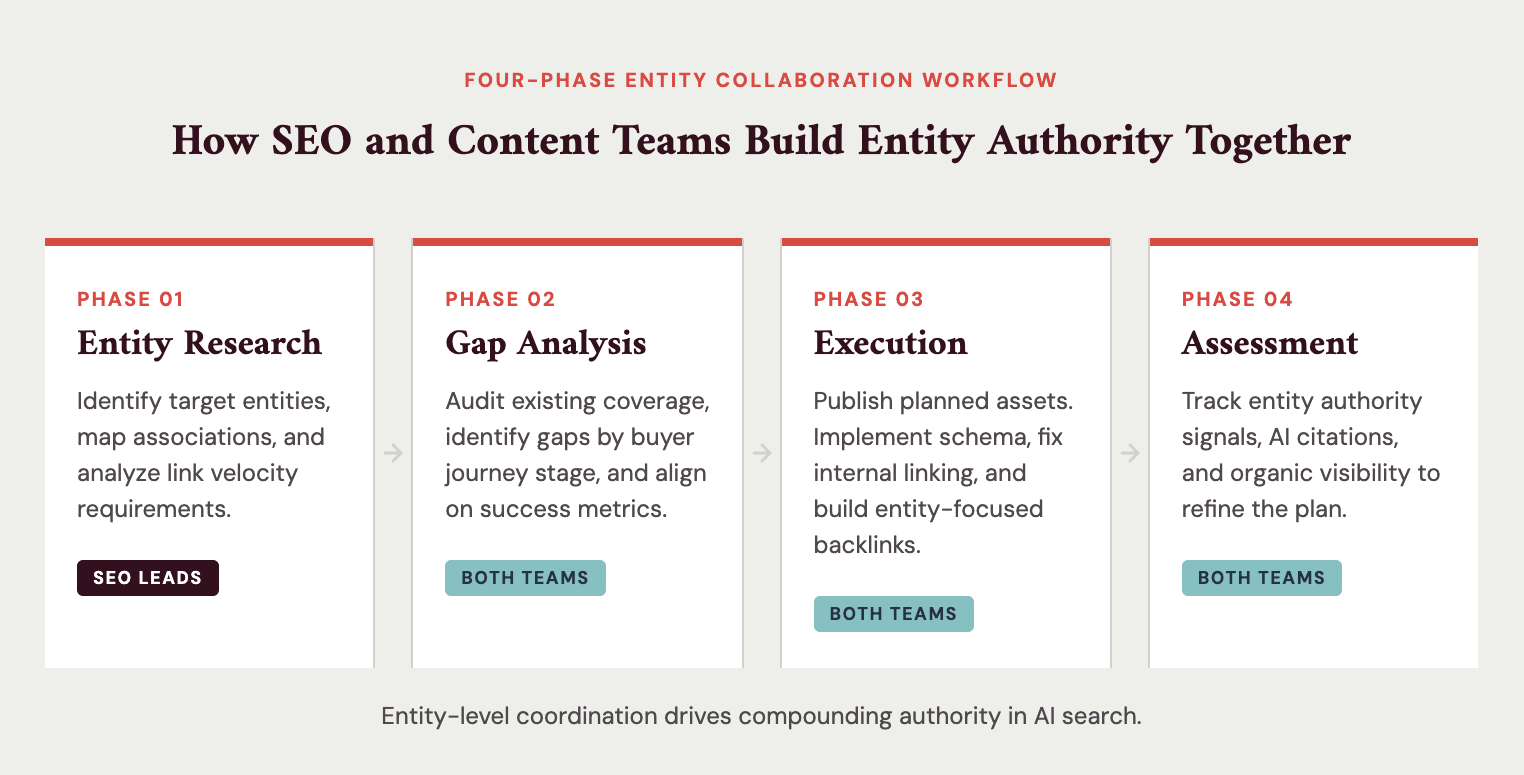 Image created by Victorious, March 2026
Phase 1: SEO Conducts Entity Research
SEO begins by identifying entities aligned to the business’s services or products. Through vector embedding analysis (using tools like Google’s Natural Language API or Semrush to create a numerical representation of semantic associations), the team identifies related topics (entity associations) that would build authority for these main entities. This analysis reveals patterns of topic similarity and competitive gaps.
During this phase, SEO also analyzes link velocity requirements for each main entity, with the understanding that link building will be distributed across the entity cluster. This entity cluster would include pages with different search intents that cover different aspects of the same concept (entity). The output is a shortlist of main entities with their associated entities, aligned with business objectives and realistic resource constraints.
For a project management platform, the main entity might be “project management,” with associated entities like “resource planning,” “capacity management,” and “project forecasting.” Focusing on a limited number of main entities allows both teams to commit sufficient resources to build depth rather than scattering effort across too many targets.
Phase 2: SEO and Content Teams Analyze Content Gaps and Prioritize Impact
The teams review existing content coverage for each target entity together. They identify gaps across the buyer journey (awareness, consideration, decision) and prioritize which assets to create based on competitive need, business impact, and available resources. This isn’t content asking “what should we write?” or SEO saying “we need these pieces.”
Both teams evaluate comprehensiveness together:
Does the entity coverage span formats (research, guides, comparisons, how-tos)?
Does it address different stages of the buyer journey?
Does it create the depth that AI systems recognize as authority?
At this point, the teams also align on success metrics. Each team needs to agree on what entity authority looks like for the target entities and which signals will indicate progress, taking into account current content performance. This shared measurement framework ensures both teams work toward the same definition of success.
At the end of this phase, the teams should have a prioritized content plan showing which assets support which entities, target publication dates, and metrics for measuring entity authority growth.
Where Most Teams Break Down
Content and SEO often report into different leaders, operate on different timelines, and measure success differently. Content teams may focus on production and engagement, while SEO teams may focus on rankings and links. Without a shared framework, priorities drift and execution becomes fragmented.
Aligning around entities gives both teams a common target, so decisions about what to create, what to promote, and what to fix all point in the same direction.
Phase 3: Both Teams Execute on the Plan
Content creates and publishes the planned assets. SEO implements schema markup to highlight entity relationships, analyzes and fixes internal linking between entity clusters, and executes backlink building using entity-relevant anchor text and targeting publications that discuss those entities.
When prioritizing internal linking fixes, SEO focuses first on pages that already have topical relevance to the target entity but lack incoming links from related content, as these represent the fastest wins for entity cluster cohesion. For anchor text, the goal is to show natural variation rather than exact-match repetition to avoid over-optimization. Links also may not necessarily point to newly published content. What matters is that link velocity, anchor text, and link sources all reinforce the same entity associations that the content is building.
The goal here is entity-level coordination over piece-level coordination. Content and SEO teams work toward improving entity authority together.
Phase 4: Teams Assess Performance and Refine Plan
Together, the teams track implementation progress and entity authority signals to determine whether their efforts are improving brand visibility and ultimately, the bottom line for the business.
They’ll monitor ranking increases for related terms, since organic visibility influences AI citation opportunities. They also track AI Overview citations when users search entity-related queries (e.g., “[entity] best practices,” “[entity] solutions”) and frequency of brand mentions in AI-generated responses.
Traditional metrics like traffic and conversions emerge later as lagging indicators. Teams use the early signals to refine the plan: maintain the current approach, accelerate investment in high-performing entity clusters, or adjust tactics for underperforming entities.
Example: Resource Planning Entity in Action
Vector embedding analysis at a SaaS project management platform reveals “resource planning” as an entity association with strong similarity to their main “project management” entity. Building authority on resource planning would strengthen their overall project management authority. Competitive analysis shows they need consistent link velocity over six months to reach parity. (This six-month timeline assumes a moderately competitive landscape. In more saturated categories, building to parity may take longer, and teams should calibrate expectations based on their specific competitive environment before committing to a roadmap.)
A joint review of existing coverage reveals one surface-level blog post on resource planning basics. Competitive sites have research on resource allocation trends, comprehensive guides on capacity planning, comparison content evaluating resource planning approaches, and implementation how-tos. The gap is clear.
Together, they prioritize:
Awareness: Original research on resource planning practices
Consideration: A comprehensive resource planning guide
Consideration: A comparison of resource planning methodologies
Decision: Implementation guides for different team structures
Over three months, the content team publishes the planned assets while SEO implements schema, tightens internal linking across the entity cluster, and builds links from project management publications to pages across the site, not just the new content. They start looking for organic ranking changes, branded traffic changes, and AI citation rates.
After four months, visibility increases for resource planning queries across multiple pages, not just the newly published content. The research piece earns two AI Overview citations. These results reflect the entity strategy working as designed: content depth, technical infrastructure, and external corroboration all reinforcing the same entity signals together. Neither outcome would have happened on the same timeline if the teams had executed independently. That’s the compounding effect of entity-level coordination in practice.
It’s Time To Move Toward Structured Experimentation
Entity-focused collaboration isn’t a fixed formula, but rather, a framework for structured experimentation. Teams will need to test which entity associations drive the strongest authority signals, which content formats generate the most AI citations, and which link-building strategies accelerate entity recognition most effectively.
Though the workflow outlined here provides a starting structure, iteration is expected. You’ll likely find that entity clusters don’t build authority at the same pace, buyer journey stages that seem less critical may drive unexpected retrieval, link velocity requirements vary by competitive landscape, and the measurement signals themselves evolve as AI search capabilities change.
Flexibility is essential. Teams need space to test approaches, measure what works, and adapt quickly. Tighter coordination between content and SEO enables faster learning cycles. When both teams work from the same entity framework and shared success metrics, they can identify what’s working and shift resources accordingly. The brands that establish entity authority now, before AI search surfaces fully mature, will be significantly harder to displace later.
BOOK YOUR AEO STRATEGY SESSION
Image Credits
Featured Image: Image by Victorious. Used with permission.