
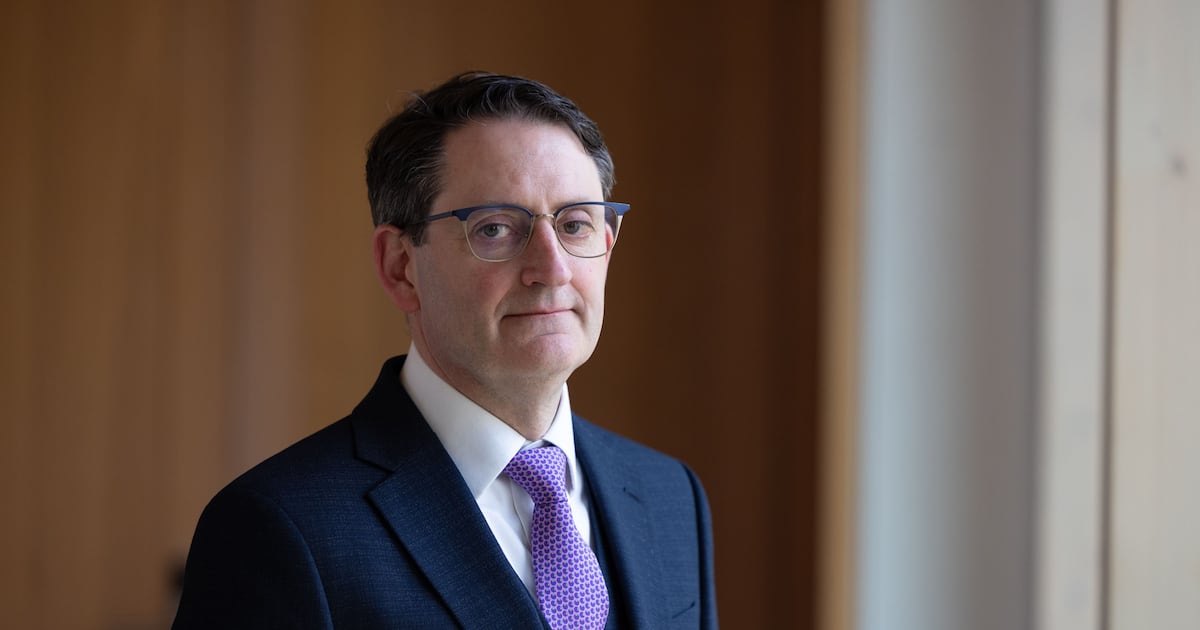
Ireland needs 5,000 additional hospital beds to cope with its ageing population and “must at least have a plan” for substantially increased provision in the future, the new president of the Irish Medical Organisation (IMO) has said at its annual general meeting in Killarney.
Prof Matthew Sadlier acknowledged the number was “big” and said it might be regarded as aspiration “but it is what Ireland needs”.
He said the country’s health services traditionally had a different demographic breakdown to many other European countries because of mass emigration, and that had spared the health service some of the strain experienced elsewhere, but “now we’re catching up”.
“That’s why there are more bands from the 80s and 90s playing concerts here each summer because there are more of us around to buy tickets,” he said.
“Previously, where the percentage of the population over 65, in a developed world country, would be somewhere around 20 per cent, historically in Ireland it was 10, 11, 12 per cent so now we are there are two things … we have a much bigger population and we’ve a much bigger older population, people who tend to need hospital beds.”
He said the Government needs to have a unified plan on how to develop services, over the coming decades with the suggestion community ones are going to somehow negate the need for major hospitals a form of “magical thinking”.
That there is some way to go on the issue was demonstrated by the recent refusal of planning permission for the Rotunda’s proposed extension.
“So you have the Department of Health, one part of Government, saying we need this but it then being turned down on the basis of regulations written by another part of Government instead of the various strands of Government working together to deliver something that is needed. It absolutely boiled my brain,” he said.
Fragmentation of services remains a major issue.
“Dublin has 20 different locations where you can turn up when you need attention between maternity hospitals, eye and ear hospitals, separate paediatric hospitals, separate general hospitals,” he says.
Newcastle Gateshead, which is an equivalent sized city in the United Kingdom, has one super big hospital. Patients arrive at one emergency department and are sent wherever they need to go.
“Here it’s: ‘Oh, it’s your ear … you have to go to Adelaide Road, you have a burns … you have to go to St James’, it’s a spinal injury … that’s the Mater, you need head surgery … that’s Beaumont. We’ve this unbelievably fragmented system, which leads to huge inefficiencies.”
Hospital consultants, a portion of whom make one constituent group of the IMO’s membership, have often been identified as part of the problem and it has been suggested that the public only contracts to which more than half have now signed up have yet to deliver the sorts of productivity gains that had been hoped for.
Sadlier says those contracts have helped with recruitment and retention, which has been a positive, but that productivity will only come with “a whole of hospital approach”. That, he suggested, is hindered by the relative lack of larger, major multidisciplinary centres.
Danielle Jeffries, a senior policy analyst at The King’s Fund in London, told the opening session of the conference on Thursday that productivity has been a particular issue across the UK since the pandemic.
“There are a number of reasons for it, including underinvestment in infrastructure … people working in old buildings and with old technology.”
She said the ageing population there, as in Ireland, presents significant challenges with doubts raised about whether the sector’s funding and workforce requirements are sustainable.