

AUD/USD rose 0.56% on Thursday, extending its winning streak to four sessions as the ceasefire-driven risk rally continued to lift the Aussie Dollar. The pair is now flirting with the 0.7100 handle, a level it has not traded at since late March, and well above the 200-period exponential moving average near 0.6950 on the hourly chart. Stochastic RSI has pushed back above 80, suggesting momentum is running hot but not yet exhausted.
The ceasefire trade keeps giving
The two-week halt in US military operations against Iran, announced earlier in the week, remains the dominant driver. President Trump’s decision to pause strikes in exchange for Iran’s agreement to reopen the Strait of Hormuz has pulled the rug from under the US Dollar’s safe-haven bid. The move has been especially generous to commodity-linked currencies like the Aussie, which had spent much of early April pinned near 0.6900 on geopolitical anxiety. The risk is that the ceasefire is fragile. Questions remain over whether Israel will halt operations in Lebanon, a condition Iran reportedly attached to the deal. Any sign of escalation over the weekend could reverse AUD/USD gains quickly.
PCE lands hot, but markets shrug
Thursday’s February Personal Consumption Expenditures (PCE) data was a mixed bag. Headline PCE printed at 2.8% YoY, above the 2.6% consensus forecast, while core PCE came in at 3.0% YoY, matching expectations but still uncomfortably far from the Federal Reserve’s (Fed) 2% target. On a monthly basis, both headline and core rose 0.4%, stronger than expected. In normal circumstances, that kind of print would send the US Dollar higher. But markets are clearly more focused on the geopolitical mood shift than backward-looking inflation data from February, which does not yet capture the impact of the Iran conflict on energy prices.
Friday’s CPI is the real test
The March Consumer Price Index (CPI) report drops at 12:30 GMT on Friday and is expected to show the first clear imprint of the Iran war on consumer prices. Economists surveyed by FactSet expect headline CPI to surge 0.8% MoM, driven by a sharp jump in energy costs, pushing the YoY rate to around 3.1%-3.3%. Core CPI, which strips out food and energy, is forecast at a more modest 0.2%-0.3% MoM and 2.7% YoY. For AUD/USD, the CPI print is a double-edged sword. A hotter-than-expected number could revive rate hike expectations and give the US Dollar a jolt, dragging the pair off its highs. A softer core reading, on the other hand, would validate the market’s view that the inflation spike is energy-driven and transitory, giving the Aussie room to push through 0.7100. With no meaningful Australian data on the calendar Friday, the pair’s fate rests entirely with the US data docket.
AUD/USD daily chart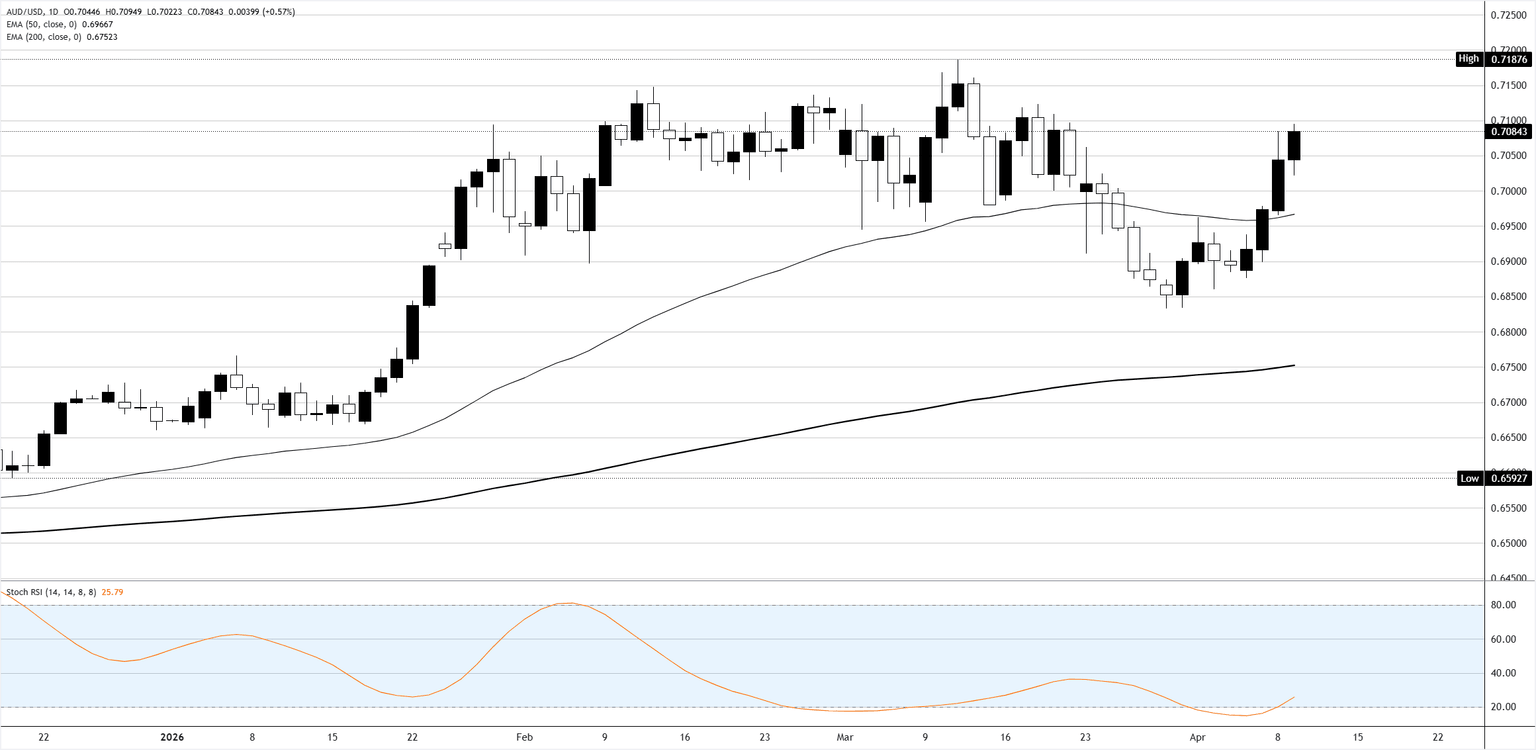 Technical Analysis
In the daily chart, AUD/USD trades at 0.7084. The pair holds a constructive near-term bias as spot remains comfortably above both the 50-day exponential moving average (EMA) at 0.6967 and the 200-day EMA at 0.6752, keeping the broader uptrend intact after the latest bounce from sub-0.70 levels. The Stochastic RSI around 57 hints at improving but not yet overbought momentum, suggesting that buyers still retain control while leaving room for further upside extension.
On the downside, immediate support is seen near the recent close at 0.7084, with the 50-day EMA at 0.6967 providing the next layer of dynamic support ahead of the more strategic 200-day EMA at 0.6752. As long as AUD/USD holds above the 50-day EMA, pullbacks are likely to be treated as corrective within the broader bullish structure, while a sustained break beneath that level would expose the 200-day EMA as the next downside target.
(The technical analysis of this story was written with the help of an AI tool.)
Australian Dollar FAQs
One of the most significant factors for the Australian Dollar (AUD) is the level of interest rates set by the Reserve Bank of Australia (RBA). Because Australia is a resource-rich country another key driver is the price of its biggest export, Iron Ore. The health of the Chinese economy, its largest trading partner, is a factor, as well as inflation in Australia, its growth rate and Trade Balance. Market sentiment – whether investors are taking on more risky assets (risk-on) or seeking safe-havens (risk-off) – is also a factor, with risk-on positive for AUD.
The Reserve Bank of Australia (RBA) influences the Australian Dollar (AUD) by setting the level of interest rates that Australian banks can lend to each other. This influences the level of interest rates in the economy as a whole. The main goal of the RBA is to maintain a stable inflation rate of 2-3% by adjusting interest rates up or down. Relatively high interest rates compared to other major central banks support the AUD, and the opposite for relatively low. The RBA can also use quantitative easing and tightening to influence credit conditions, with the former AUD-negative and the latter AUD-positive.
China is Australia’s largest trading partner so the health of the Chinese economy is a major influence on the value of the Australian Dollar (AUD). When the Chinese economy is doing well it purchases more raw materials, goods and services from Australia, lifting demand for the AUD, and pushing up its value. The opposite is the case when the Chinese economy is not growing as fast as expected. Positive or negative surprises in Chinese growth data, therefore, often have a direct impact on the Australian Dollar and its pairs.
Iron Ore is Australia’s largest export, accounting for $118 billion a year according to data from 2021, with China as its primary destination. The price of Iron Ore, therefore, can be a driver of the Australian Dollar. Generally, if the price of Iron Ore rises, AUD also goes up, as aggregate demand for the currency increases. The opposite is the case if the price of Iron Ore falls. Higher Iron Ore prices also tend to result in a greater likelihood of a positive Trade Balance for Australia, which is also positive of the AUD.
The Trade Balance, which is the difference between what a country earns from its exports versus what it pays for its imports, is another factor that can influence the value of the Australian Dollar. If Australia produces highly sought after exports, then its currency will gain in value purely from the surplus demand created from foreign buyers seeking to purchase its exports versus what it spends to purchase imports. Therefore, a positive net Trade Balance strengthens the AUD, with the opposite effect if the Trade Balance is negative.