
Save
You have reached your maximum number of saved items.
Remove items from your saved list to add more.
AAA
Humans are one giant leap closer to becoming a multi-planet species as the Artemis II lunar flyby mission approaches splashdown. The Orion spacecraft’s return to Earth will begin the countdown to a boots-on-the-ground moon landing and, eventually, life on Mars.
Before that, of course, the four astronauts on board face the grave and fiery test of re-entry on Saturday morning, relying on a heat shield that failed on its last test. Should the four astronauts land successfully in the Pacific Ocean, the mission’s crucial goal will be fulfilled: proving we can still send humans to the moon and back.
And what a human mission it was. The astronauts revelled in “moon joy”. They grasped for words to describe their awe at ancient lava plains and bright highlands on the lunar surface, an eclipse they saw from space, and how beautiful Earth looked: a blue pearl nestled in a black void. They wept in a floating bundle after resolving to name a shining crater after Commander Reid Wiseman’s late wife, Carroll. They ate macaroni and cheese and mango salad. The toilet broke.
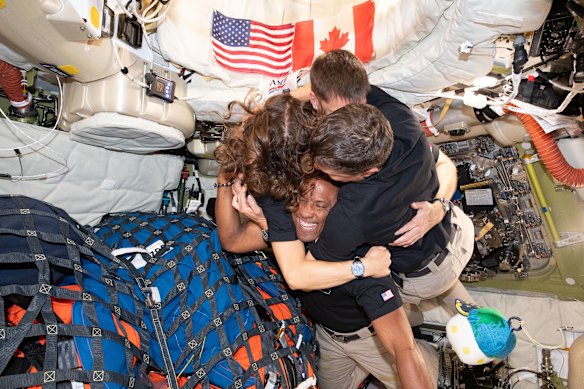 A group hug on the astronauts’ way home on Wednesday.AP
“It has been phenomenal seeing how much everybody has connected with these four incredible human beings,” Dr Sara Webb, a Swinburne University of Technology astrophysicist, says of crew members Wiseman, Victor Glover, Christina Koch and Jeremy Hansen. “That human element has really brought a lot of attention to the mission, to the goals and to the science, rather than if it was a robotic probe.”
Putting astronauts near the moon for the first time in half a century also brought human nous. Eyeballs can analyse and comprehend the 3D structure of shadowy craters in a way satellites can’t. The astronauts’ six-hour direct observation of the lunar surface also highlighted an underappreciated fact: the moon is colourful.
“Our human eyes can discern quite a few different things, including colour variations, where a lot of instruments on board spacecraft are designed to only look within certain wavelengths, which limits what you’re seeing,” Webb says.
Astronaut Hansen reported huge swaths of brown hues and tinges of green. The tan striations may be iron oxide (as in rust) while green may signal the presence of titanium or the mineral olivine.
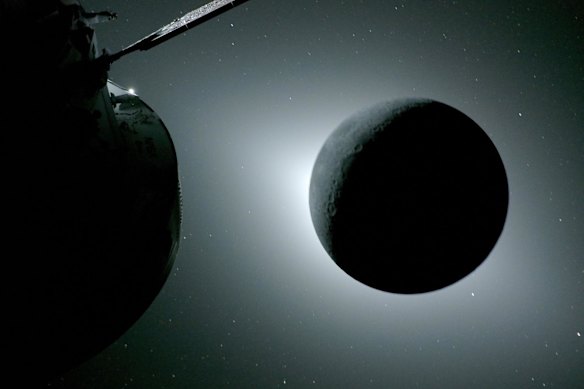 The moon, seen here backlit by the sun during a solar eclipse on April 6, 2026, as photographed by one of the cameras on the Orion spacecraft’s solar array wings.NASA
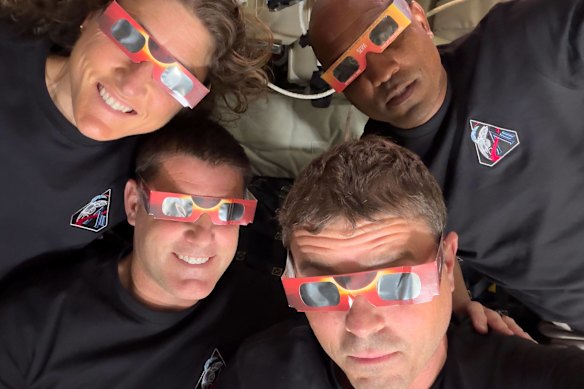 The Artemis II crew pose with eclipse-viewing glasses.AP
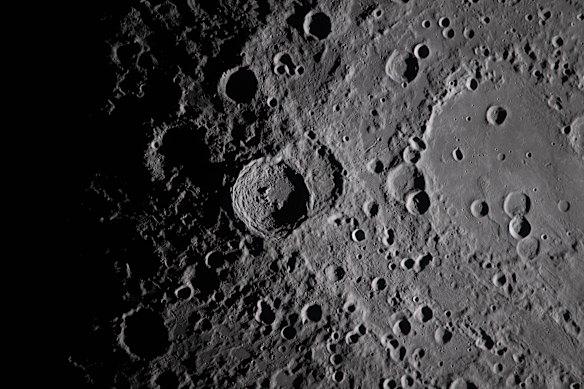 An image of the Vavilov Crater on the moon captured by the Artemis II.NASA/AP
The astronauts also spied bluish-white flashes: six mini-meteorites striking the moon. Without an atmosphere, the moon is pummelled by rocks, which in our skies would burn up as shooting stars. Observation of the strikes set off “screams of delight” at mission control, said NASA science officer Kelsey Young. Understanding the mini-meteorites’ strike rate is key to crafting a lunar shelter for human habitation that can withstand the bombardment.
The mission’s true moon shot is to beat China and Russia to set up a base on the lunar surface and, eventually, reach Mars. The launch of the rocket – the size of Big Ben’s clock tower – that thrust Orion skyward was a major success for NASA after SpaceX and Russia dominated launch pads for the past few years.
“NASA’s longer-term plans are to use this rocket for Mars, and they have taken a hugely different approach to SpaceX in developing a Mars-capable rocket,” Professor Andrew Dempster, director of the Australian Centre for Space Engineering Research, says.
“SpaceX does very fast cycles of development, happy to explode and implode many rockets in the process.
“NASA takes the more measured, traditional, high-reliability approach. So an awful lot was riding on the launch, and its success is truly great news.”
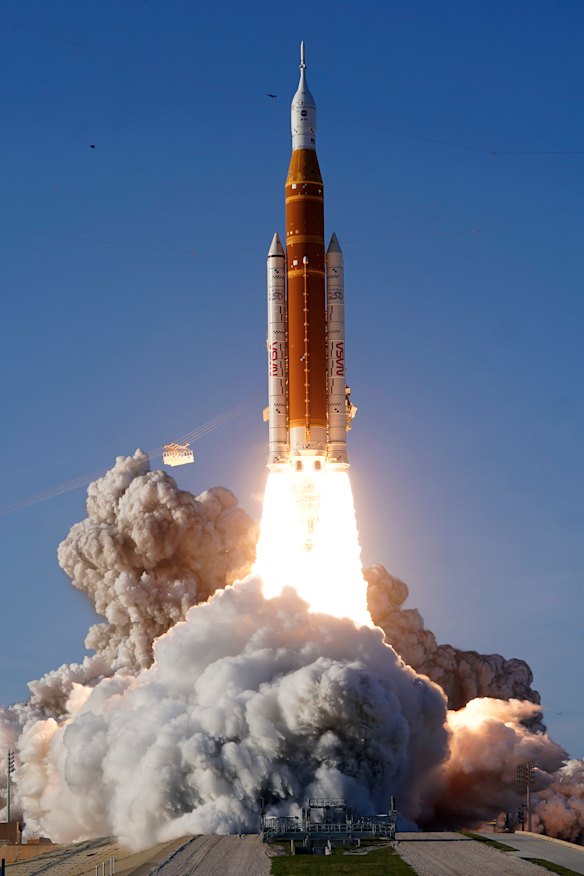 NASA’s Artemis II moon rocket lifts off from the Kennedy Space Centre’s Launch Pad 39-B, Wednesday, April 1.AP
But could our fragile, fleshy bodies really live on the moon, or even Mars?
Space medicine expert Dr John Cherry is the man to ask. He holds senior roles in both the Australasian Society of Aerospace Medicine and the Australian Antarctic Program, and says science on the icy continent has directly enabled modern space travel.
“Is it feasible? Absolutely,” he says. “Is it going to happen? Well, I think time will tell.”
There are many parallels between keeping humans alive on Antarctica and on the moon, which is why Cherry’s expertise has fed into the training of European astronauts. “Evacuating a patient from the surface of the moon would take roughly the same amount of time as evacuating an Australian Antarctic expeditioner from Antarctica,” he says.
Cherry’s program has worked with NASA on how astronauts might be taught to use ultrasound machines to run their own diagnostic imaging, such as scanning veins for blood clots. But the major challenge to a long-term lunar mission, he says, is how the human brain copes in a hostile and alien place. On the ice, as in space, a warp in mental function can be deadly.
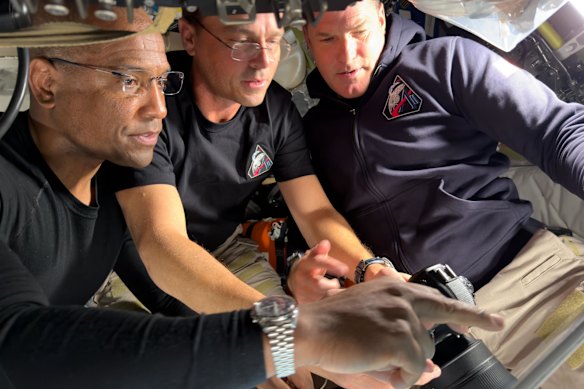 Cognitive function and teamwork are deeply studied during space missions.NASA
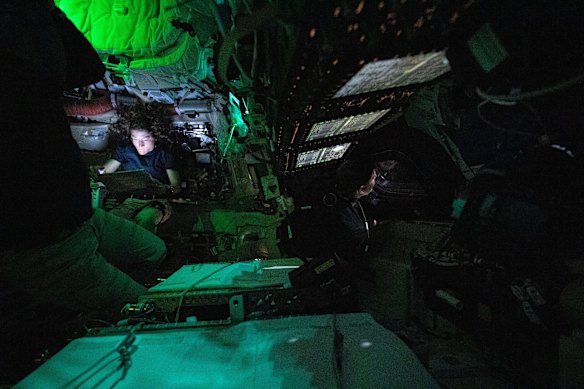 Astronauts including Christina Koch, pictured within Orion, took blood tests and saliva samples during the mission.AP
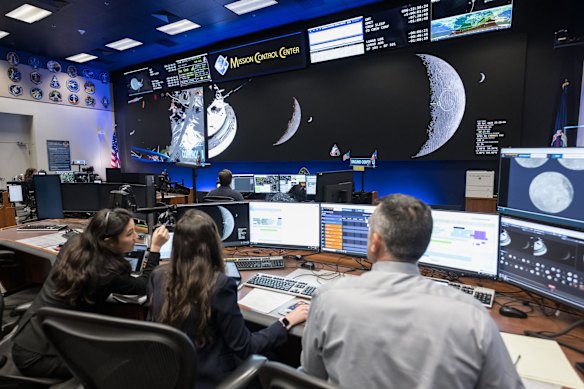 Mission control at NASA’s Johnson Space Centre in Houston, Texas.NASA
“You get to the middle of winter and you feel cognitively slower,” Cherry recalls of surviving an Antarctic winter. “It’s more difficult to multitask, you feel like you’re not quite as sharp as you normally are.” This dip in cognition hits people in both the Antarctic and on the International Space Station, and its possible causes range from physical isolation and stress to the severing of the brain from a normal circadian rhythm.
Data from the Artemis II crew’s sleep patterns, psychological tests and studies on their bone marrow cells could shed more light on how humans fare in extremis. In the future, Cherry said, eyeglasses could monitor astronauts’ pupils and quickly detect subtle changes in cognition.
“Making sure that people’s cognition is optimised in those extreme environments is obviously important for crew safety and crew survival, but it’s also important for optimising mission operations. That’s equally true in our setting in Antarctica as it is in human spaceflight.”
The astronauts are also the first people in 53 years to pass through the Van Allen radiation belt – bands of high-energy particles trapped by the Earth’s magnetic field – and will be closely monitored for the effects of that exposure upon their return. During re-entry they’ll wear their fetching fluoro-orange pressurised space suits with built-in life support.
“They are graded to be able to keep a human alive, in theory, for up to six days,” says Webb. “If anything catastrophic happens within the Orion capsule, they should be able to survive within that suit to re-enter back into the Earth safely.”
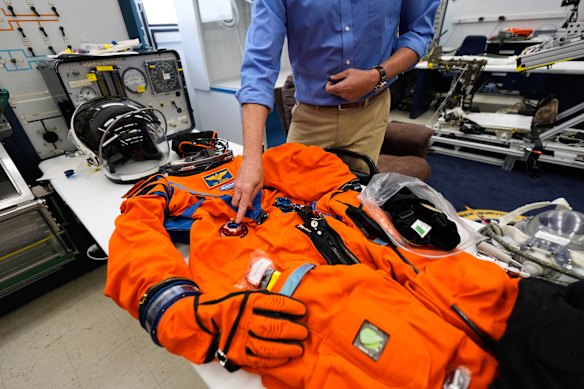 The Artemis II suits can support life for 144 hours.AP
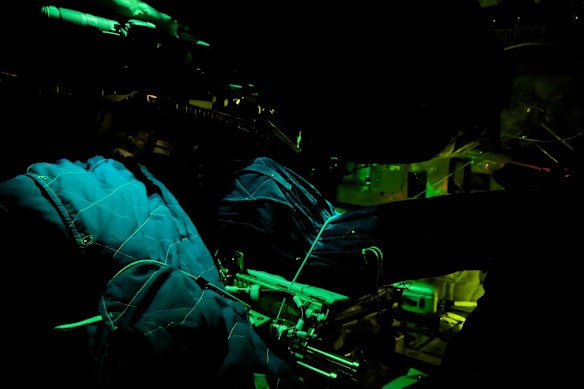 Artemis II crew member sleeping bags are illuminated inside the Orion spacecraft.NASA
Enrico Palermo, head of the Australian Space Agency, agreed the astronauts themselves were the true experiment of the mission. “The technology to understand how the human body is reacting to the radiation environment can now be measured with a lot more precision,” he said. That will be key to long-term survival beyond Earth’s protective magnetosphere.
Our space agency is a partner of the Artemis missions. As well as helping track Orion and test a new laser communication system, Australian scientists are figuring out how to coax building materials from the lunar soil, and making giant, spider-like robots that can construct lunar shelters. Others are trying to 3D-print astronaut food that mimics cheese and meat, and are developing plants such as duckweed boosted with fat, protein and amino acids, to grow on future spaceships and lunar bases.
Shortly before the Artemis II launch, NASA abandoned plans to build a “Lunar Gateway” in the moon’s orbit, in favour of a permanent $US20 billion ($28 billion) moon base on the ground. It’s a move that suits Australia, Palermo says.
“I think that actually really pivots to Australia’s expertise in remote operations, the ability to use resources locally and build infrastructure semi-autonomously, as we do on our mine sites.”
The space agency is working with company Fleet Science to find critical minerals and water ice in the first few centimetres of lunar soil, as well as Advanced Navigation, whose technology guides landers to the moon.
NASA plans to land astronauts on the moon in 2028. If you believe the plan, it will send people to Mars in the 2030s. Wiseman spoke about “how excited we are to watch this nation and this planet become a two-planet species”.
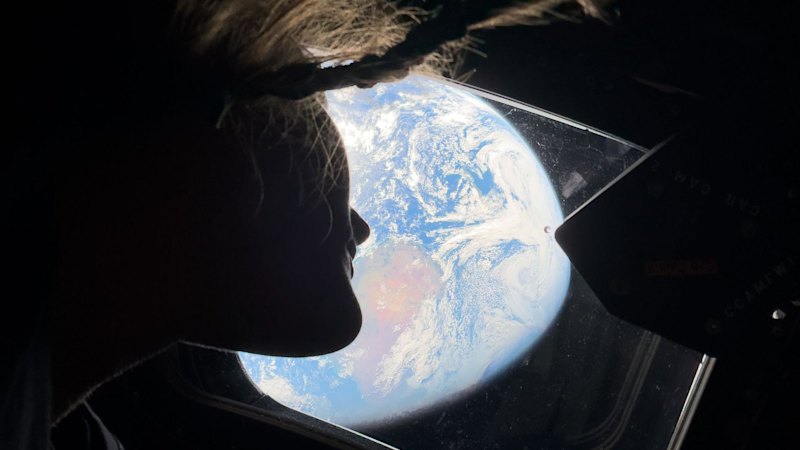
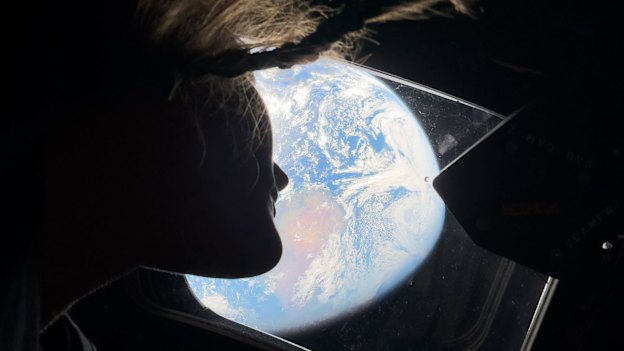 Christina Koch peers out of one of the Orion spacecraft’s main cabin windows, looking back at Earth.NASA
Palermo, like many, wasn’t even alive during the Apollo missions. This is the new lunar moment – the Artemis moment – that may fundamentally re-gear a new generation’s ambition for how far humanity can go.
“You’ve got a whole generation, I think, that will be inspired here in Australia to pursue careers in science and math and develop technologies that will benefit life here on Earth,” he says.
Related Article
For now, space nerds all over are celebrating Artemis II’s success in uniting the denizens of Earth; a humane mission launched by a government mired in a war of its own making.
There’s a psychological phenomenon experienced by astronauts, known as the “overview effect”. When one sees Earth from space, the preciousness of humanity and our collective reliance on Earth – and each other – forever alters your view of our planet and its creatures. It hit Koch like a train.
“We will explore. We will build ships. We will visit again. We will construct science outposts,” Koch said from somewhere out there, very far from home.
“We will inspire – but ultimately we will always choose Earth. We will always choose each other.”
The Examine newsletter explains and analyses science with a rigorous focus on the evidence. Sign up to get it each week.