
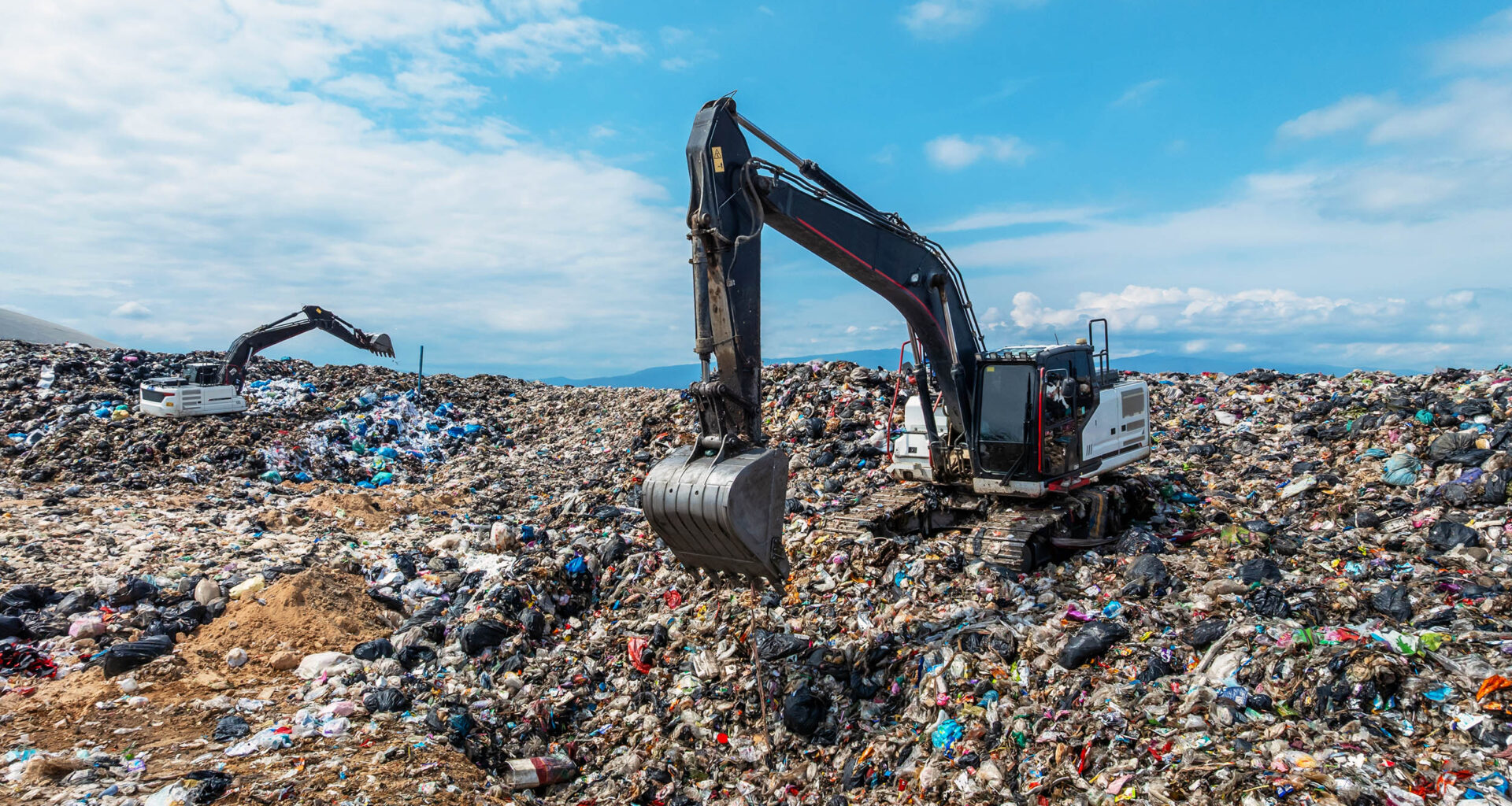
If you’ve ever seen what a city looks like when waste management workers go on strike – bags piling up, smells creeping in, rats getting brave – you already know how big of a problem human garbage can become if not managed properly.
Human garbage is a public health issue: clogged drains that trigger floods, smoke from burning waste, and methane gas emissions that drive climate change.

That’s the basic assessment from the World Bank’s What a Waste 3.0 executive summary: the global waste problem is growing much faster than expected, and the places least equipped to deal with it are the ones where it’s growing the quickest.
We hit 2030 levels way too early
The world is already producing roughly 2.56 billion tons of municipal solid waste (MSW) per year as of 2022.
That’s almost the same amount the previous report (What a Waste 2.0) expected the world wouldn’t reach until 2030 (2.59 billion tons).
And if we keep going the way we’re going now, the report projects global waste will climb to 3.86 billion tons by 2050 – roughly a 50% increase from today.
The growth isn’t evenly distributed, either. The biggest increases are projected in low-income countries, especially in Sub-Saharan Africa and South Asia.
These are exactly the regions where waste collection and disposal systems are often already stretched thin.
Who produces the most waste
Waste is one of those things where “average” hides the real story. High-income countries are home to about 16% of the world’s population but generate 29% of the world’s waste.
Upper-middle-income countries generate the biggest share overall – 42% – because they combine large populations with rising consumption.
Lower-middle-income countries produce 25%, and low-income countries about 4%.
If we look at the regional picture, we discover that East Asia and the Pacific is the biggest generator at 33% of global waste, while the Middle East and North Africa is lowest at 6%.
On its own, that’s just a distribution chart. The bigger issue is that rapid growth in waste often outpaces the boring but essential infrastructure needed to deal with it – collection trucks, transfer stations, landfills that don’t leak, composting and sorting systems, enforcement, staffing, budgets.
When systems fall behind, the “solution” becomes dumping or burning, and everyone nearby pays for it.
The biggest problem is not recycling
Before you even get to “reduce, reuse, recycle,” there’s a more basic question: does the waste get picked up at all?
The report’s numbers are brutal: high-income countries collect 99% of municipal waste and low-income countries collect only 28%. The global average is 83%.
That 28% isn’t just a statistic. It means people living with waste in empty lots, in waterways, in informal pits, or in burn piles. It means choking smoke and contaminated water.
It also means “waste management” conversations that focus only on fancy recycling targets are missing the immediate crisis: in many places, the garbage system basically doesn’t exist.
What happens to waste after it’s collected
Even when waste is collected, the world still relies heavily on landfills and still loses a lot of waste to uncontrolled dumping.
The report’s global breakdown shows that recycling + composting + anaerobic digestion together account for 21%, while incineration with energy recovery accounts for 20%.
But about 30% of waste worldwide is either openly dumped or not collected at all.
Income level changes everything here. In high-income countries, nearly 100% of waste is managed in controlled facilities, but in low-income countries, only 3% is managed that way.
So yes, the world has modern waste facilities. It’s just that a huge chunk of humanity doesn’t have access to them. Moreover, the environmental consequences don’t stay neatly contained inside national borders.
The single largest contributor
Globally, food waste is the single biggest component of municipal waste: 38%.
That’s important because food and other organics are the stuff that rots quickly, smells terrible, attracts pests, and produces methane when it breaks down without oxygen (like in dumps and landfills).
You’d think composting and anaerobic digestion would be a massive part of the solution. But the report finds that only about 6% of global waste is composted or treated through anaerobic digestion.
We’re handling the biggest share of our waste in the worst possible way – and then acting surprised when methane emissions increase.
Waste is a climate problem
The executive summary puts numbers on something many people underestimate: solid waste management is already a serious greenhouse gas source.
In 2022, emissions from the waste sector were estimated at about 1.28 billion tons of CO2-equivalent per year. Methane accounts for most of that – about 1.15 billion tons annually.
And without major changes, waste-sector emissions are projected to rise to about 1.84 billion tons of methane by 2050, which is a 43% increase from 2022.
The report also highlights the broader food system problem: potentially one-third of all food produced globally is lost or wasted each year. This impacts climate, land use, and food security at the same time.
The future isn’t locked in
The scientists model three scenarios that could reduce the impact of accumulating waste. In a business-as-usual: waste rises to 3.86 billion tons by 2050.
In a “low ambition” scenario, waste rises to 3.12 billion tons, while in a “high ambition” one, global waste generation is essentially held around today’s level despite growth in population and economies.
Across all scenarios, waste collection improves and open dumping declines. But here’s the catch. Even in the “better” scenarios, where less waste is produced and global costs go down overall, low- and lower-middle-income countries still face rising costs.
That’s because they need major investments just to reach safe, basic waste services. The world can’t just tell fast-growing regions “do better” without money, planning, and long-term support. Waste systems don’t appear by magic.
So what’s the real takeaway?
The What a Waste 3.0 report is saying two things at once.
First, it is clear that the waste crisis is worse than we want to admit. We’re generating enormous volumes, and a staggering share is still unmanaged.
Second, solutions exist. If you want to cut the damage fast, you prioritize what the report’s data keeps pointing at: expand collection where it barely exists, stop open dumping, and treat organic waste and methane as “front of the line” problems rather than side projects.
And looming behind all of it is the bigger shift the report keeps hinting at: moving from a world that constantly extracts, consumes, and dumps to one that actually keeps materials in use – what the report frames as a move toward “circularity.”
Because the truth is that even if recycling got perfect overnight (it won’t), we still wouldn’t solve waste if collection fails, organics rot in open dumps, and we keep producing more and more trash each year.
—–
Like what you read? Subscribe to our newsletter for engaging articles, exclusive content, and the latest updates.
Check us out on EarthSnap, a free app brought to you by Eric Ralls and Earth.com.
—–