
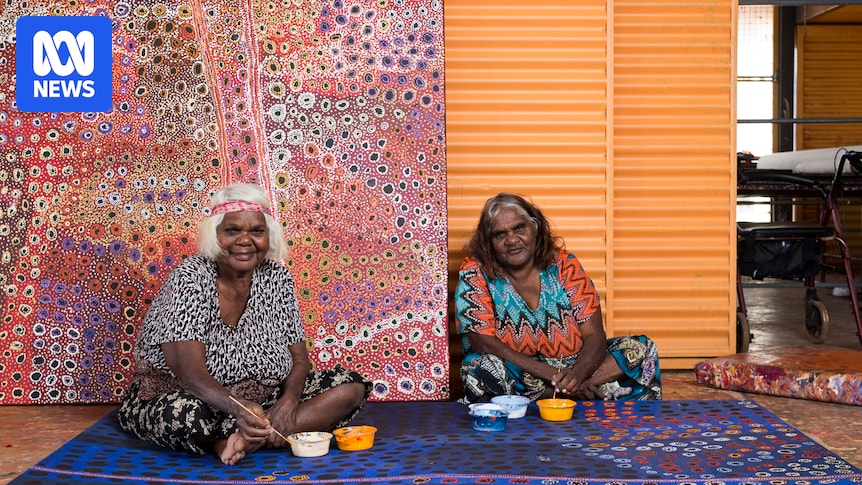
The National Gallery of Australia has opened a long-awaited exhibition of work by First Nations artists from the Aṉangu Pitjantjatjara Yankunytjatjara (APY) Lands, Coober Pedy and Adelaide.
After a three-year delay, 30 paintings by 49 artists are now on display as part of the exhibition Ngura Puḻka — Epic Country, presented in partnership with APY Art Centre Collective.
Tina Baum, head curator of First Nations art at the National Gallery, said this artist-led exhibition was unique because of the large scale of the works.
“Thirty of the works we have in the exhibition, 29 of them are three-by-three meters,” Ms Baum said.
“They’re epic in story, they’re epic in scale.”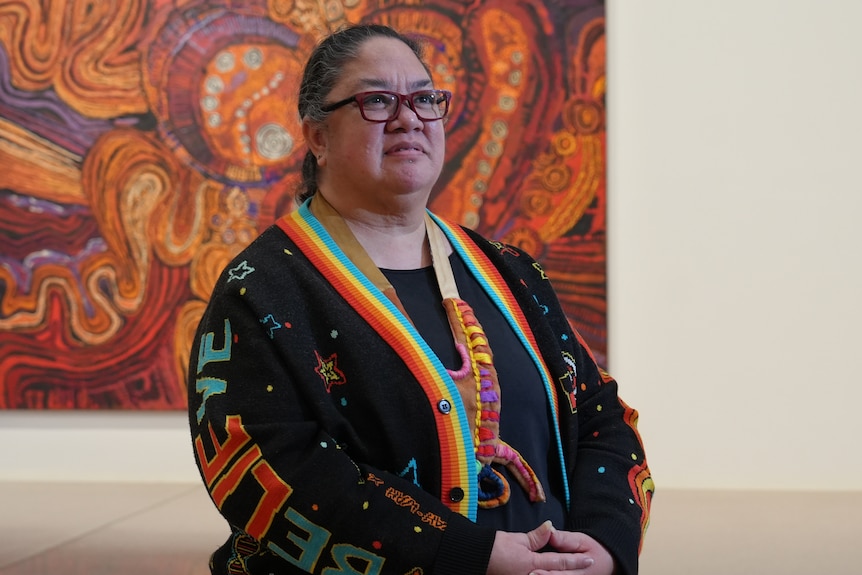
Tina Baum says the majority of the works are three-by-three meters in size. (ABC News: Lois Maskiell)
Plans for the exhibition were stalled three years ago over allegations of non-Aboriginal workers interfering with the works.
The National Gallery undertook an independent investigation into 28 works, postponing the original opening date of June 2023 until today.
“Since the investigation, of course, those claims against ‘the white hands on black art’ were disputed. There’s no warrant in them at all,” Ms Baum said.
“The artists have 100 per cent authorship of their artworks in this exhibition.”
Stories of sky, land and underground
Ms Baum said the artists are sharing their jukurrpa, meaning their lore and ceremony, from remote north-west South Australia.
“We’ve got Seven Sisters story of the sky, land stories, as well as stories about the underground. I think audiences will get a real diverse cross-section of stories from the APY Lands,” she said.
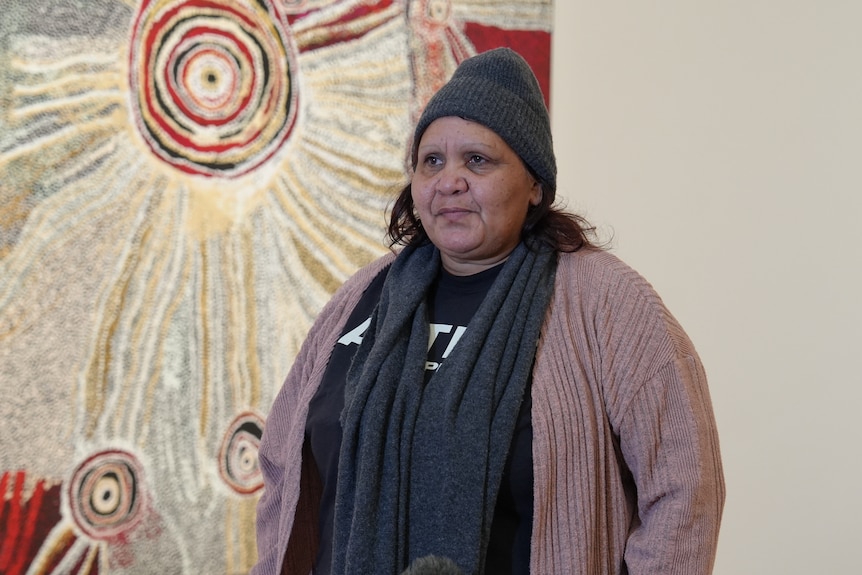
Yankunytjatjara artist Sandra Pumani says she is proud to display her work in the exhibition. (ABC News: Lois Maskiell)
Yankunytjatjara artist Sandra Pumani, whose work features in the exhibition, said she was proud to showcase her art, which is about the place where she grew up.
“It’s about my home, I talk about my home, where I grew up,” Ms Pumani said.
“I look back, it was really precious that I’ve experienced so much in that life, growing up in a beautiful place.”
Ms Pumani, who is also chair of APY Art Centre Collective, said she comes from a family of artists, with her grandmother, mother and aunt all having practised art.
“Coming here, bringing our work and our stories and sharing it with other people makes us very proud.”
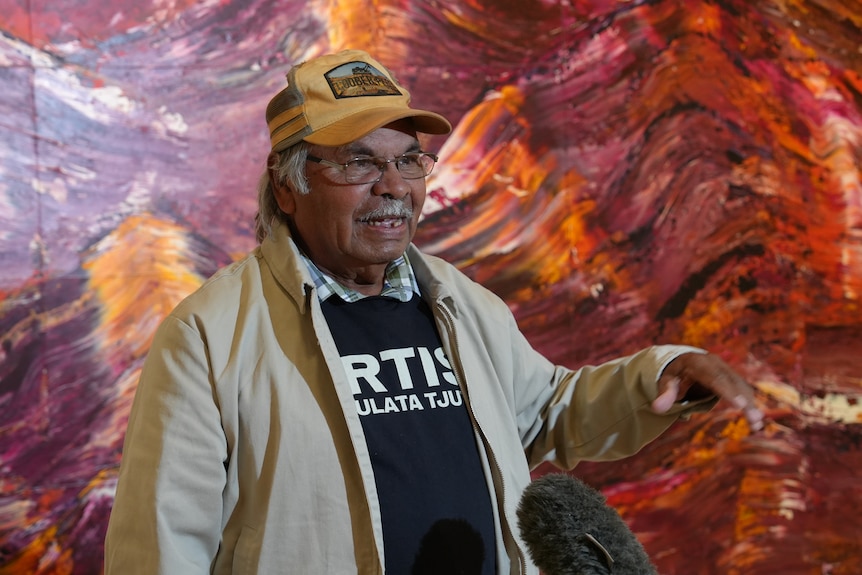
Yankunytjatjara artist George Cooley stands in front of his artwork, titled Blue Ground Country. (ABC News: Lois Maskiell)
Yankunytjatjara artist, community leader and avid opal miner George Cooley said his work captures his country in Coober Pedy from ground level.
“This particular painting I’ve called it blue ground country … In opal miners’ language, when you come to a blue ground, it’s an indicator that you will probably not find any opals,” Mr Cooley said.
“The other side was to capture the beauty there, the sediments, the layers of colours.
“Unlike my colleagues, they’ve got an aerial view of their artwork, I’ve got a front on view, but I’m telling the same story; the story is about country, hunting, camping, and looking for bush tucker.”
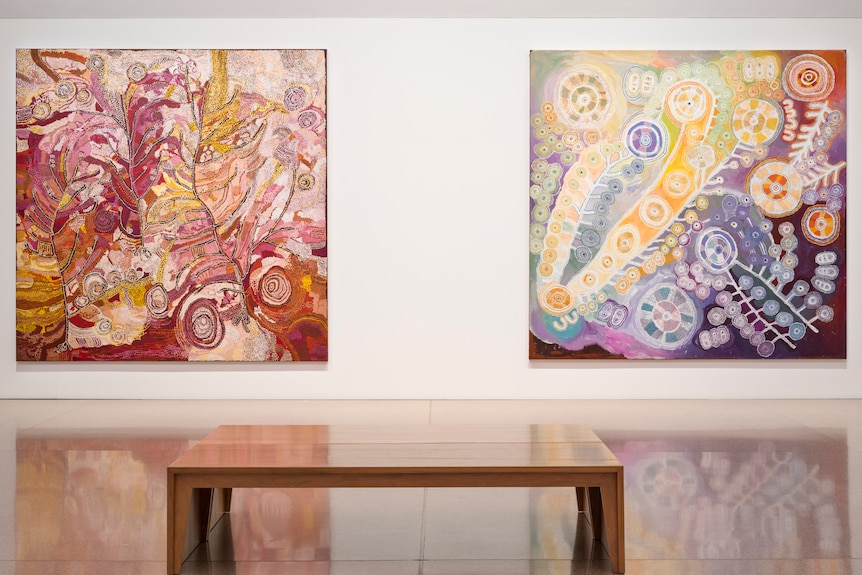
Yankunytjatjara artist Kunmanara (Nellie Ngampa) Coulthard’s work Tjuntala Ngurangka (Country with Mulga wattle) pictured next to Pitjantjatjara artist Tuppy Ngintja Goodwin’s work Antara. (Supplied: NGA)
‘A fascinating place’
The exhibition is supported by Tjala Arts, Mimili Maku Arts, Umoona Arts, Iwantja Arts, Kaltjiti Arts, Collective Art Centre Adelaide, as well as artists from Ernabella and Pipalyatjara.
Ms Baum said the gallery had “worked really closely” with the artists to produce the show.
“We’ve gone out to the homelands, we’ve gone out to the art centres, and we’ve worked with the artists and heard from them,” she said.
Launching the exhibition in Canberra, National Gallery director Nick Mitzevich said the APY Lands were “a fascinating place” with a rich artistic culture.
“They represent around 2000 people in 20 communities and there are more than 500 artists in the APY Lands, making it probably the most concentrated place of art making on the planet,” he said.
“This exhibition has been a long time coming, but what’s important today is we have a group of 30 works of art that capture the energy and inspiration of the APY Lands.”
Ngura Puḻka — Epic Country is now open at the National Gallery in Canberra and runs until August 23.