
Welcome to the new-look film set, where the quiet hum of a coding floor has replaced the cacophony of cameras, clapperboards, and shouted directions.
The Collective Artists Network, a top talent agency for Bollywood A-listers, has long brokered the careers of real-life superstars.
Now, it is engineering digital ones.
In its Bengaluru premises, filmmakers use artificial intelligence tools to create content based on Hindu mythology – a popular genre in India.
One film, based on the religious text Ramayana, has a scene showing the god Hanuman flying while carrying a mountain.
A show based on a separate ancient epic, Mahabharat, features a sequence depicting the princess Gandhari, who blindfolded herself upon marrying a blind king.
India produces the most films of any country, and stars such as Shah Rukh Khan and Amitabh Bachchan command cult-like followings.
But shifting audience habits, including the rise of streaming, are squeezing production budgets, many industry players say.
The number of moviegoers fell to 832 million in 2025 from 1.03 billion in 2019, according to consulting firm Ormax Media.
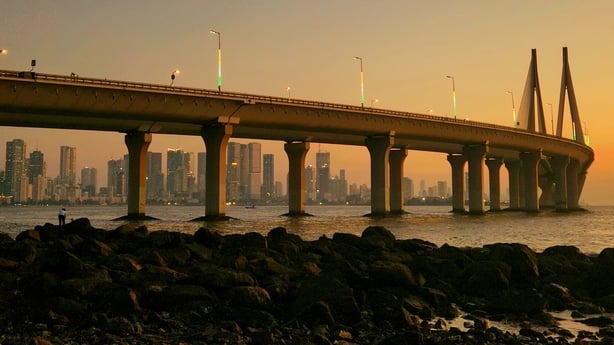
India produces the most films of any country
While box-office sales hit a record $1.4 billion last year, revenue has been choppy since the pandemic and reliant on a handful of hits and pricier tickets.
Studios in India are responding by deploying AI at a scale unseen elsewhere: creating fully-fledged AI-generated films; using AI dubbing to release films in numerous languages; and recutting endings of older titles to eke out additional sales.
In the process, they are reshaping the economics of filmmaking, compressing production timelines, and pitting AI-driven efficiency against a recurring problem: audiences have often reviewed AI content harshly, even when it sells.
“AI is slashing production costs to one-fifth of what they used to be for traditional filmmaking in genres such as mythology and fantasy,” said Rahul Regulapati, who heads Collective’s AI studio, known as Galleri5.
Production time?
“Down to a quarter,” he said.
The approach differs from Hollywood, where union contracts and fears of job displacement have constrained studios’ use of the technology.
In India, at least one major production house is reviewing its entire library for AI re-releases, and Google, Microsoft, and Nvidia have made early bets by partnering with local filmmakers.
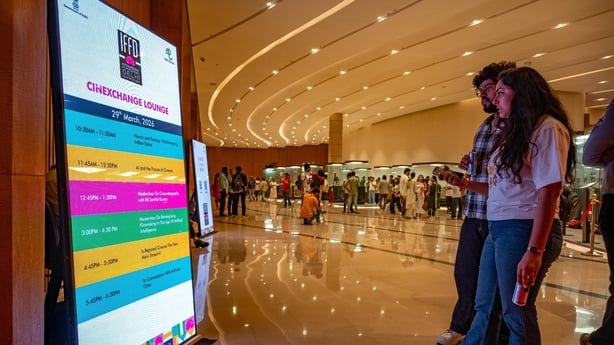
The number of moviegoers in India fell to 832 million in 2025 from 1.03 billion in 2019, according to consulting firm Ormax Media
Previous reporting has explored how Indian filmmakers are harnessing AI, and India’s divergence from Hollywood.
But Reuters is detailing for the first time the extent to which India’s film industry is reorganising itself around AI and the economics driving the shift.
Reuters visited two AI studios and tested filmmaking tools, attended film festivals, and interviewed 25 people for this story, including directors, studio heads, industry executives, and start-up figures.
American and British studios have experimented with AI filmmaking – producing the first full-length AI-animated features in 2024 and an AI-powered immersive version of The Wizard of Oz last year.
But the ambitions of India’s filmmakers are on a different level, said Dominic Lees, a film and AI researcher at the University of Reading in the UK.
“If they can deliver, then the shift in AI filmmaking will be to India,” he said.
The pivot to AI reflects India’s embrace of the technology broadly.
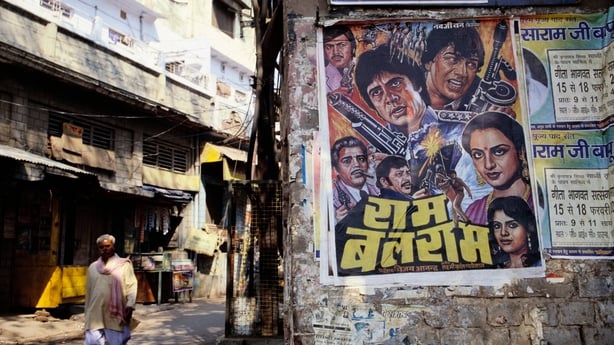
India’s film industry is reorganising itself around AI
Last year, Reuters detailed India’s wager that leaning into AI will create enough opportunities to offset shorter-term disruption.
AI could boost Indian media and entertainment firms’ revenue by 10% and reduce costs by 15% over the medium term, according to analysis by consulting firm EY.
Vikram Malhotra, founder of Abundantia Entertainment, told Reuters the Bollywood production house, which recently announced investment in an $11-million AI studio, is building its AI capability from scratch and expects content generated or assisted by AI to account for one-third of its revenue within three years.
New endings for old dramas
Last year, India’s Eros Media World re-released a 2013 hit, Raanjhanaa, with an AI-altered twist.
It replaced a tragic ending, in which the protagonist died, with a happier finale where he opens his eyes to the surprise of his lover, who smiles through tears.
The rewrite drew backlash.
Dhanush, the lead actor, who goes by one name professionally, said on X that the AI remake had “stripped the film of its very soul” and set a “deeply concerning precedent for both art and artists”.
Still, the re-release of Raanjhanaa drew audiences.
India’s largest cinema chain, PVR Inox, told Reuters that 35% of available tickets to the Tamil-language version of the film were sold during its release month, August.
That was 12 percentage points higher than the average in 2025.
Now, Eros is going further: Pradeep Dwivedi, its Group CEO, told Reuters the studio is reviewing its 3,000-title catalogue “to identify candidates for AI-assisted adaptation”.
The group’s Indian unit, Eros International, last year warned of “competition from digital platforms” as its consolidated annual revenue from operations fell 44%.
“It’s both a revenue opportunity and a creative renewal strategy,” Dwivedi said of the plans for AI rewrites.
In Hollywood, such alterations would face barriers.
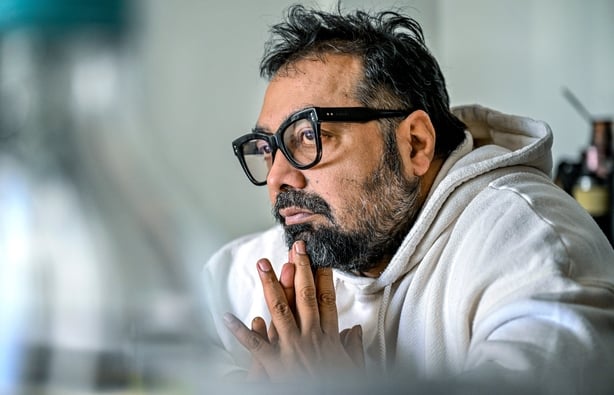
Anurag Kashyap, a Bollywood director, told Reuters he is concerned about the growth of AI in filmmaking in India and the lack of guardrails around its use. However, he grudgingly conceded the economic case for studios to deploy the technology
Under an agreement with the US actors’ union SAG-AFTRA, studios cannot digitally alter an actor’s performance or create a digital replica without the performer’s informed consent.
The Directors Guild of America contract bars studios from using AI for creative decisions without consulting the director and prevents AI from doing the work of its members.
Indian studios, by contrast, are pushing into aggressive experiments using AI, including in Hindu mythological tales – big business in a country with millions of devout followers.
Collective is planning eight AI-generated titles focused on deities such as Hanuman, Krishna, Durga, and Kali.
JioStar, a media joint venture between billionaire Mukesh Ambani’s Reliance and Walt Disney, has been airing an AI-generated adaptation of the ancient Hindu epic Mahabharat – the first episodic series to emerge from Collective’s cinematic AI lab.
The AI rendition of the tale about a dynastic war between princes has recorded at least 26.5 million views since its October release on JioStar’s streaming platform, the company told Reuters.
An earlier TV adaptation drew 200 million viewers between 1988 and 1990.
The show has faced a rocky reception with audiences, however.
Mahabharat holds a rating of 1.4 out of 10 on IMDb, with some reviewers criticising lip-sync issues and others saying some sequences felt low-quality or lacked authenticity due to unnatural styling.
Alok Jain, a senior executive at JioStar, told Reuters the response “has been a mix of appreciation and healthy debate, which is natural for any ambitious creative leap”.
He said JioStar is exploring making original stories in AI format.
Some industry figures lament the rise of AI in filmmaking.
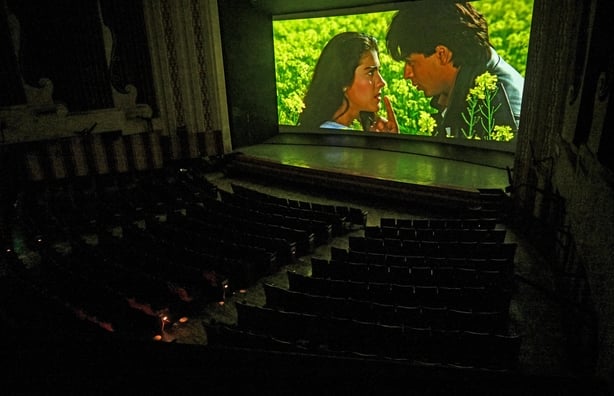
While box-office sales hit a record $1.4 billion last year, revenue has been choppy since the pandemic and reliant on a handful of hits and pricier tickets
Jonathan Taplin, an American writer and producer who has worked with Hollywood studios, said the use of AI to create entire feature films is “an affront to the whole history of cinema”.
“It will fill your cinemas and screens with formula slop,” he said.
Dubbing with AI
Dubbing may offer a smoother path to acceptance of AI in film.
India’s 22 official languages and hundreds of dialects split the country into micro-markets, making dubbing essential for any film to become a national blockbuster.
Audiences have long griped about mismatched lip movement – a problem AI is beginning to address.
During a Reuters visit to NeuralGarage, an AI startup in Bengaluru that provides dubbing for top studios like Yash Raj Films, co-founder Subhabrata Debnath demonstrated a clip of an AI-generated character speaking in English.
He then superimposed a German audio track, and within minutes the character was speaking fluent German, lips and jaw in sync.
Debnath said the technology preserves “the performance, identity, and the speaking style of the person” while altering the face enough to make the dubbing look natural.
NeuralGarage’s AI technology was used last year to dub Yash Raj’s Hindi film War 2 into the Telugu language of south India.
The production house did not respond to Reuters questions.
Tech majors meet the red carpet
Global tech majors also want a piece of the action.
Google partnered with Bollywood director Shakun Batra in August to produce a five-part cinematic series using its Veo 3 video-generation and Flow AI tools to experiment with AI-powered filmmaking.
Mira Lane, Google’s Vice President of Technology and Society, told Reuters that AI could also allow independent artists to create complex sequences that “might otherwise be out of reach due to budget or logistical constraints”.
Collective has been working with Microsoft, which told Reuters it is providing AI computing power to help “shape the next wave of global storytelling” through such collaborations.
To bypass the limitations of standard text prompts, Collective uses a hybrid of physical recording and digital animation.
Actors wear sensor-equipped motion-capture suits to record body movements as 3D data, while smartphones capture facial expressions.
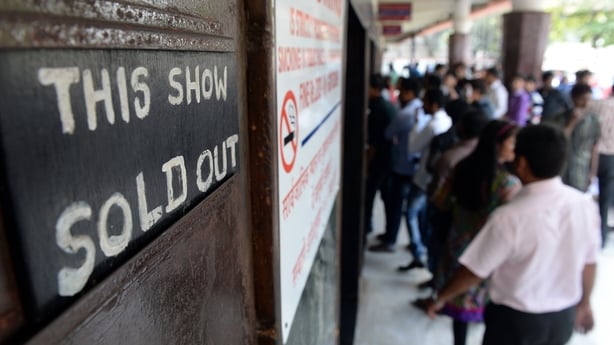
Shifting audience habits in India, including the rise of streaming, are squeezing production budgets, many industry players say
This data is fed into the AI pipeline, allowing for nuanced control over the AI-generated characters.
The ripples are reaching beyond the studio.
Globally, festivals dedicated to screening AI-generated shorts have proliferated in locations including Los Angeles, Cannes, and Barcelona.
India’s first took place in November at Mumbai’s Royal Opera House, where young storytellers walked the red carpet alongside a dancing robot.
In February, Nvidia shared the stage with aspiring AI filmmakers at the second edition of India’s AI film fest in New Delhi.
Pradeep Gupta, a Global Vice President of Nvidia, told the audience the company is working to slash computing costs so that anyone can “create something substantial without putting a lot of money” into production.
Anurag Kashyap, a Bollywood director, told Reuters he is concerned about the growth of AI in filmmaking in India and the lack of guardrails around its use.
However, he grudgingly conceded the economic case for studios to deploy the technology.
“In India, cinema isn’t about art. It’s purely business, so studios are going to use it to make mythologicals,” Kashyap said of AI.
“Our audience is a sucker for it.”
Source: Reuters