
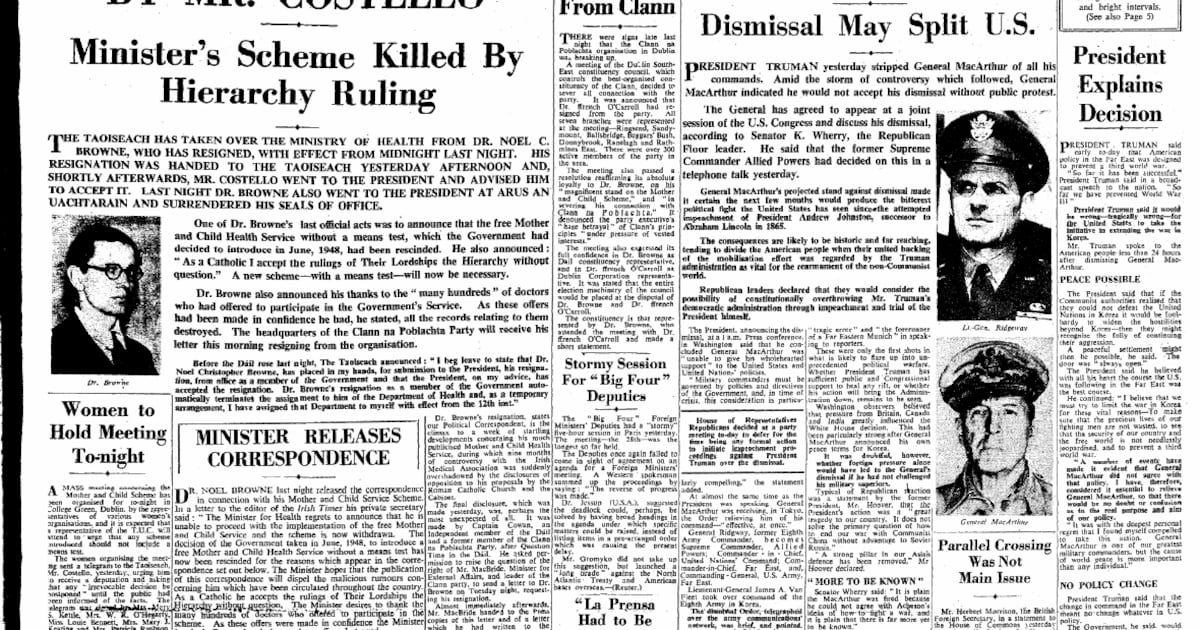
Seventy-five years ago this week, minister for health Dr Noël Browne resigned over the refusal of his cabinet colleagues to support his Mother and Child scheme.
He then did something unprecedented in Irish political history to that date. He sent all the correspondence related to the debacle to The Irish Times.
It revealed the extent to which the Catholic hierarchy had successfully lobbied the government to block Browne’s attempts to bring in free medical care for mothers and children up to the age of 16.
An Irish Times editorial concluded: “The most serious revelation is that the Roman Catholic Church would seem to be the effective Government of the country.”
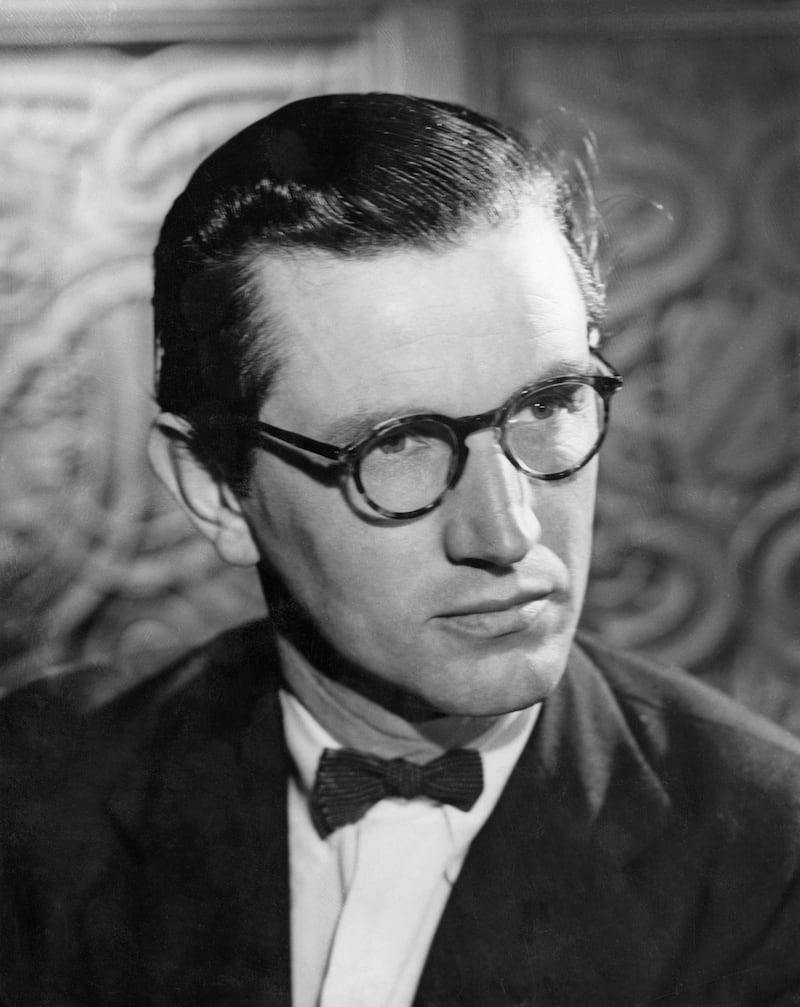 Dr Noël Browne. Photograph: Fox/Hulton/Getty
In the intervening years, the Mother and Child scheme has frequently been cited as a battle of wills between the high-minded Browne and an overbearing Catholic hierarchy.
Absent from much of the analysis is the third party involved – the medical profession.
Browne’s scheme was actually one of four attempts to introduce comprehensive free healthcare for mothers and children under the age of 16. The medical profession, in league with the church, spent eight years opposing the various proposals and eventually succeeded.
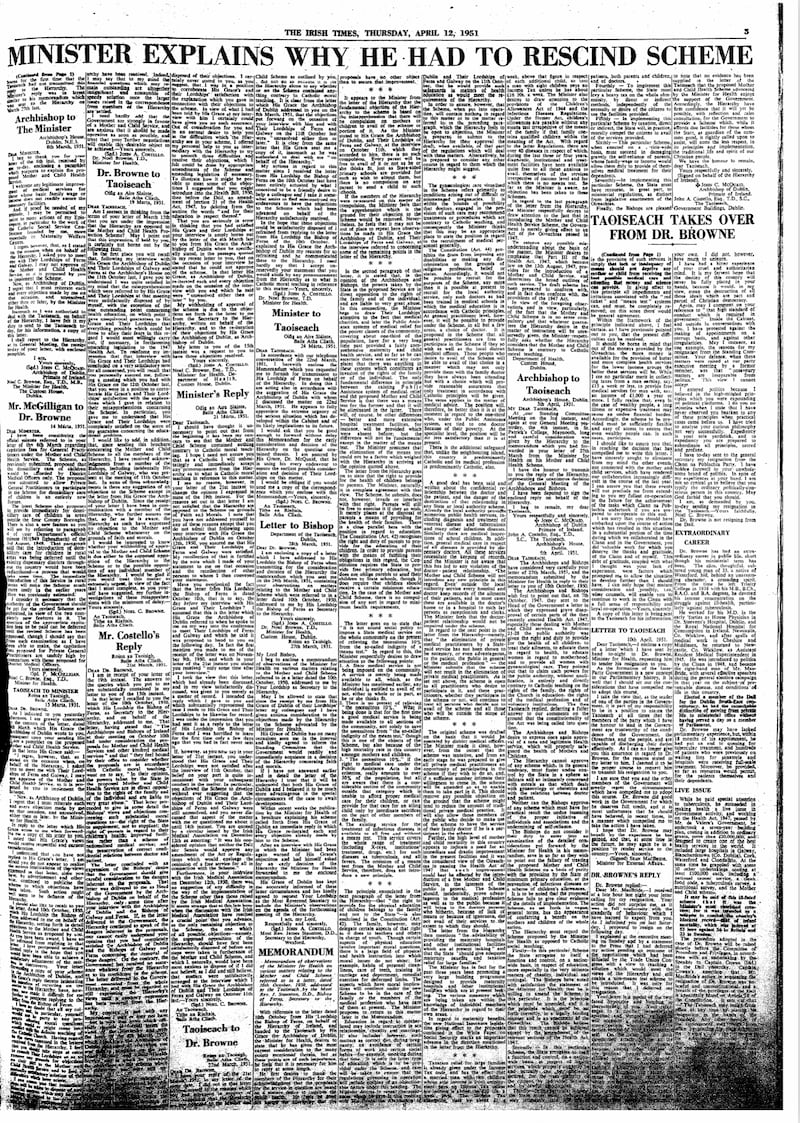 On April 12th, 1951, The Irish Times published the correspondence between the Catholic hierarchy and the government in relation to the Mother and Child scheme
The legacy of that opposition remains relevant to this day, but not in a way that many people assume. The church is greatly diminished and politicians no longer fear the belt of the crozier.
But our two-tier health system can be traced back to this period in Irish history.
The first attempt to introduce the Mother and Child scheme was made in December 1945 by the then Fianna Fáil minister for health, Dr Con Ward.
A medical doctor and a pugnacious politician, Ward was forced out of office by an unrelated political scandal in 1946. The legislation passed to his successor, Dr James Ryan.
Ryan was determined to implement something that became a greater political imperative when the NHS was introduced in the UK and Northern Ireland in August 1947. He immediately recognised that the provision of a free healthcare system for all citizens in Northern Ireland, while most people in the South paid privately, would be a considerable impediment to ending partition.
The Irish State’s laissez-faire attitude at the time meant it provided for only 16 per cent of all health spending in the country – almost all of it directed at the poorest in society.
In October 1947, Ryan was notified of the objections of the Catholic hierarchy to his scheme. The bishops thought it was an unwarranted State interference in the individual’s right to choose their own healthcare. Curiously, they made no objection to its most important provision – that it would be free and not means tested.
Ryan’s Bill was subject to a court challenge and the Fianna Fáil government fell in 1948.
[ How The Irish Times exposed the Mother and Child scandal 70 years ago todayOpens in new window ]
Browne, another medical doctor, became the third minister to attempt to implement it. He tried to assuage the hierarchy’s reservations about parts of the legislation which might not be in accordance with church teaching.
He made a fatal mistake in thinking that the bishops had no objection to the absence of a means test. The bishops made clear their objections in a letter later published in The Irish Times, arguing the State should provide for the “10 per cent necessitous poor” but not for those who could afford to pay.
Browne disputed this figure, arguing that 30 per cent of the population was on some kind of welfare. In any case, he was adamant that a means test was an “unforgivable degradation and an interference with the privacy of the individual”.
He would not yield on the means test issue, believing the opposition of many in the medical profession was entirely self-serving as it threatened their income from private patients.
When the inter-party government fell in 1951, Ryan again became minister for health. He was in favour of an NHS-style health system for Ireland, arguing that everybody should be “eligible for benefits – no means test – no pauperism”.
Browne joined Fianna Fáil in 1953 on the basis that the party would succeed where he had failed. His successor faced the same objections from the medical profession, which this time mobilised the church directly and publicly.
[ James Ryan: the most influential minister not to have become taoiseachOpens in new window ]
The eventual Health Act of 1953 provided free medical care for mothers and their children only up to the age of six weeks rather than 16 years, though it did include significant concessions that abolished or greatly diminished hospital charges for most patients.
Attempts to introduce an NHS for Ireland finally ended in 1957 when the Fine Gael minister for health Tom O’Higgins established the Voluntary Health Insurance Board (VHI).
This enshrined the principle that those who could, should pay more, even if it meant preferential access to health services.
Former minister of State for health Róisín Shortall – who chaired the Sláintecare committee, which reported in 2017 – said Ireland never had the postwar conversation other European countries had about welfare provision. She contrasted the Irish situation with the postwar Labour government in the UK, which introduced the NHS despite the opposition of the medical profession.
“Circumstances suited the doctors very well in Ireland because the church and many elements in politics were totally opposed to the socialisation of medicine,” she said.
“Because we didn’t have that debate we came up with Sláintecare, which is supposed to provide a single-tier health system.
“Elements of the plan have been introduced, but there are still elements in Government opposed for ideological reasons to an NHS.”
It was not until 2015 that GP charges were abolished for children, and then only up to the age of six. This was expanded to children under eight by Stephen Donnelly, who also abolished all in-patient charges and expanded free GP visit cards to people earning up to €46,000 a year during his time as minister for health.
“We have progressed far beyond Noël Browne’s ambitions. Since 2020 we dismantled most charges in the public health system so GP care is now free for over half the population,” he says.
The State’s provision for women’s healthcare has greatly expanded in recent years, he says, beyond what Browne envisaged. Those measures include free contraception and fertility care, and expanded maternity services.
Yet, Donnelly believes an Irish NHS would not be an appropriate model.
“The overarching goal of a public health service should be to achieve the highest attainable standard of health for the whole population, for a given level of funding,” he says.
“The World Health Organisation says ‘affordable’, it does not say ‘free’ – because there are trade-offs to services being free for everyone, including overuse of such services.”
In the absence of an Irish NHS, the public pays €3 billion for health insurance annually – an average premium of €1,900.
Recent polling in Northern Ireland shows the disparity between the two health services would be a big consideration in any vote for a united Ireland – just as James Ryan forecast.
Seventy-five years after the Mother and Child scheme, provision for a single-tier health system in the Republic remains a work in progress.