
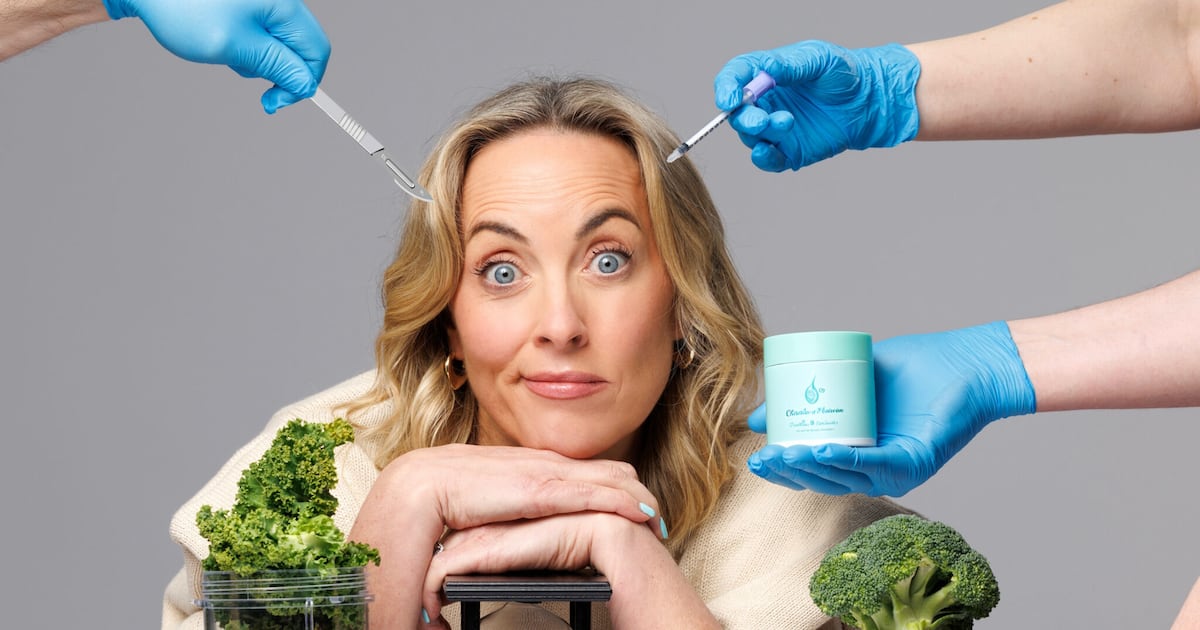
Squeamish viewers are advised to keep a cushion to hand throughout part one of Kathryn Thomas’s thought-provoking documentary Young Forever: The Death of Ageing? (RTÉ One, Monday, 9.35pm). This unflinching look at the anti-ageing industry doesn’t shy away from the gorier aspects of trying to stay young in perpetuity – including a visit to an operating theatre where cosmetic surgeon Richard Hanson is wielding the scalpel.
“If you’re going to faint, fall backwards,” he tells Thomas, whose face is suddenly even paler than her hospital scrubs. “So, let’s have a look in here. This is cool … See the white little stringy things? They are all the nerves that supply your facial expression. If you damage them you can’t smile … This is lovely, beautiful stuff.” Thomas just about sputters a reply: “That is very, very visual.”
Hanson is performing a “deep plane” facelift at the Mater Private Hospital in Dublin. While the procedure sounds like something from an art-house horror movie, customer satisfaction is high. “When I look in the mirror I look like me,” says 55-year-old dentist Ciara Carroll. “Whereas before I didn’t know who this old woman was appearing before me.”
At 47, Thomas has not yet opted for a facelift, deep plane or otherwise. However, she does confess to twice-yearly Botox injections in her forehead – a procedure her doctor believes should be increased to three annual visits. “In the beginning I didn’t admit to it at all. I know it’s not for everybody,” she says.
As a TV presenter, Thomas is frank about the pressure to look young. Having had her first child at 39, she is also anxious about staying spry into later life, in order not to be a burden on her family when they are grown up. She isn’t the only relatively young person anxious about ageing. Just as ancient explorers searched for the fountain of youth, so modern medicine is chasing the dream of a much-lengthened lifespan – a trend Thomas describes as the “longevity boom”.
But this wish to stay young has a dark side. Healthcare worker Karl Dempsey recalls undergoing surgery at age 16, so concerned was he with ageing.
“I looked like a space raider, like an alien,” he says. “It’s crazy. In the gay scene there is a fear of ageing.” Thomas also travels to Miami, where she meets biohackers who guzzle thousands of dollars worth of pills each month in a bid to slow down ageing. One such “hacker”, Joe Cohen, talks about pushing “at the frontiers of biology”.
The picture painted is a grim one of people who cannot come to terms with the truth that ageing is part of life – that it, in fact, gives it purpose. If we were all to live forever, what would any of it mean: our families, our careers, our hopes and dreams? It is that ever-ticking clock that brings meaning to our days. Without it, we would just be drifting in the wind, twisting into eternity.
Thomas rarely offers an opinion and seems more comfortable reacting to the many zany characters she meets. But the message that ageing is a crucial element of our humanity is cogently articulated by Cathy O’Connor, a stylist, personal shopper and founder of Women Unbranded, which has the mission of “giving a voice to women over 40 and beyond who have experienced a lack of representation”.
“I’m 65. I’m really happy to have wrinkles. I don’t want to be frozen faced,” she says. “One of the challenges is the depiction of age. The only portrayal we see of age is advanced old age. It’s a very bleak picture. The effect it has on many women is that they feel invisible. What’s really appalling is when they are invisible to themselves. The notion we can stop [ageing], ‘I’m digging my heels’ … is a very sad outcome for life.”