
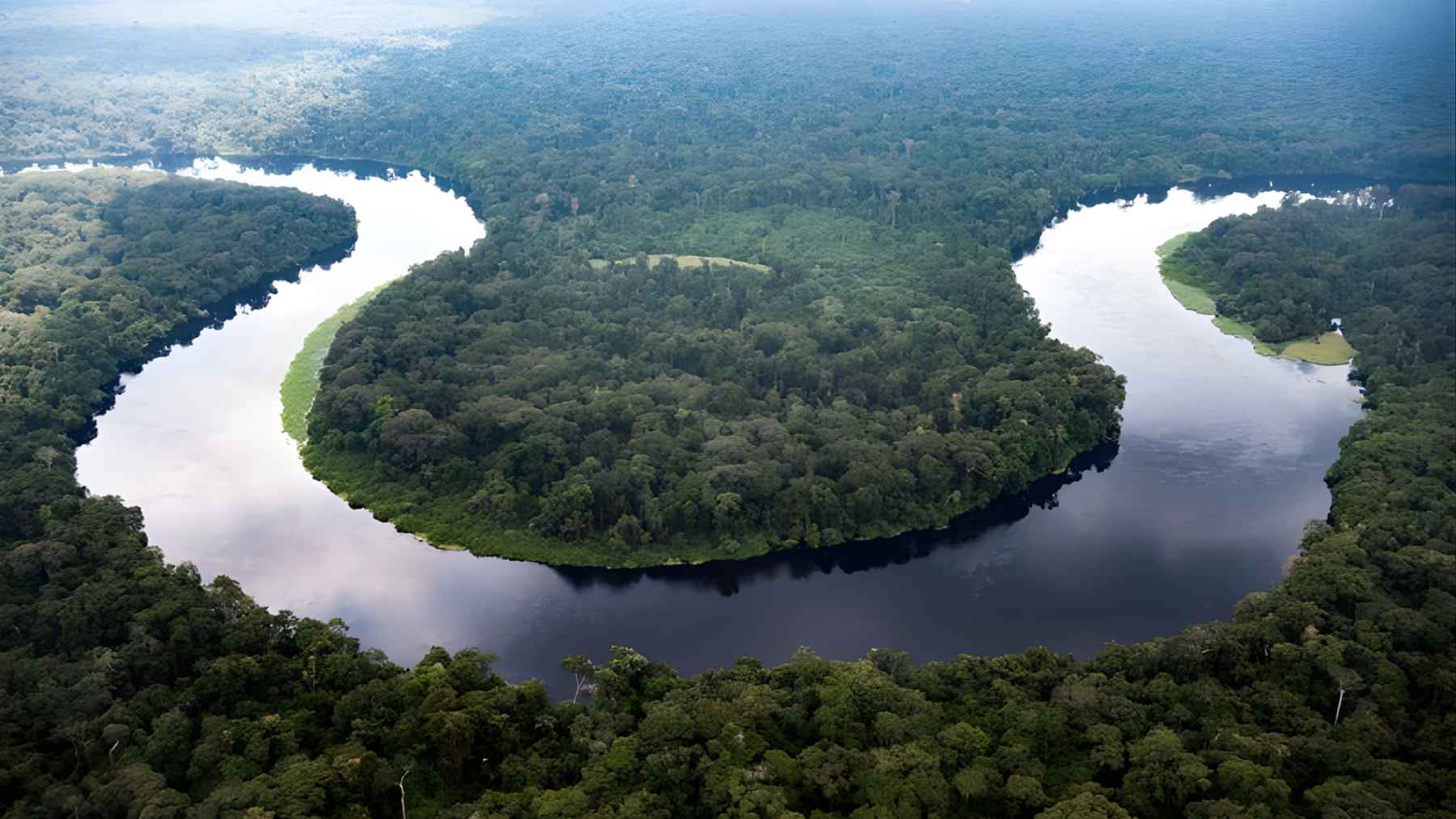
The Congo Basin is often described as one of Earth’s great natural “climate buffers” because its swamp forests and peatlands lock away carbon for centuries or even millennia.
Scientists studying two huge blackwater lakes in the Democratic Republic of the Congo found something unsettling in the water itself. A significant share of the carbon dioxide bubbling out is not “new” carbon from recent plant life, but carbon that has been stored in peat for thousands of years. That’s the kind of quiet shift that can be easy to miss, until it starts showing up in the atmosphere.
The Congo Basin’s dark lakes are not just scenic: they are chemical reactors
Lake Mai Ndombe and Lake Tumba sit inside the central Congo Basin peatland complex, where waterlogged soils slow decay and allow carbon to build up as peat. The lakes look almost like black tea because so much dissolved organic material from surrounding swamp forests stains the water dark brown.
In a Nature Geoscience study published February 23, 2026, researchers report that these lakes are major CO2 sources, meaning they regularly release carbon dioxide to the air. Measurements show the lake water holds far more CO2 than the atmosphere, which naturally drives steady outgassing.
What makes this story bigger than two lakes is what they connect to. Congo Basin swamps and peatlands cover only about 0.3% of Earth’s land surface, yet they hold roughly one-third of the carbon stored in tropical peatlands, and tropical peat systems overall store around 100 gigatons of carbon. In other words, even a “small leak” matters.
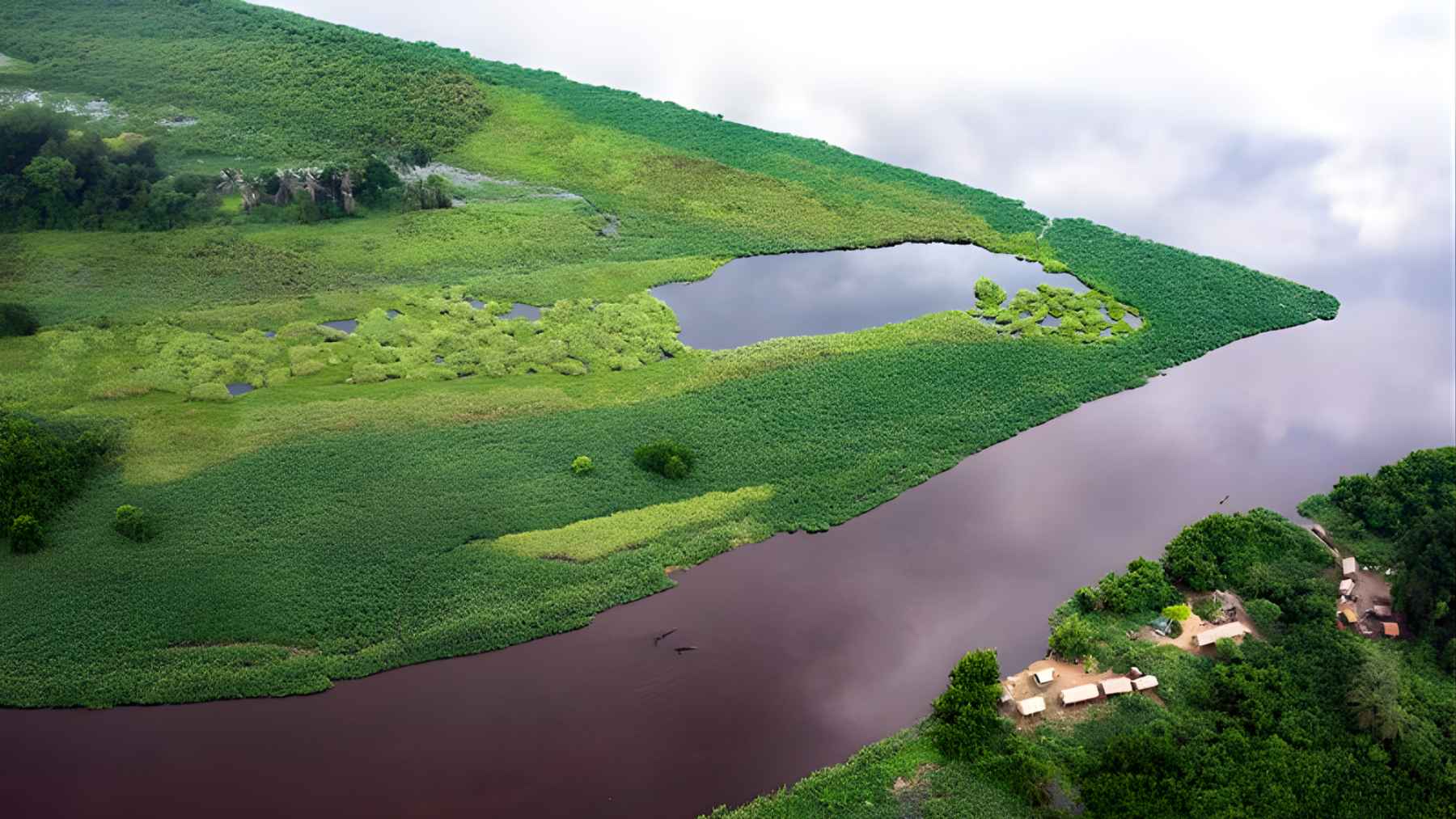 An aerial image shows one of the dark waters of the Congo Basin, where scientists found signs that ancient carbon stored in tropical peatlands may be escaping through connected lakes and waterways
Radiocarbon dating shows the CO2 is coming from deep time
The team used radiocarbon dating to figure out how old the dissolved inorganic carbon was in the lakes, and the results landed with a thud. The dissolved carbon they measured corresponds to about 2,170 to 3,515 radiocarbon years old, and an estimated 39 to 40% of it traces back to surrounding peatlands.
Lead author Travis W. Drake put it plainly in ETH Zurich’s summary of the work, saying, “We were surprised to find that ancient carbon is being released via the lake.” A co-author, Matti Barthel, added that “the carbon reservoir has a leak, so to speak, from which ancient carbon is escaping.”
There’s another clue that this isn’t a local oddity trapped inside the lake basin. The Nature Geoscience paper reports that similarly old dissolved inorganic carbon shows up in the Fimi River, which drains Lake Mai Ndombe, suggesting this ancient-carbon signal can move through connected waters before reaching the air. It’s like finding smoke not just in one room, but drifting down the hallway.
Why scientists are worried about dry spells and methane
If CO2 is the long-term climate driver, methane is the punchier cousin that hits harder in the short run. A separate study in Journal of Geophysical Research (Biogeosciences), released via ETH Zurich’s research collection, looked closely at Lake Mai Ndombe and found the lake is highly supersaturated in not only CO2, but also methane (CH4) and nitrous oxide (N2O) across multiple water-level seasons.
The good news, if you can call it that, is that the lake’s own microbial community appears to consume a lot of what gets produced. The researchers estimate that up to 90% of pelagic methane is reoxidized by methanotrophic microorganisms, meaning much of that methane is eaten before it escapes.
But the same paper warns that small changes in water depth, dissolved oxygen, and microbial communities could significantly change how much greenhouse gas is ultimately emitted.
This is where everyday weather starts to feel less ordinary. When drought lowers water levels, oxygen can penetrate deeper into peat and lake systems, which may change how fast old organic matter breaks down and how gases travel upward, even if the precise pathways are still not nailed down.
And with climate change pushing heat and rainfall patterns around in many regions, scientists are watching these water-level shifts with growing unease.
A climate “sink” can still have vents, and that changes what we track
For years, many researchers assumed Congo peat carbon mostly stayed put unless the region experienced extreme stress like prolonged drought. What this new work highlights is a more active escape route, one that runs through water, microbes, and the everyday chemistry of lakes and rivers.
The mechanism that mobilizes old carbon from peat into lake water is still uncertain, and the researchers themselves emphasize that uncertainty.
That nuance is important because the stakes are high and the story is not finished. The Nature Geoscience authors estimate that the share of ancient peat carbon in lake CO2 implies that Lake Mai Ndombe alone could outgas more than 150 gigagrams of peat carbon per year, and the big question is whether that represents a long-running natural baseline or an early warning sign of destabilization.
In practical terms, protecting the Congo Basin’s climate role is not only about stopping deforestation, even though that remains crucial. It also means protecting hydrology, avoiding drainage and land-use changes that dry peat, and building long-term monitoring that can catch these invisible gas pathways before they scale up.
Photo sources: Greenpeace