
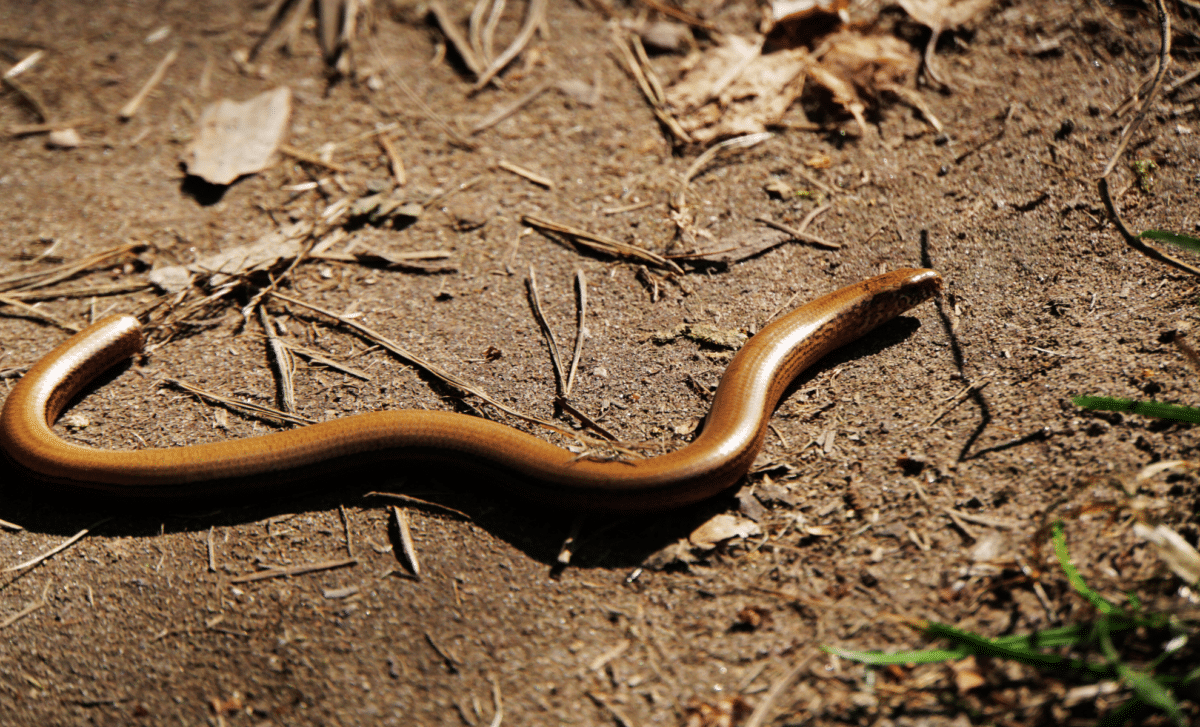
Researchers have confirmed the existence of a new native species of legless lizard in Taiwan. This significant revelation, published in ZooKeys, not only settles a century-old taxonomic debate but also provides vital information that will aid in protecting this elusive reptile. Known for its snake-like appearance, Dopasia formosensis has long been mistaken for an outsider, but the new study proves that it is, in fact, a unique species native to Taiwan’s cool mountain forests.
Unraveling the Mystery of Taiwan’s Hidden Lizard
For decades, the legless lizard of Taiwan had been a source of confusion among scientists. Misidentified as a local variant of another species, it was largely overlooked by researchers. But a team led by Si-Min Lin from National Taiwan Normal University (NTNU) has put an end to this uncertainty, confirming that the lizard is a distinct species, Dopasia formosensis.
The key to solving this mystery lay in revisiting preserved specimens and combining them with new findings. Lin and his team carefully analyzed historical records and connected them to recent observations, ultimately revealing the true identity of the animal. The study was published in the journal ZooKeys, providing a firm resolution to a naming dispute that had lasted over 100 years.
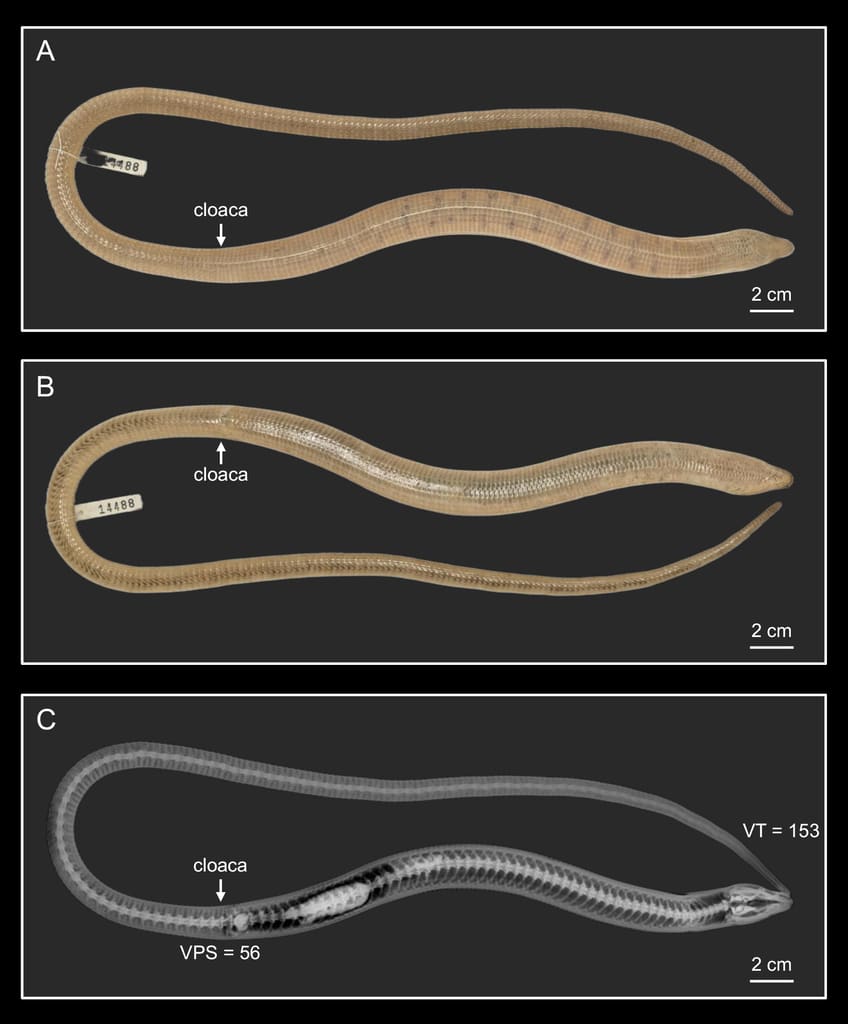 Neotype of Dopasia formosensis, NMNS 14488 (SVL = 221 mm, TotL = 605 mm), an adult male from Mingchi, Yilan County, Taiwan. A. Dorsal view; B. Ventral view; C. X-ray image showing presacral and total vertebral counts.
Credit: Chih-Wei Chen, Chin-Chia Shen, and Yuan-Peng Kuan.
Characteristics That Set It Apart
At first glance, the Dopasia formosensis lizard is often mistaken for a snake. Its long, limbless body and smooth, glossy scales can easily deceive even the most experienced naturalists. However, a closer look reveals distinct features that separate it from true snakes, including small ear openings and blinking eyelids, traits that no snake possesses.
The lizard’s body is highly specialized for a life of concealment. Its long tail, which can be nearly twice the length of its body, aids in navigating through the dense forest litter, where the creature spends much of its life hidden from view. This remarkable adaptation helps the species evade predators and catch its prey, while also facilitating egg-laying.
Another interesting feature is the lateral fold that runs along the sides of the animal’s body. This skin groove allows the lizard to expand its body, aiding in respiration and providing more room for egg-bearing. These unique traits have made the lizard a mystery for so long, with scientists often misidentifying it based on its deceptive appearance.
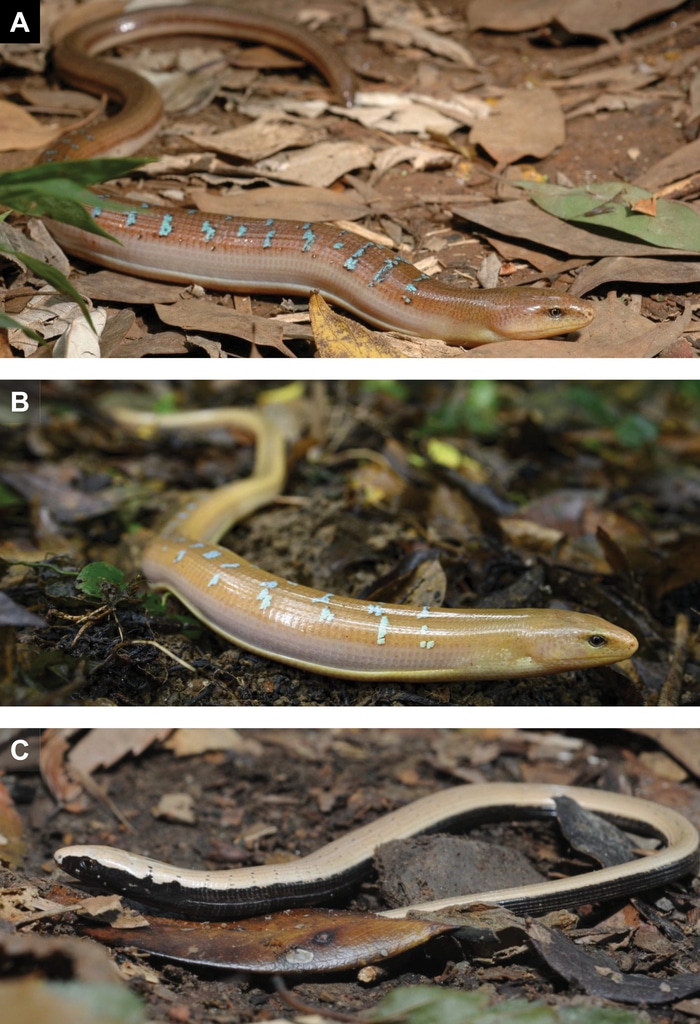 Dopasia formosensis in natural habitat.
A. A fully mature adult male showing its dorsal bluish marking; B. A relatively younger male; C. A young individual with pale brown dorsal coloration and sharply contrasting black ventral surface. Credit: Y-JL.
The Importance of Accurate Identification
The confirmation of Dopasia formosensis as a native species is more than just an academic victory. It has important implications for conservation. Taiwan has long protected the legless lizard under its Wildlife Conservation Act, but the lack of clarity surrounding its exact species meant that researchers could not effectively monitor its population or establish focused conservation efforts.
With this new discovery, the focus will shift from mere identification to understanding the ecological needs of the species. Lin and his team are hopeful that this stable identification will aid in future studies that could inform strategies to protect the species. “A clearer identity provides a solid foundation for future research, which is critical to preserving this rare and elusive reptile,” Lin explained.
A Rare and Elusive Species
Dopasia formosensis is not a creature that is easy to spot. Found primarily in Taiwan’s cool, wet mountain forests, the lizard prefers areas with dense canopy cover, which keeps the forest floor moist. This environment is critical for both feeding and reproduction, as leaf litter provides both shelter and a steady supply of prey.
The species thrives at altitudes ranging from 1,640 to 6,560 feet, and many sightings have been reported along mountain roads and hiking trails. However, due to its secretive nature, the lizard is rarely seen in the wild. In fact, much of the data used in the recent study came from specimens found by the Taiwan Roadkill Observation Network, which has helped fill in gaps in the animal’s known distribution.
Males of the species are more mobile during the breeding season, which peaks between April and June. During this time, males engage in slow, deliberate rituals to compete for mates, sometimes leading to intense confrontations. These fights often result in the loss of a tail, a process known as caudal autotomy, which is costly as the tail does not regenerate.
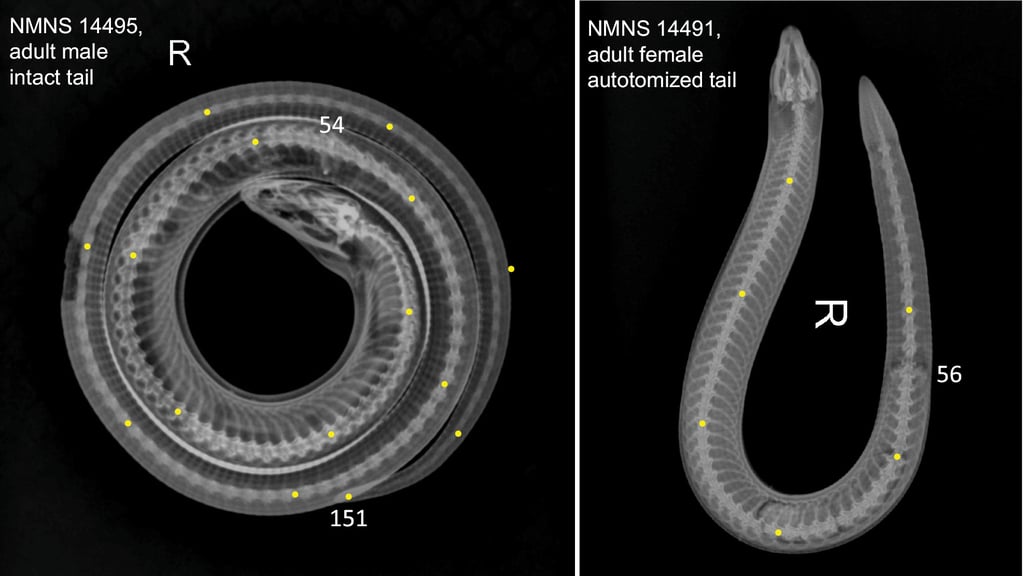 X-ray photographs used to determine the number of presacral vertebrae (VPS; from the atlas to the remnants of the hind limb bones), caudal vertebrae (VC; available only in specimens with an intact tail), and total vertebrae (VT; intact tail only). A. NMNS 14495, adult male with intact tail (VPS = 54, VT = 151); B. NMNS 14491, adult female with an autotomized tail (VPS = 56). Yellow dots mark every tenth vertebra to facilitate visualization of the counting procedure.
Credit: Dr. Yuan-Peng Kuan, Bright Exotic Animal Hospital.