
James Burrows is the rare figure for whom the word legend seems woefully insufficient. A sitcom veteran whose credits stretch all the way back to The Mary Tyler Moore Show, he was, with one exception, nominated for an Emmy every year between 1980 and 2005—a period during which he directed 237 episodes of Cheers and shot the pilots for Friends, Frasier, and Will & Grace. His 2022 memoir, Directed by James Burrows, overflows with casually dispensed bits of wisdom—it’s the multicamera equivalent of Sidney Lumet’s Making Movies—and reveals him to be not just one of the most successful but one of the most thoughtful craftsmen the television medium has ever known.
And yet, it’s one of his rare on-camera roles that gets him stopped on the street. As he said on an HBO podcast a couple of weeks ago, when people come up to tell him they love his work, he’ll respond with a self-effacing, “Thank you, thank you—yeah, I did Cheers, I did Friends.” And they’ll say, “No, I loved you on The Comeback.”
Burrows’ role on The Comeback, where he plays a thinly veiled version of himself, isn’t a big one. Over the course of the HBO sitcom’s three seasons, which have materialized once a decade since 2005, he’s only appeared in eight episodes, sometimes for no more than a single scene. And yet he serves a critical function in its overarching story about the travails of an aging TV actress, one that’s made his brief appearances both memorable and often surprisingly moving. As co-creator Michael Patrick King puts it, “Jimmy represents the truth.”
Although Burrows talks about “Jimmy the director” as if there’s a distinction, his Comeback character is deeply informed by his real-life history, not just in the industry but with the show’s star, Lisa Kudrow. As Michael Schulman’s recent Kudrow profile for the New Yorker points out, Burrows helped cement Kudrow in the role that would change her life, flying the entire cast of Friends to Las Vegas after they finished shooting the pilot for what he informed them would be their last taste of anonymity. But he also directed the original pilot for Frasier, where Kudrow was cast and then replaced in the role of the hard-charging radio producer Roz, which eventually went to Peri Gilpin. According to Directed By, when he was gearing up for the Friends pilot, word got back to Burrows that Kudrow had been expressing her displeasure behind his back: “That fucking Jimmy Burrows is directing the show?”
Time has borne out Burrows’ judgement. And on The Comeback, his unofficial role is that of TV-industry sage. In the show’s first season, Kudrow’s washed-up sitcom star, Valerie Cherish, gets a shot at re-grasping the brass ring when she’s cast on a show called Room and Bored. She’s thrilled to learn that Jimmy will be directing the pilot, but has trouble adjusting to the fact that she’s no longer the sexy young lead she was on her breakthrough show, an ’80s workplace comedy called I’m It! In the imagination of the Room and Bored writers, two frat-boy hotshots in their 20s, a woman in her 40s can only be a dried-up old hag, and the more Valerie tries to fight for her character’s dignity, the more they douse her in humiliation. (At one point, Valerie’s Aunt Sassy busts in on the show’s real star, played by Malin Akerman, getting a tongue bath from an adorable puppy, and the writers have her yell, “I haven’t been licked like that since 1943!”) Jimmy knows there’s no saving this show, but he also knows Valerie is only hurting herself by trying to buck the egos of its creators, for whom she represents exactly the kind of corny, heavy-handed comedy they’re trying to distinguish themselves from. When she protests that the writers on I’m It! always took her notes, Jimmy pulls her aside, because he realizes he’s the only person in her life who will level with her. “You know what?” he tells her. “You’re not it anymore.”
Burrows, who, with his longtime creative partners Glen and Les Charles, was instrumental in reorienting American sitcoms around ongoing storylines with greater emotional investment, was put off at first by The Comeback’s caustic tone. He recalls asking King, who he knew from the latter’s days in the Will and Grace writers’ room, “She gets shit on at every moment—can she have a moment of redemption?” King responded, “No. I don’t do that.” But Burrows’ character has often been the series’ vehicle for those hard-won moments, which are like tiny cups of water in an emotional marathon.
In the second season, Valerie reinvents herself as a serious actress, starring on a prestige drama about a sitcom writer struggling with his heroin addiction and his show’s temperamental star. Valerie’s not crazy about the job, in part because the new show’s creator is one of Room and Bored’s writers and the character she’s playing is plainly an unflattering caricature of herself. But she perseveres, even as her marriage is falling apart and her beloved hairstylist, Mickey (Robert Michael Morris), is struggling with health issues. By the end of the season, she’s made it all the way to an Emmy nomination, but she ends up at the awards ceremony alone, because Mickey’s in the hospital and her husband has moved out. Desperate for someone to share her moment of glory with, she makes a beeline for her old pal, Jimmy. They’ve never really been close—she has to remind Jimmy of her husband’s name—but when she implies that the nomination makes up for all her personal sacrifices, he takes the opportunity to set her straight, telling her, “It’s important, but it’s not as important as that. This is one night. A great night. But only one night.” Valerie takes the hint: She runs to Mickey’s bedside, where her husband is pleasantly shocked to see her pass up professional validation to care for someone she loves. (Because this satire of Hollywood is still a product of it, she wins the Emmy anyway.)
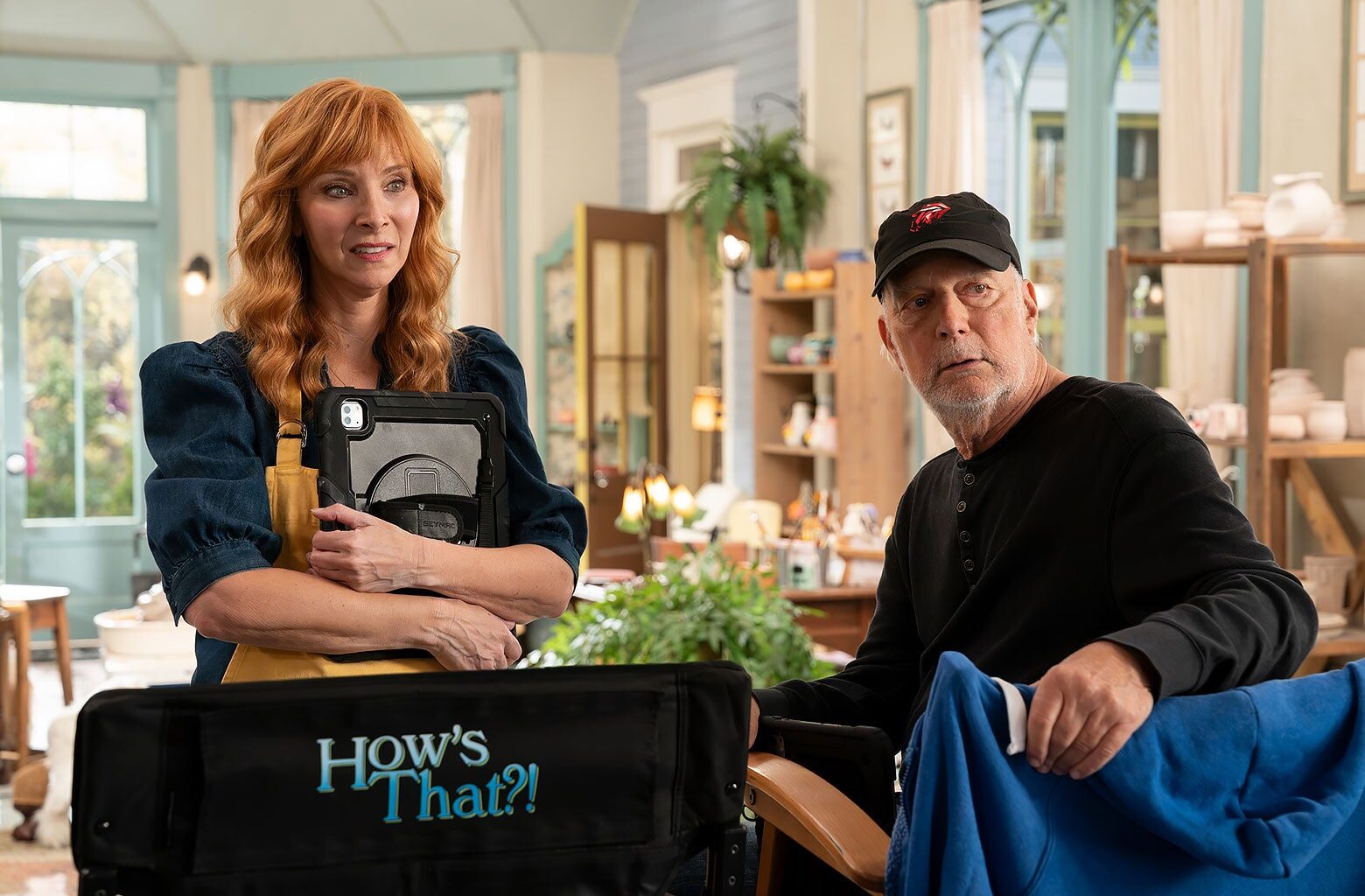
The Comeback’s third and final season brings Jimmy the director face to face with an existential threat to his livelihood: generative A.I. Valerie’s latest vehicle is a show called How’s That?!, which will be the first TV show written entirely by A.I. Jimmy, who Valerie coaxes out of retirement to direct the pilot, is startled when he learns the closely guarded secret behind the show’s authorship, and more so when he first sees the A.I. at work. “Well, that’s upsetting,” he remarks after it acts to fill in a missing character beat in the pilot script. “That machine wrote a pretty good scene in 10 minutes.” Given that the season opens with the 2023 Writers Guild strike, which was propelled in part by fears that the studios would use A.I. to replace human writers, his response generates a frisson of real alarm—if A.I. can write a scene good enough for James Burrows, maybe we really are in trouble.
One of Music’s Biggest Stars Delivered a Divisive Coachella Performance. Critics Are Missing the Point.
She Changed the Way Women Have Sex. Decades Later, Her Impact Can Still Be Felt.
If you know James Burrows is one of the greats, though, that “pretty good” is a dead giveaway. In this season’s fourth episode, which aired on Sunday, Valerie shoots the pilot for How’s That?! in front of a live audience, where the “blow”—the big final joke that’s meant to tie a bow on the cold open—audibly falls flat. The showrunners, a married couple (John Early and Abbi Jacobson) who are essentially putting up a false front in order to keep the writers’ union in the dark, want to move on; it’s funny enough, and besides, they’ve got a sitter waiting at home. But Jimmy won’t have it. This is the first scene of the first episode, and if it doesn’t end with a big laugh, the audience is gone. Within seconds, the A.I. generates a dozen alternatives, and Jimmy selects No. 4, which draws enough of an appreciative chuckle for him to call it a wrap.
It’s gone about as well as it can go, and Valerie is eager to get Jimmy to commit to further episodes. But he’s done—with the show, and maybe, if this is the way things are going to go, with television itself. Val protests, “But tonight was so good!” And Jimmy responds with a monologue that is as close as this slippery, acidic show has come to laying its cards on the table:
Good, but never gonna be great. … The machine is fast and cooperative. I’ll give it that. But I saw every one of those jokes coming, and so did you. Surprising only comes from a group of writers huddled in a corner, beating themselves up to beat out a better joke. The chubby guy who’s a secret alcoholic. It’s the gay guy who, despite all the work he’s done, still hates himself a little. Or the funny woman who’s been invisible for way too long. They turn all that pain into a joke. Those broken, beautiful souls are what make something great. And you didn’t see it coming.
As King admits, this is almost embarrassingly on the nose, a writer making a self-interested case for the importance of human writers. It helps, in a way, that Burrows isn’t an actor, that he’s disinclined to—and possibly incapable of—milking the emotion out of his big speech. Its weight comes from King’s writing and Burrows’ unmatched experience. No one is better qualified to judge what separates a serviceable sitcom from a genuinely inspired one, the pretty good from the great.
It’s not clear that Burrows, whose autobiography is full of happy sets and lifelong friendships, puts any stock in the notion that you have to suffer to make something great. There’s a kind of mythological tautology to the idea that comedy can only come from pain—pain which A.I. is definitionally incapable of experiencing. But Burrows does say that the unhappiness of his parents’ divorce is part of what drove him to create such happy onscreen families, whether or not the characters were related by blood.

Sam Adams
He Created One of the Most Beloved Comedies of the 2010s. Now He’s Finally Back With a New Show.
Read More
Over the decades, The Comeback has become as much a show about the fate of the sitcom as it is the trials and triumphs of its beleaguered heroine. Like Valerie, the show has changed with the times, tweaking its format and framing to take on the most pressing threat to the comedic half-hour’s existence: reality TV, prestige drama, A.I. But Burrows has always been true to the classic multicamera format, with its broad and bawdy humor, its primal connection to a live studio audience that just wants 20-odd minutes of relief. And he concludes, finally, that if the industry is content to turn out inhuman mediocrities, he’d just as soon take his leave. He’s got a “fun clause” in his contract, he tells Valerie, and this isn’t fun anymore.
Valerie ignores him, of course. The season is only half over, and she still has things to learn. But Jimmy has taught her everything he has to teach. From here on out, the mistakes are all hers.
Get the best of movies, TV, books, music, and more.