
 Paleontologist John Moretti searching for fossils in the stream that flows through Bender’s Cave. Credit: John Moretti.
Deep beneath the limestone of Central Texas, an underground stream has yielded a submerged menagerie. Paleontologists snorkeled through the pitch-black waters of Bender’s Cave and found a trove of fossilized bones belonging to massive, bizarre creatures that stalked the earth hundreds of thousands of years ago.
Based on other Late Pleistocene sites in Central Texas, paleontologists always envisioned a cool, relatively dry, and open grassland. The fossil record from Bender’s Cave, however, introduces a striking contrast. It includes giant armadillo relatives and giant tortoises—species that require significantly warmer temperatures to thrive.
Alongside them, the researchers found the remains of mastodons and giant ground sloths, which depended on forested habitats. Finding these species together suggests that the area likely experienced a warmer, forested interglacial period roughly 100,000 years ago.
A Submerged Pleistocene Graveyard
The journey into Bender’s Cave began when local caver John Young started exploring it. It is a treacherous, difficult-to-access environment, completely cut off from the surface save for a few narrow sinkhole shafts.
Once inside the dark waters, Young encountered a vast array of bones. He quickly relayed his findings to John Moretti, a vertebrate paleontologist at the University of Texas at Austin.
“[Young] kept sending me photo after photo of bones he was finding in there, wanting to know what they were,” Moretti told Texas Monthly.
Moretti decided to join the underground expedition. Between March 2023 and November 2024, the two men embarked on six demanding trips into the cavern. Equipped with wet suits, goggles, and snorkels, they scoured the submerged clays of the stream bed. They did not need to excavate the fossils from heavy rock as the bones were resting openly on the floor.
The sheer volume of the remains was staggering.
×
Thank you! One more thing…
Please check your inbox and confirm your subscription.
“There were fossils everywhere, just everywhere, in a way that I haven’t seen in any other cave,” Moretti noted in a statement. “It was just bones all over the floor.”
Giants of a Lost Forest
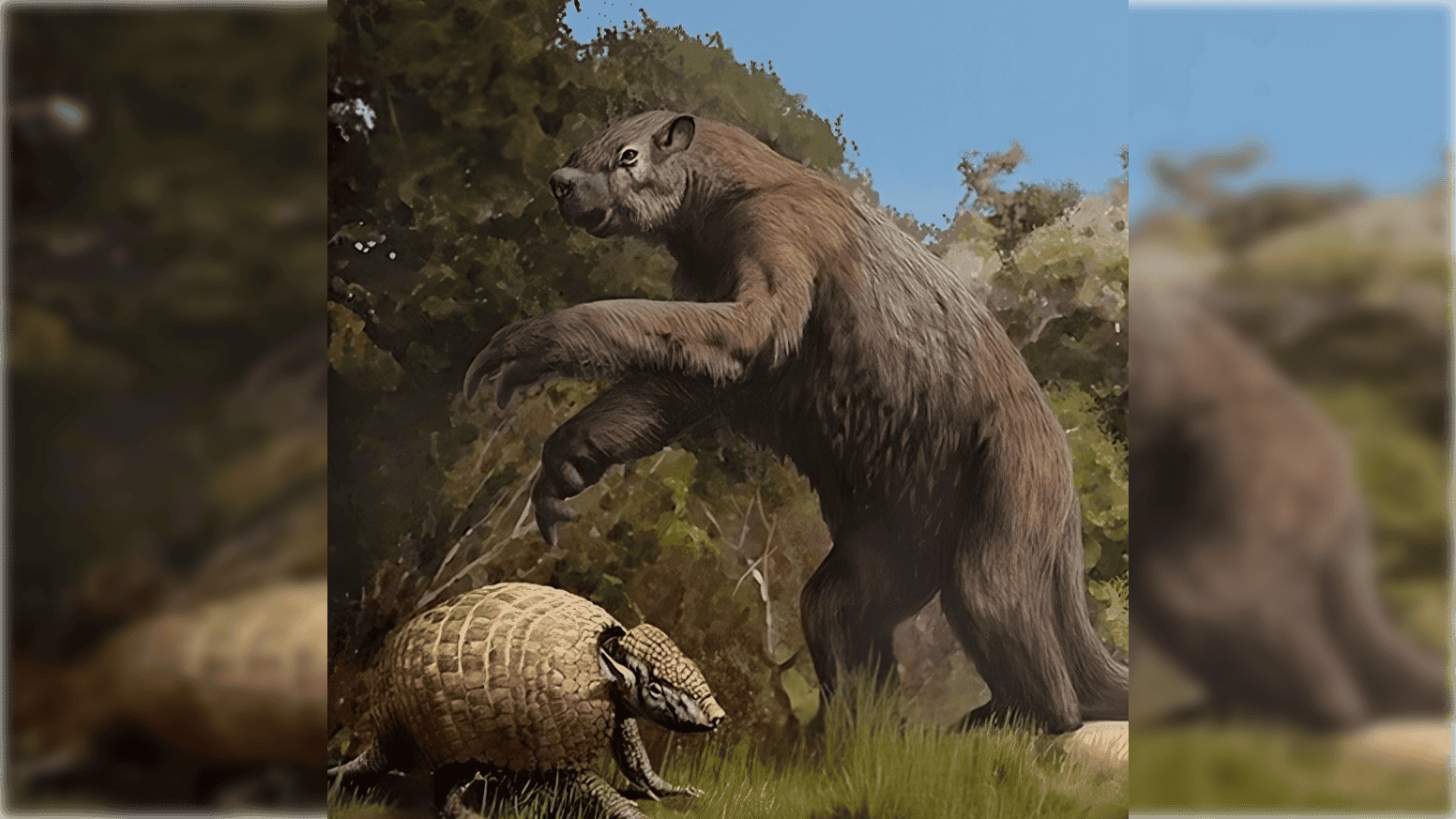
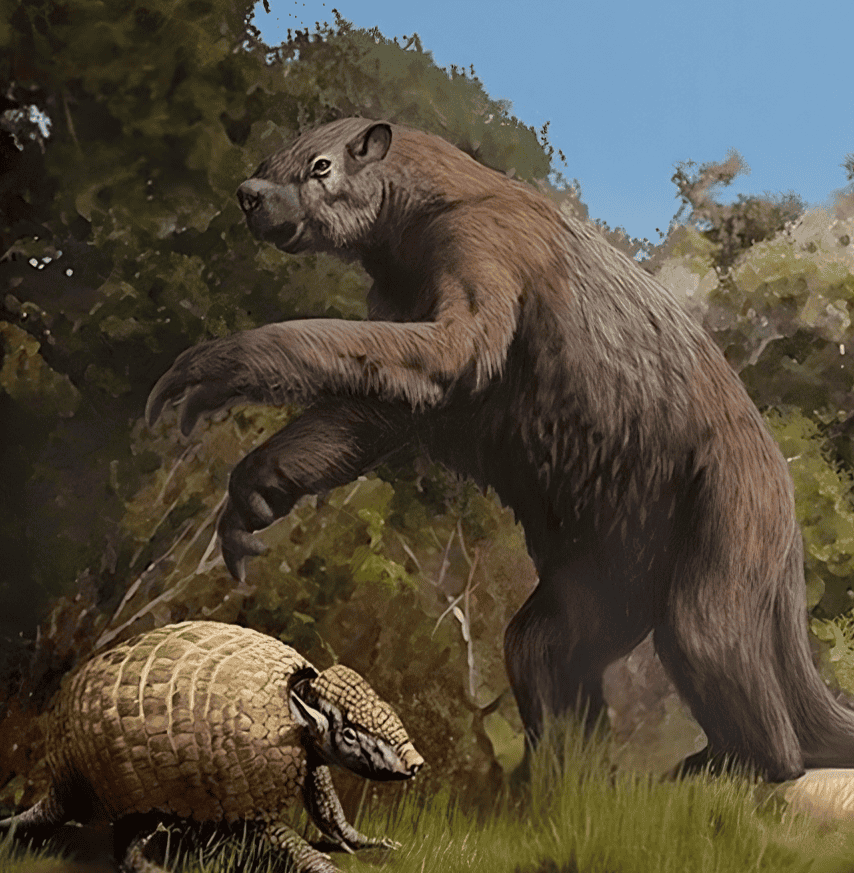 Artist’s interpretation of an armadillo-like pampathere and giant ground sloth similar to the ones found in the cave. Credit: Jaime Chirinos
The team cataloged specimens across 21 different zones of the cavern. They pulled out teeth from mammoths and mastodons, the remains of ancient horses, and the bones of camel relatives known as Camelops. They even recovered a specialized, meat-shearing cheek tooth—along with skull and neck fragments—of a scimitar-toothed cat, Homotherium serum.
But the most startling recoveries belonged to a quartet of anomalous giants. The researchers identified fragments of Hesperotestudo—a massive tortoise that could grow up to 5 feet in length and weigh over 1,100 pounds—and Megalonyx jeffersonii, an extinct ground sloth that stretched nearly 10 feet long and weighed up to 2,200 pounds. They also found the intricate armor plates of a pampathere called Holmesina septentrionalis, a lumbering cousin of the modern armadillo that could grow to the size of a lion.
You’d expect to find this kind of mega fauna in a chilly Pleistocene grassland. Mastodons and ground sloths relied on dense, woody forests for their food. Giant tortoises and pampatheres, meanwhile, required consistently warm, subtropical temperatures to thrive.
 Hesperotestudo replica. Credit: Wikimedia Commons
David Ledesma, a paleontologist at St. Edwards University who was not involved in the research, expressed surprise.
“Some of the fossils that John has come across are species that we didn’t think would occur in this part of Texas,” Ledesma said. “That we’re still learning new things and finding new things is quite exciting.”
The researchers theorize that these creatures perished on the surface and their remains eventually washed down through sinkholes during heavy floods. Inside the cave, mineral-rich groundwater coated the bones, preserving them with a rusty, red finish.
Cracking the Geologic Clock
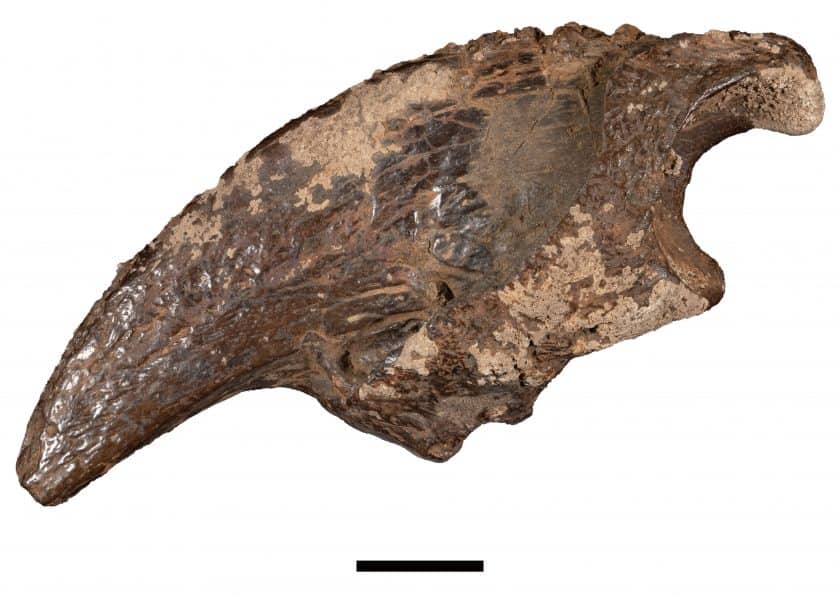 A fossil claw from the giant ground sloth Megalonyx found in a Texas water cave. Scale bar is two centimeters. Credit: John Moretti/The University of Texas
Determining exactly when these creatures lived is not straightforward. The very water that preserved the fossils also washed away their delicate organic signatures. Paleontologists typically rely on collagen proteins within bones to conduct radiocarbon dating.
Unfortunately, the Bender’s Cave fossils lack collagen entirely. Furthermore, the bones absorbed old carbon and secondary carbonates from the surrounding limestone aquifer, heavily contaminating them and rendering standard dating techniques unreliable.
To bypass this roadblock, the team is shifting its focus to the environment holding the bones. They plan to use uranium-thorium dating on the calcite crusts that formed directly on the fossils, which will provide a minimum age for when the remains washed into the subterranean stream.
Even without a precise timestamp, the ecological clues point toward a specific epoch. The unique assemblage strongly aligns with the last interglacial period, an era approximately 100,000 years ago when global temperatures spiked, but the authors say firm dating is still needed. Statistical analyses group the Bender’s Cave fossils with known interglacial sites near Dallas and the Gulf Coast, rather than the younger, colder sites typical of Central Texas.
“These connections and partnerships make possible a lot of the natural science that gets done in Texas,” Moretti emphasized. “It takes contributions from everyone—not just scientists at universities—to learn about the natural world we live in and depend on.”
 Scale from the shell of a pampathere. Credit: John Moretti / The University of Texas
As researchers work to confirm the dates, the fossils already suggest that Central Texas may have hosted a more varied set of Late Pleistocene habitats than previously recognized.
The study was published in the journal Quaternary Research.