
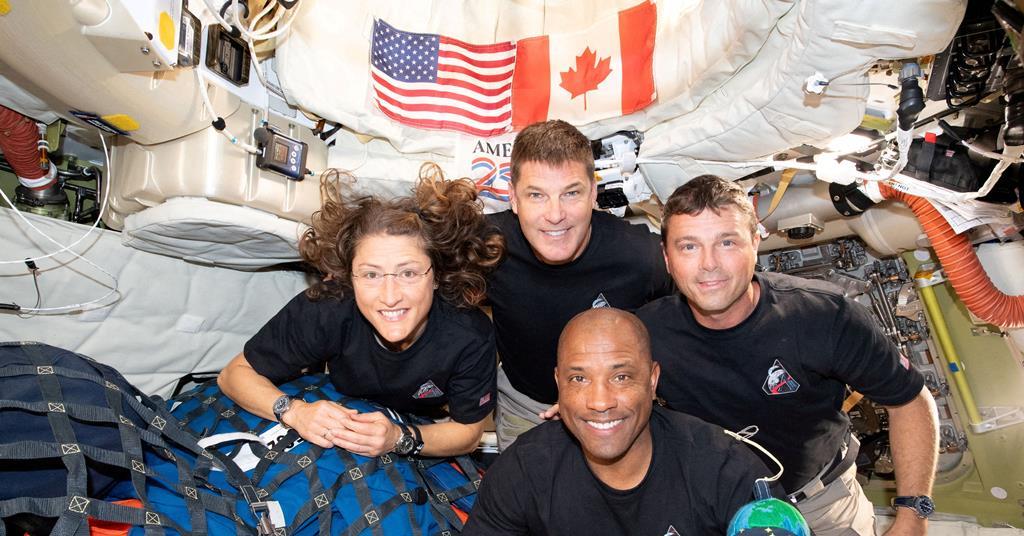
It was a big week for science as the Artemis II mission launched, passed by the far side of the Moon, and successfully returned to Earth, all within a span of ten days. The mission took four astronauts 252,756 miles from Earth, the furthest we as a species have ever travelled.
The purpose of the Artemis mission, which cost an estimated $93bn, was to prepare for humans to live and work on the Moon as a precursor to establishing human settlements on Mars, and there are various suggested benefits to that. Economically, there are possibilities for mineral extraction and testing new technologies; geopolitically, there are advantages to staking a claim on valuable lunar sites before a rival nation; and from an existential perspective, creating human colonies in space makes it more likely that human life could survive a catastrophe on out own planet.
But the motivation of the astronauts themselves, and how they reacted to the experience, was much more personal and profound than that.
The overview effect
One mission specialist, Christina Koch, became an astronaut because “I love things that make me feel small. I love contemplating the vastness of the universe and our place in it.” This references the ‘overview effect’, a sentiment common among astronauts who have seen the Earth from space and feel awed and humbled by their experience.
After returning from the Artemis II mission, Koch expanded on this reflection: “I found myself noticing not only the beauty of the Earth, but how much blackness there was around it, and how it just made it even more special. It truly emphasised how alike we are, how the same thing keeps every single person on planet Earth alive.”
Victor Glover, the craft’s pilot, is a practising Christian. He took a Bible with him to the moon, and NASA revealed that the daily playlist to which the astronauts awoke included ’Good morning’ by Christian artists Mandisa and TobyMac. For Glover, the mission was an opportunity to share a message of unity. Over Easter, he spoke of seeing the “beauty of creation” and “all the amazing things that were done for us”, revealed in the Bible. In his last broadcast before losing radio contact with NASA as they travelled around the far side of the Moon, Glover reminded listeners around the world of the importance of love.
“I would like to remind you of one of the more important mysteries there is on Earth. Christ said in response to what is the greatest command, is to love God with all that you are. And, equal to that, is to love your neighbour as yourself. So, as we prepare to go out of radio communication, we still feel your love from Earth, and to all of you down there on Earth, and around Earth, we love you from the Moon.” It was a message he repeated to the crowds who gathered to welcome him home.
God’s creation
We might expect to hear such a strong expression of faith in church; it’s more surprising to hear it in the context of a space mission. Shouldn’t scientists be neutral, objective and detached from their emotions?
Recently, I spent time at NASA’s jet propulsion laboratory in Pasadena. Speaking with scientists there, I found the opposite: there was a deep joy among them for scientific exploration, and genuine wrestling with the ethical questions that accompany it.
For those who were Christians, these questions were grounded in the knowledge that the universe is God’s creation, and science is given by God to explore and take delight in this creation.
Our innate curiosity, which we explore through science, is part of being made in God’s image, and should be used with God’s values of compassion and justice. There need be no separation between our humanity, our spirituality and our scientific endeavours.
The Artemis II mission was a reminder of another aspect of Christian theology, which is exemplified during the Easter season. Humans are not only beings of mind and soul, but of flesh and blood. In Jesus, we see a God who communicates with humanity through incarnation, by becoming a human being.
Even if robots and sensors could explore the universe for us, relieving us of the risk (and the plumbing issues) of deep space travel, there is something important and human about stepping on to the surface of other worlds ourselves, of seeing our planetary home at a distance, and of returning to family and community with new eyes of wonder and appreciation.
However advanced our technology, however bold our geopolitical aims, in the end it is love and fellowship that sustains us – wherever in the universe we find ourselves.
This article was co-written with Helen Billam, communications manager for the ECLAS project