
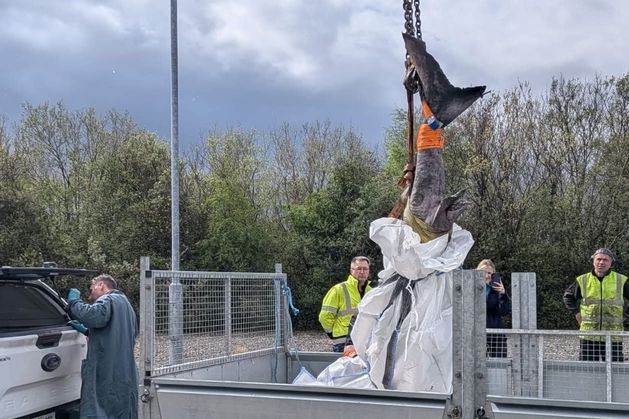
Sharks are known to reach sexual maturity around 150 years of age – and give birth to their pups live after a gestation period of eight to eighteen years
The discovery of the 3-metre-long Greenland shark (Somniosus microcephalus) is the first recorded stranding of this species on the Irish coast.
The specimen was initially reported by members of the Irish Whale and Dolphin Group (IWDG), who notified the National Museum of Ireland after discovering the animal in a difficult-to-access part of the coast.
Due to the challenging terrain and the threat posed by incoming tides, an urgent multi-agency response was coordinated with the Regional Veterinary Laboratory Sligo, Department of Agriculture, Food and the Marine (DAFM), Sligo County Council, the Harbour Master, members of the IWDG, and a number of academic and independent researchers.
The shark is now undergoing detailed scientific post mortem examination, contributing valuable data to the understanding of this elusive deep-water species. Tissue samples and selected anatomical components are being preserved as part of the National Museum’s scientific collections, ensuring a permanent record of this exceptional specimen.
The Greenland shark, known for its extreme longevity and deep-sea habits, is exceptionally rare in Irish waters, and this stranding represents a significant opportunity for research into its biology, health, and ecology.
Subject to the condition of the skin and its suitability for preservation, the National Museum hopes to display the specimen in the future, which would allow visitors to learn more about one of the world’s most mysterious shark species and the scientific work undertaken to study it.
The National Museum has expressed its gratitude to all partner organisations and individuals involved for their swift cooperation and expertise in preserving this nationally significant specimen.
In a post on their Facebook page, the Irish Whale and Dolphin Group said:
“On the evening of Saturday April 11, the IDWG Live stranding hotline got a report of a dead Greenland Shark.
“The Greenland Shark is the longest vertebrate in the world with a life span of several centuries; the oldest recorded recorded specimen was over half a millenium in age.
“They are a large species, they typically reach lengths of four to six metres.
“Little is known about the elusive Greenland Shark in Ireland, and it is native to deep and remote waters of the Arctic and North Atlantic.
“However, they are known to reach sexual maturity around 150 years of age and give birth to their pups live after a gestation period of eight to eighteen years.
“At 2.87 metres, this male individual in Sligo had very developed claspers, perhaps on the brink of maturity.
“We would like to thank finders Hammad Chaudhry and James Winters O’Donnell for reporting the stranding to IWDG and providing photos of the animal amd its GPS location, Taylor Chapple of Big Fish Lab for a positive ID, IWDG volunteers Rossa Meade and Darren Craig who secured the shark with help from Monica Sullivan, Noel Rafferty and Ruth Hannify and thanks to Sligo County Council for providing access.”
Sophie Bresnihan, Co-Ordinator of Sligo IWDG congratulated all concerned.
“On Sunday it was really thanks to volunteers in the Irish Whale and Dolphin Group who secured the shark as the tide would have just washed it back out.”