
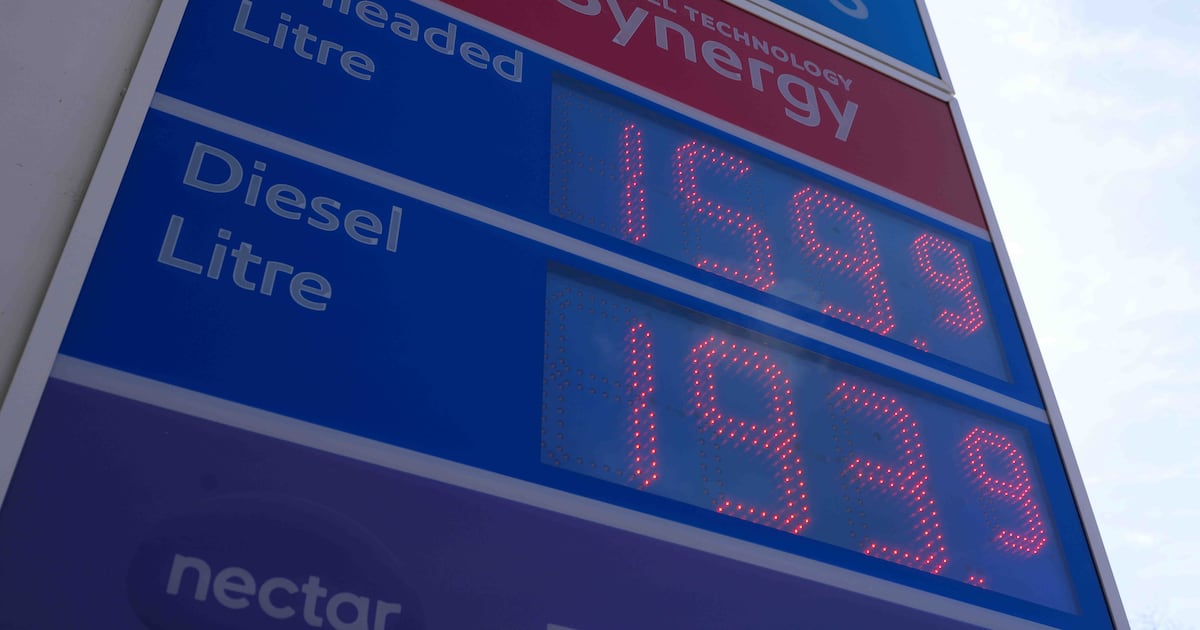
How do Ireland’s fuel supports measure up against other countries in Europe?
Well, we are the best in the class, according to Taoiseach Micheál Martin.
Really? It’s not like us to be the best when it comes to the price of anything.
It really isn’t, but in the Dáil this week the Taoiseach said the Government’s response to the crisis amounts to “proportionately the largest assistance package of any European country”. He claimed the “closest any country comes is Spain, where the support package is over a quarter smaller. The packages in Germany and Poland are roughly 90 per cent lower than the supports we are implementing. As for Northern Ireland, the actions taken by the Executive and the British government combined are a fraction of what we are implementing.”
Well that sounds all right. And is there hard data to support this bold claim?
Well, no. We did ask the Taoiseach’s office if it could provide us with any. A spokesman said: “There is no official central data on the scale of measures adopted by countries.”
Publicly available data for the total packages for Germany, Poland and Spain were assessed and compared those on a per capita basis with the package announced for Ireland.
“This showed that compared with those countries, the Irish figure of approximately €145-€155 per capita was significantly higher than Germany and Poland and also somewhat higher than the Spanish figure.”
So, what are other countries doing then? Is the German government’s offering really 90 per cent meaner than our Government’s?
That is an interesting question, for sure, and it probably depends on how you look at it.
It could be argued that the word “proportionately” in the Taoiseach’s statement and “per capita” in his spokesman’s response are doing a lot of heavy lifting. The measures rolled out here will cost around €750 million, so on a per capita basis we are certainly outperforming our peers across Europe. But a per capita basis doesn’t really paint the full picture.
It doesn’t?
Look at it this way: the top-line measures rolled out by the Government are the 27 cent cut in the duty attached to a litre of petrol and the 32 cent cut in the tax on a litre of diesel. That averages 29.5 cent – and while it is certainly better than the 17 cent cut in a litre of fuel announced by the Germans, it is by no means more than 90 per cent better, which is what the Taoiseach claimed.
Okay, so that is Germany. What about other places?
Well, the Spanish have introduced a tax cut that is effectively worth 30 cent per litre, putting that country on a par with Ireland. If a typical motorist uses 1,100 litres of fuel a year, the annualised impact of the Irish moves are worth about €324 while the cuts in Spain are worth €330, making them marginally better off.
But the British have done nothing, right?
Yes and no. But mostly yes. Martin is absolutely correct to say that the British government has introduced no new measures in response to the current crisis. But the British did cut the excise duty on a litre of fuel by just under 6 cent in 2022 in the wake of Russia’s invasion of Ukraine and have yet to revert to the higher rate. Ireland also cut excise duty in response to that crisis but reverted to the normal rate in April 2024. That means the British have benefited from an additional two years of lower excise, and that has been worth about €132 to the typical motorist there. It is certainly less than what the Irish Government has done in recent weeks, but it is not nothing.
Anywhere else doing anything comparable to Ireland?
Yes, as it happens. The Italians have cut the tax on petrol and diesel by 25 cent in the short term; if it was annualised, it would amount to a saving of €275 for the typical motorist.
Hungary has not reduced prices, but set an upper limit on how much a litre of petrol or diesel can cost – with the former capped at €1.54 per litre and the latter capped at €1.59.
Poland, which Martin said was offering supports that were 90 per cent less than Ireland’s, has cut the VAT on fuel from 23 per cent to 8 per cent, and cut excise duty, with the reductions costing the State about €370 million a month.