
The phrase “cottage industry” is sometimes deployed for the type of TV show that clusters within a larger oeuvre. One might, for example, cite the current surge of travel shows about celebs going to Italy, which has so far seen Stanley Tucci, Gino D’Acampo, Francesco da Mosto, Clive Myrie, Giovanna Fletcher, Alex Polizzi – I’m not finished yet – Alan Carr and Amanda Holden, Andrew Graham-Dixon and James May all front programmes about Italy this decade alone.
And then there are those individuals who have become not just a cottage industry but a genre unto themselves. In this bracket we would be forced to place Gordon Ramsay, whose new show, Gordon Ramsay’s Secret Service (Channel 4, Monday), may seem strikingly familiar to fans of everything else he has ever done (one exception being the slightly more sedate travelogue he did with D’Acampo and Fred Sirieix, in which they travelled around, er, Italy).
In Secret Service, the TV chef uncovers scurrilous kitchen crimes – nightmares, you might even call them – in a series of family-owned restaurants across the United States, checking for culinary shortcuts, unsafe conditions and horrible hygiene issues.
But this time there’s a twist. The problem, Ramsay explains, is that he’s so famous that the very sight of him – the world’s most famous shouter-at-of-restaurant-staff – immediately puts eateries on high alert, and the only way he can bypass this effect is by going in under the cover of darkness.
This is meant literally, as the show’s first minutes document Ramsay sneaking around the closed premises of Parthenon, a once-famous Greek restaurant in Washington, DC, that has fallen on hard times. He snoops around the kitchen soundtracked by what you might call espionage techno, armed with a blacklight and an extremely unforgiving frown.
He illuminates queasy splatters of food waste on every surface, plate and utensil, steps in horrid pools of stagnant, clumpy water and discovers an oven that has been left on overnight.
This all serves as little more than a queasy starter, however, as we then follow Ramsay to the basement, where he swabs surfaces and machinery for bacteria. Firing up his electronic germ-counter while the music from Tom Clancy’s Splinter Cell on the PlayStation 2 saws away in the background, he tells us that an unflushed toilet will register at 1,400 on its bacteria scale.
When the screen bleeps back with 5,550, we delight at the knowledge that his shouting muscles are no doubt flexing as we speak.
But, no, our confrontation must wait, for he’s too busy packaging up samples for later analysis, installing hidden cameras and careening around the darkened premises in night vision, swearing at the drear and detritus he sees around him.
[ Patrick Freyne: From Fargo to The Den, these reboots were made for gawkingOpens in new window ]
Even as night turns to day, our thirst for a good ol’-timey Ramsay bollocking is not sated, for a further twist is revealed. The staff of Parthenon believe they are the subject of a documentary called Restaurant Refresh, and they have therefore allowed cameras everywhere in their premises.
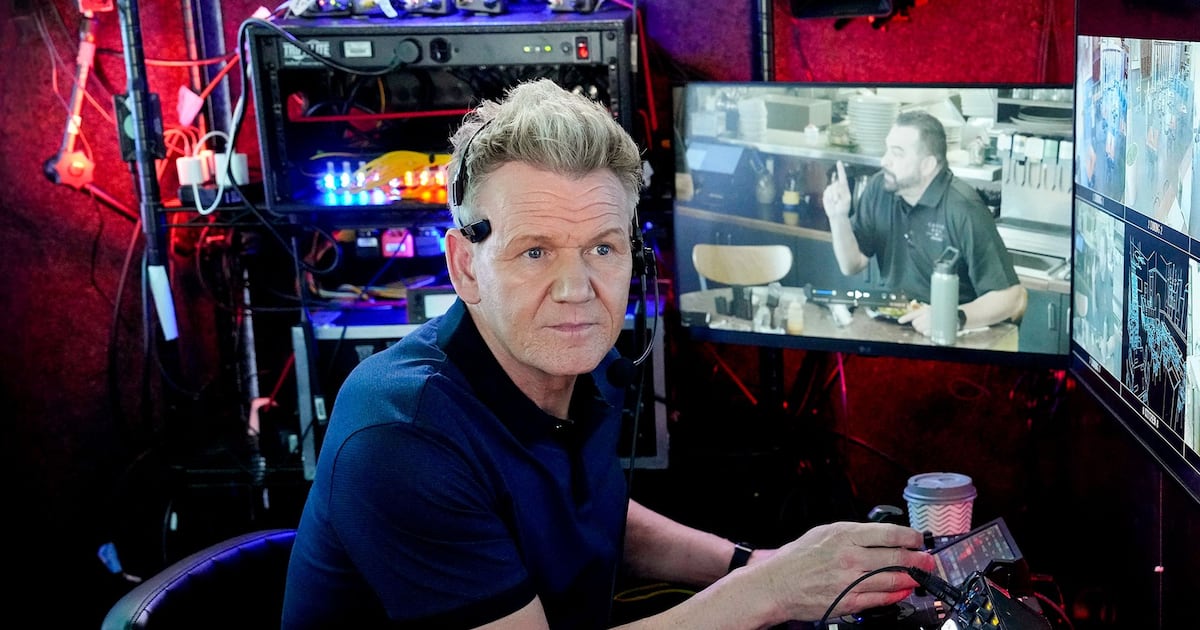
These Gordon will now watch, all day, from an FBI-style surveillance van that bears more than a passing resemblance to the Tactics Truck, Andy Townsend’s short-lived but much-missed statistical-analysis vehicle.
What follows is precisely what you’d expect. Staff are useless and Ramsay swears a lot – it’s just that he mostly does so on his own in the dark or inside a truck.
Just before the halfway point, after hosting a microbiologist in his van and deploying a duo of top chefs as secret diners, Ramsay can resist no longer. “I’ve seen enough – I’m on my way,” he says, like a special-ops sniper moving in on a hostage-taker.
“Stop what you’re doing – right now!” he exclaims to staff as he bursts in the back entrance, all but flashing an FBI badge. Things take an even more beautifully surreal turn as he moves to the dining area and tells patrons to “gather your things and exit the restaurant, please”, in a tenor that suggests he has found a bomb in a cupboard.
[ My name is Séamas O’Reilly – or at least I thought it was until recentlyOpens in new window ]
From there the show mutates into the standard Kitchen Nightmares format – part confrontation, part cookery course, part renovation, part tearful group-therapy session – leaving us to wonder why any of this subterfuge was necessary.
The notion that the sight of Ramsay puts restaurant staff on their best behaviour would make a kind of intuitive sense were it not for the fact that his decades-long career in American television consists almost exclusively of him proving that the opposite is the case.
One might also quibble with the premise that the best way to get these restaurants to drop their guard is to simply pretend they’re filming a different restaurant-makeover show, which nevertheless requires constant surveillance from dozens of cameras that record their every move.
All of which is to think too hard about a show that resists such efforts with the sheer force of its inane thrills. In the wider oeuvre of television shows, this is supremely stupid fare. But in the genre of Gordon Ramsay shows, this is truly excellent stuff.
If Ramsay is his own cottage industry, others are more like multinational conglomerates. The Beatles industrial complex has provided us with more documentaries about the Fab Four than one might reasonably expect of a band that recorded music together for seven years. Wikipedia lists at least 33 full-length films, not counting dramatic works but including Get Back, Peter Jackson’s eight-hour opus, and Man on the Run, this year’s solo Paul McCartney doc from Morgan Neville.
At first blush, therefore, McCartney: The Hunt for the Lost Bass (BBC Two, Saturday) may conjure within your mind the distinct sound of a barrel being scraped. The McGuffin this time is McCartney’s famous 1961 Hofner bass guitar, which accompanied him for the entirety of his Beatles career before disappearing entirely in 1972.
 Paul McCartney in McCartney: The Lost Bass. Photograph: Passion Pictures/BBC
What could be the slightest conceivable topic for a documentary is, thankfully, elevated by a knotty crime caper that remains compelling even if the stakes never exactly rise to cold-war levels.
It’s a handsomely mounted documentary, featuring Elvis Costello, Klaus Voormann and McCartney himself, and though the obligatory speed through Beatles history is likely unavoidable – one imagines it’s written in a contract somewhere that we simply must see black-and-white footage of the band playing in the Cavern Club, then arriving to screaming fans in 1960s New York – it’s handled briskly and with care, allowing the rest of the film to follow an agreeably shaggy story of unlikely sleuths and odd gossip.
It’s a tale that takes in Bavarian luthiers, small-time crooks and the prog superstars Hawkwind before it comes to its stirring conclusion.
There are still absurdities here. There’s an involuntary jerk towards overstatement when one hears a contributor utter a sentence like: “It’s the most important bass, of any bass, ever, anywhere.” But The Hunt for the Lost Bass somehow surmounts the low stakes of its mission by making its quixotic venture seem a little more tongue in cheek, and a lot more rewarding, than it has any right to be, not least in its final moments of sweetness and resolution.
If only the bass had shown up in Italy, alas. I know 12 people who could have been there like a shot.