
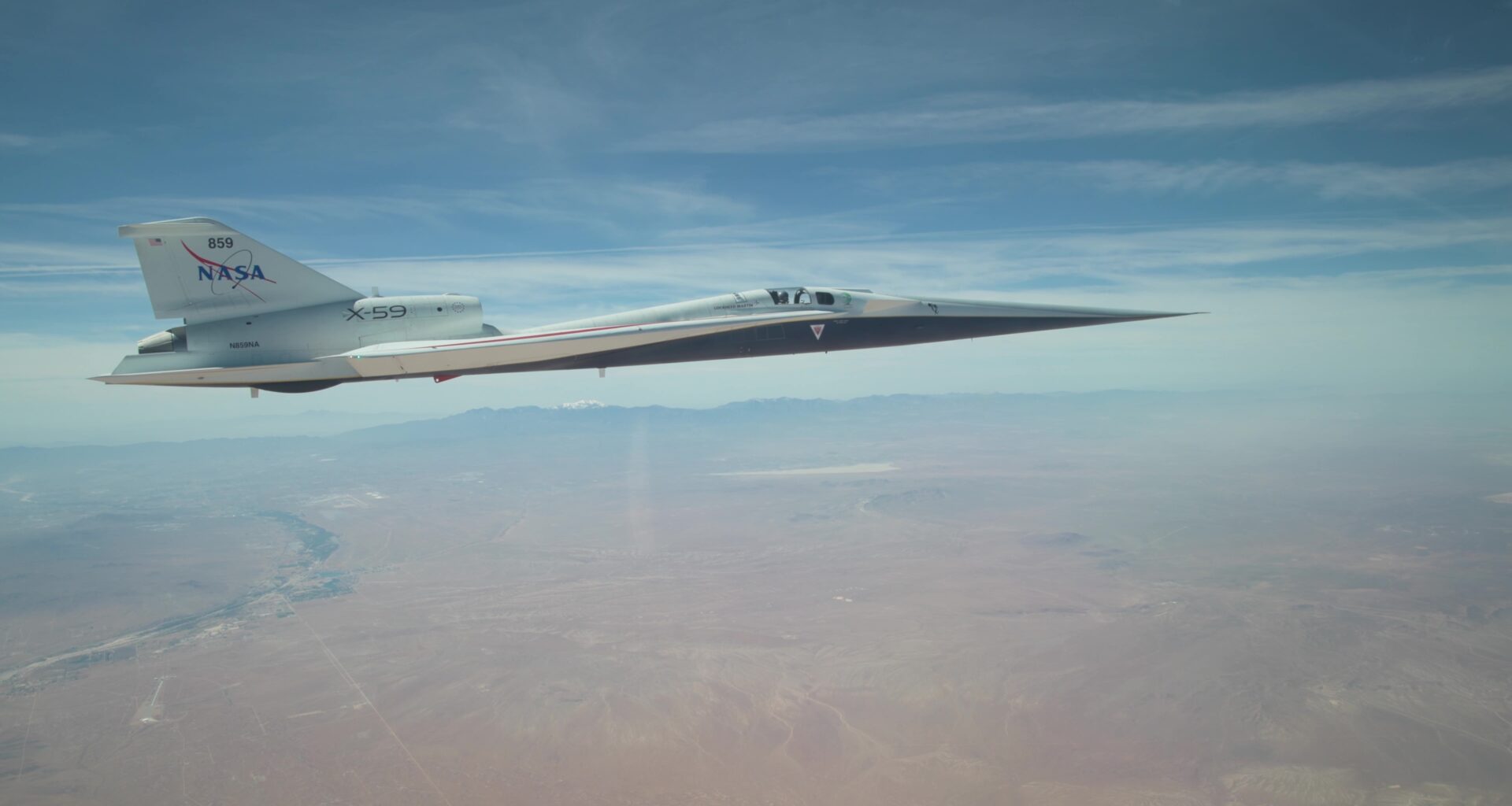
As NASA’s X-59 quiet supersonic jet takes to the air, its sleek configuration is now on display thanks to a key milestone it reached in April – flying wheels-up. The transition marks an important step in the aircraft’s testing.
Experimental aircraft typically make their earliest test flights with the landing gear down, then begin retracting it after successfully meeting performance benchmarks. The X-59 flew wheels-up for the first time April 3.
Piloted by NASA test pilot Jim “Clue” Less, the aircraft departed from its home base at NASA’s Armstrong Flight Research Center in Edwards, California, and flew for 90 minutes, reaching a maximum altitude of 20,000 feet and a top speed of approximately 460 mph.
Flying with the landing gear up allows the team to examine the performance of the X-59’s streamlined profile, which is a key design element ensuring the X-59 can fly faster than the speed of sound with just a quiet thump instead of a loud sonic boom.
The X-59 has made eight flights as of April 10 as it continues its test flight envelope expansion campaign. The X-59 is at the center of NASA’s Quesst mission to enable quiet commercial supersonic flight over land.
More X-59 to Explore
AERONAUTICS RESEARCH MISSION
Quesst
Quesst is the name of NASA Aeronautics’ mission to help take the first step toward enabling commercial, faster-than-sound air travel over land. The centerpiece of the mission is NASA’s X-59 research aircraft. The experimental supersonic jet is designed with technology that reduces the loudness of a sonic boom to a gentle thump. NASA will fly the X-59 over select U.S. communities and take surveys to record what people think of the quieter sonic thumps. The human response data will be delivered to U.S. and international regulators, who will consider setting new rules that allow supersonic flight over land.
Stay up to date at the Quesst mission page

April 15, 2026 12:38PM