
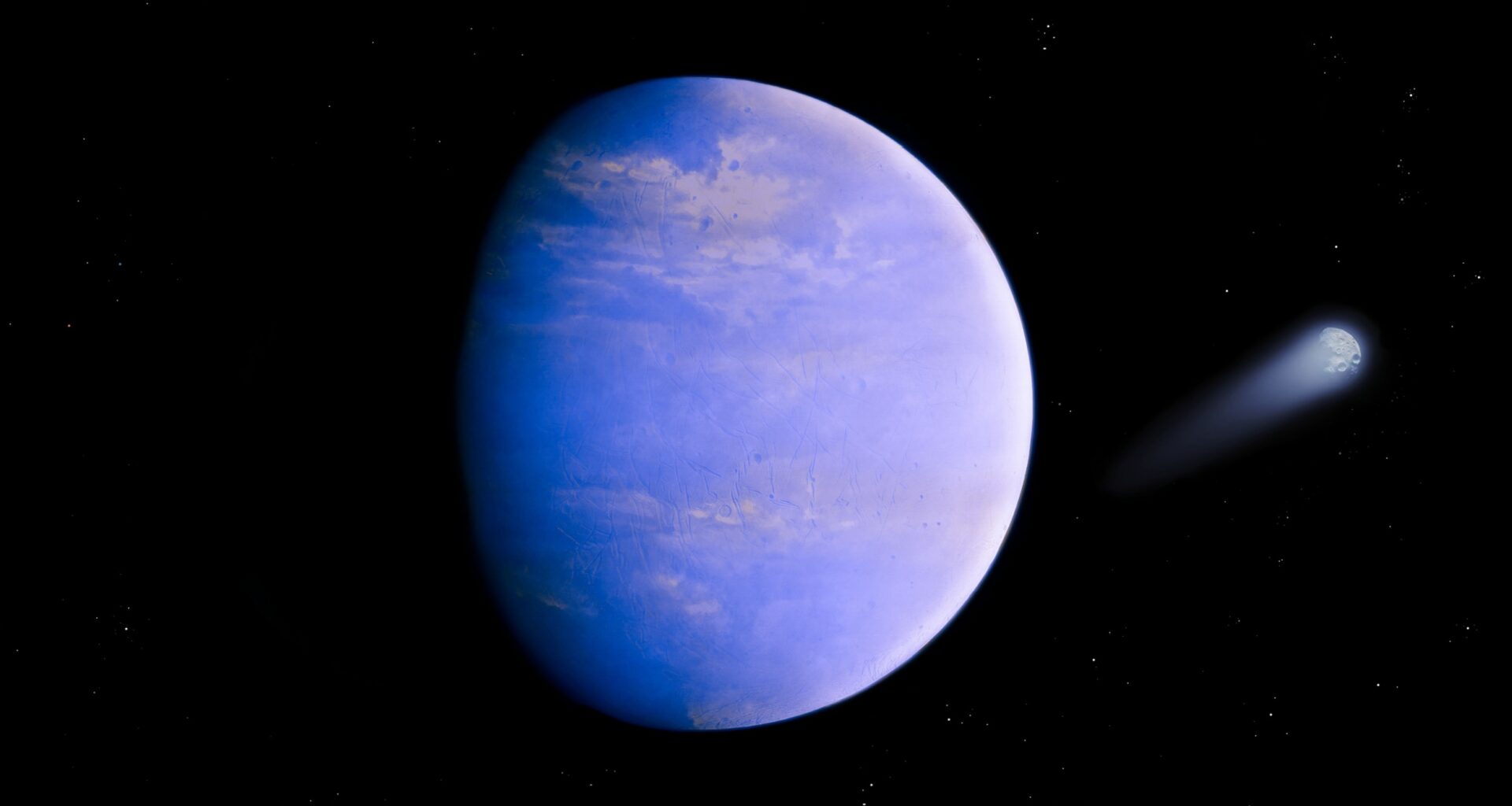
Water has long been the shortcut for spotting potentially habitable worlds. If a planet is in the habitable zone and shows signs of liquid water, it is often treated as a strong candidate for life.
But that simple rule may be missing something important. New research suggests that some Earth-sized planets can have water and still fail, simply because they do not have enough of it to keep their climate balanced.

Instead of staying mild, those worlds may drift toward long-term warming, narrowing the search for truly habitable planets.
When rain starts to fade
In the driest modeled worlds, rainfall weakened first, and the chemistry that usually cools a planet started failing soon after.
By tracing that chain, researchers at the University of Washington, showed how dry worlds tip into overheating.
Even planets that begin with surface water can cross that threshold as declining rainfall reduces the planet’s ability to remove carbon from the air.
That breakdown leaves a narrow margin where water can still stabilize the climate, setting up the conditions explored in the next section.
Planets with a steady climate
The geologic carbon cycle – the slow exchange of carbon between air and rock – helps regulate the climate on wetter rocky planets.
Rain absorbs carbon dioxide, reacts with rock, and carries carbon away, where geology can bury it for ages.
Volcanoes later return some of that gas, so stable conditions depend on removal and release staying close together.
Once those flows stop matching, heat-trapping carbon dioxide begins building faster than the planet can remove it.
Dry conditions drive change
As surface water dwindles and rainfall declines, weathering – the rain-driven breakdown of rock that helps lock away carbon – begins to weaken.
Meanwhile, volcanoes can keep releasing carbon dioxide, so the atmosphere warms while the surface grows less able to respond.
More heating shifts remaining water into vapor, which leaves less liquid behind to drive rain, rivers, and new reactions.
That feedback can turn a small water shortfall into a slide toward a planet too hot for surface water.
Venus shows what went wrong
Venus now bakes near 872 degrees Fahrenheit under pressure about 93 times that of Earth, making it the clearest nearby warning of how a similar planet can go wrong.
The new work suggests one possible reason. If Venus started out drier than Earth, weak rainfall may have collapsed its carbon cycle early, preventing the kind of long-term climate balance that keeps temperatures stable.
That idea does not prove Venus once had oceans, but it offers a clear path for how a near twin could diverge so dramatically. If it holds up, Venus becomes a practical lesson in how narrow long-term habitability may be.
A broader pattern emerges
The model results point to a broader pattern. The safest planets were not barely wet worlds with scattered seas and small lakes.
Instead, stable climates usually appeared only when planets held roughly 20 to 50 percent of Earth’s ocean mass.
That range matters because planets below it might still look promising from a distance, even as they quietly slip toward climate instability.
It also shifts the focus for future searches – water quantity, not just water presence, may be what separates truly habitable worlds from those that only seem that way.
The search for exoplanets
Astronomers have confirmed more than 6,100 exoplanets, and the total keeps rising, making triage unavoidable for the search archive.
Inside that crowd, the habitable zone, the orbital band where liquid surface water could persist, no longer looks generous.
“When you are searching for life in the broad landscape of the universe with limited resources, you have to filter out some planets,” said Haskelle White-Gianella, a doctoral student of Earth and space sciences at the University of Washington.
The research suggests that many dry worlds once treated as plausible may rank below wetter planets of similar size and temperature.
Telescopes sharpen the search
NASA’s Habitable Worlds Observatory mission is being designed to directly image potentially habitable planets around other stars.
If it can estimate ocean coverage and land fraction, astronomers could test whether the driest targets look as risky.
The telescope also aims to search for biosignatures, chemical hints that life may be present, in alien atmospheres.
A world that lacks enough water to keep its carbon cycle stable may never produce those signs under favorable sunlight.
Venus missions move forward
Closer to home, NASA’s Venus exploration plans include DAVINCI and VERITAS, built to probe the atmosphere and surface.
DAVINCI will sample the atmosphere for clues about ancient water, while VERITAS will map the surface and reconstruct geologic history.
“It’s very unlikely that we will land something on the surface of an exoplanet in our lifetime, but Venus – our next-door neighbor – is arguably the best exoplanet analog,” said White-Gianella.
Results from those missions could show whether Venus crossed the same dry threshold now being proposed for distant rocky worlds.
Fewer worlds meet the mark
Even strong results like this still come with limits, because the model does not resolve full weather systems or detailed coastlines.
That gap matters. On dry planets, rain may fall in only a few regions, leaving vast areas barren and unable to support stable surface water. At the same time, water hidden underground or locked away as ice in colder zones could shift how much liquid actually remains available.
Those unknowns may move the exact threshold, but they do not change the bigger picture – some worlds are simply too dry to stay habitable.
That realization is narrowing the search. Life-friendly planets now appear rarer in one key way, because they need not just liquid water, but enough of it in the right places.
Over the next decade, new telescope observations and missions to Venus should help reveal whether that hidden water budget ultimately decides which rocky worlds remain mild – and which ones never quite make it.
The study is published in The Planetary Science Journal.
—–
Like what you read? Subscribe to our newsletter for engaging articles, exclusive content, and the latest updates.
Check us out on EarthSnap, a free app brought to you by Eric Ralls and Earth.com.
—–