
Public health, explained: Sign up to receive Healthbeat’s free Atlanta newsletter here.
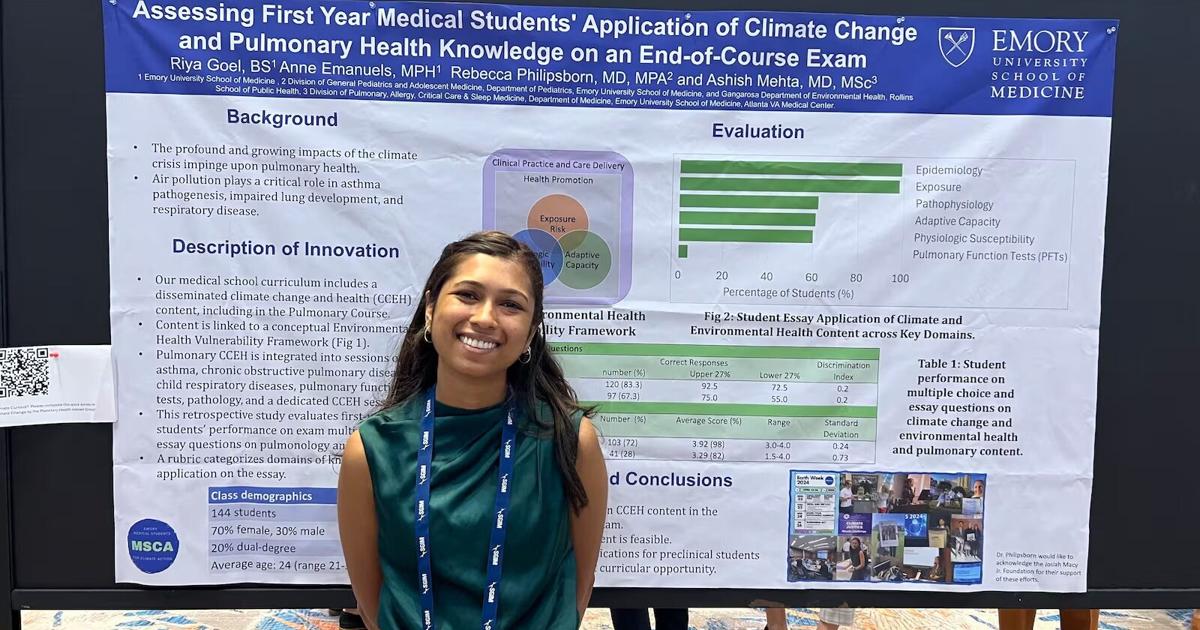
Medical student Riya Goel’s life has been shaped by climate change. She spent part of her childhood in Bangalore, India, where she experienced frequent asthma attacks, often requiring hospitalization, due to poor air quality.
Other stints living in California and Colorado exposed her to wildfire smoke. She learned firsthand about Atlanta’s extreme heat when she started medical school at Emory University, where she will graduate in May.
Those experiences sparked an interest in understanding the interaction between climate change and health. Goel has developed a resource for the Centers for Disease Control and Prevention that helps clinicians understand how heat could affect patients on commonly prescribed medications, from aspirin to antidepressants.
Many drugs can reduce patients’ ability to withstand higher temperatures. Some drugs increase sun sensitivity, and high heat can reduce the efficacy of some drugs.
Providers need to be aware of the heat risks of drugs so they can educate patients and help offset those, Goel said.
The resource provides information for clinicians about how heat impacts the body along with tips for educating patients. It then provides a list of more than 20 commonly prescribed drug classes and indicates how high heat can impact them.
For example, some common selective serotonin reuptake inhibitors, often prescribed for anxiety and depression, can increase sweating. Aspirin can make it harder for the body to release heat.
Diuretics, which are commonly prescribed for conditions like heart failure and high blood pressure, can cause dehydration, increasing the risk for falls in extreme heat. But the drugs are designed to remove fluid from the body, so increasing water intake isn’t necessarily a good solution. Ideally, people on diuretics would have access to cool environments, Goel said.
“We can be conferring risk even just by very basic prescriptions that we write for our patients,” Goel said.
She’d like to see more medications added to the CDC list, and she wants more clinicians to be aware of the potential interactions.
“A lot of current efforts, including CDC guidance, are focused on building that awareness,” she said.
The tool recommends that clinicians make a plan with their patients for days when the HeatRisk is orange, red, or magenta. HeatRisk is a National Weather Service tool that measures temperature, humidity, and other factors for locations across the United States to help people plan for high heat.
Goel created the medication list working with Dr. Laura Seeff at the CDC. The CDC provided Goel with an initial list of medications to research, and she started with a literature review before diving deeper into how heat can impact each drug.
“I remember just spending hours every day, researching and adding things to the Excel doc,” Goel said. She identified additional medications for the list through her research.
Despite her long interest in climate change and medicine, Goel said her research for the project revealed some facts she hadn’t known before. For example, inhalers like the one she uses for asthma can lose their potency if stored in high heat. They should be kept at room temperature.
Dr. Randall Tackett, a professor at the University of Georgia’s College of Pharmacy, said that kind of information is important for patients. He pointed out that many people get their prescriptions delivered by mail, and sitting outside on a porch or a driveway in hot weather could degrade some medications.
The CDC tool Goel created can be used anywhere but will be especially relevant in cities like Atlanta that have many high-temperature days.
“During the summers [in Atlanta], it’s extreme heat every single day, and there’s so many people on antihypertensives, anti-epileptics, anti-depressants, and they all kind of alter our physiology in ways that are really important to recognize,” Goel said.
The city experiences about two more weeks of high heat days than it did in 1970, Dr. Kristina Dahl, vice president for science at nonprofit Climate Central, told Healthbeat last year.
The effects can vary widely, depending on where people live in the city and their access to cooling. For example, citywide about 96% of homes have central air conditioning, but in some westside neighborhoods, that drops to 80%, a 2023 analysis by Georgia Tech Professor Brian Stone found.
Along with people who lack air conditioning, there are many other vulnerable groups, Goel said. They include:
Children
Elderly people
Unhoused people
People with certain mental illnesses or cognitive deficits
People who are immunocompromised
Pregnant people
Goel is especially passionate about that last group because she will start her OB-GYN residency at the University of California in Los Angeles in June.
Pregnant people have “decreased sweating abilities, because there’s just more fluid that’s needed to make sure the circulation is adequate, and they tend to put more fluid towards their extremities,” Goel said. “The way that they expel heat or absorb it is also different.”
Older people are also especially vulnerable, Tackett said, because age impacts the body’s ability to regulate heat. That can increase the risk of people fainting or falling, he said.
“There is always the chance of someone getting out into hot weather and developing heat prostration or fainting,” Tackett said.
Pharmacists want to counsel their patients about the medications they are dispensing, Tackett said, but often people are in a hurry and decline counseling. Patients who start taking a medication during the winter may not be aware that a medication could increase heat sensitivity, he said.
He encouraged patients to take the time to check in with their pharmacist or clinician to learn more about how their medications are impacted by heat.
Rebecca Grapevine is a reporter covering public health in Atlanta for Healthbeat. Contact Rebecca at rgrapevine@healthbeat.org.
Healthbeat is a nonprofit newsroom covering public health published by Civic News Company and KFF Health News. Sign up for their newsletters here.
Want Decaturish delivered to your inbox every day?
Sign up for our free newsletter by clicking
here.
Support Decaturish by making a contribution today.
Visit here to learn more.