
Does art’s importance depend on its context or simply on the expression itself?
A photocopy stapled to a telephone pole — is it more or less “art” than a traditional oil painting or sculpture displayed in a gallery?
A new exhibition at Mulberry Art Studios seeks the answer.
“Is This Art?: The Collected Works of Donald Shoffstall” debuted during April’s First Friday celebration in Lancaster city.
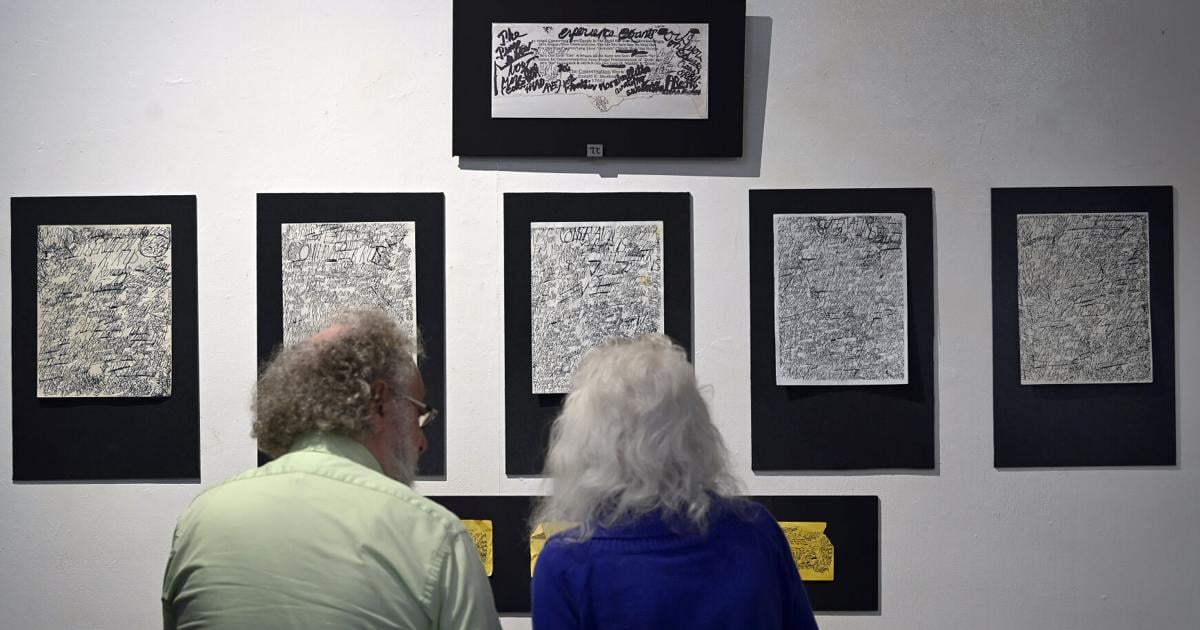
In the late 20th century, Shoffstall created signs and posters, mostly photocopies in a typical 8.5-by-11-inch format, and hung them on telephone poles throughout Lancaster city. His expression came through words, scribbled urgently across paper closely together, sometimes overlapping, in waves and lines flowing in what appear to be random directions. His writings don’t adhere to the typical conventions of writing and seem to be akin to stream of consciousness.
A work by Donald Shoffstall.
“The only unifying element is a distinctive cursive style suggestive of abstract expressionism,” the exhibitions curators say in their description of his work, which will be displayed posthumously at the gallery through the end of April.
“You couldn’t move around Lancaster sometime and not encounter one,” exhibit co-creator Steve Sylvester of Marticville says. “They were all over town. It wasn’t just one poster. For each of the things you saw, he may have made 30 or 40 copies of each one.”
Sylvester saved a few. He shared them with exhibition co-curator Jerry Greiner, of Lancaster, over a cup of coffee. To his surprise, Greiner also had saved a few of Shoffstall’s works. Greiner and Sylvester have been friends for decades but only recently became aware of their shared interest in Shoffstall’s messages.

“Why did Don Shoffstall shroud his messages to the community in complex graphic strokes?” Greiner asks in a description of the exhibit. “Also, why did he post his unique work on telephone poles? Don combined his messages, graphic style, and method-of-display into a form of expression—but did people recognize this as art? Did Don?”
Unfortunately, that answer can’t be known. Shoffstall died in Dauphin County in 2014.
Donald Shoffstall stands with one of his works in an undated photo.
Submitted
Born in 1946, Shoffstall attended Manheim Township schools and attended Penn State University. Soon after, Sylvester says, Shoffstall dealt with “a mixture of personal tragedy and emotional problems.” Sylvester didn’t give details, but according to newspaper archives, Shoffstall was involved in a 1973 crash that left someone dead and left him facing charges of involuntary manslaughter and driving under the influence.
For much of Shoffstall’s adulthood, he was homeless, Sylvester says, which led to “a lot of unfortunate encounters with society.” But, it was when Shoffstall was homeless that he created his art.
“Shoffstall was a man of the streets. He was both well-known and an invisible person. He would talk at everyone and spoke with no one,” a description of the exhibition says.
They met shortly after Shoffstall attended Penn State, Sylvester says, describing him as “a big personality.”
“Today, he would be perfect for shock radio, talk radio,” Sylvester says, “That booming voice. Very outgoing, very, ‘I want to be heard. This is my point.'”
IS IT ART?
Out of 26 people who filled out surveys during April’s First Friday event about whether Don Shoffstall’s works are art, 23 concluded that his works were art. Three people answered maybe, or kind of.
Here are anonymous comments that some attendees left:
— “The art of the visionary is hard to define, but easy to recognize. … Shoffstall is art unfiltered.”
— “Repetitive compulsive line drawings with a consistent message is often representative of naive outsider art. Since I experienced Don many times in person, I always knew he was consistent visually and in audio (talk) with his message.”
— “The man had an amazing sense of the world as he knew it, and he expressed himself accordingly, in chaos and his own reality. Wonderful.”
— “The thoughts of a man lay bare for the world to see. Perhaps a warning or prophecy! Very nicely done.”
His art wasn’t his only avenue to be heard. Greiner recalls stories of Shoffstall attending Quaker meetings, in which attendees are encouraged to stand and talk. Sometimes Shoffstall would talk for 20 minutes, uninterrupted, even if they didn’t understand what he was trying to say, Greiner says.
But in this exhibition, Greiner and Sylvester wanted to focus on Shoffstall’s art, not necessarily who Shoffstall was as a person. Most of Shoffstall’s closest relatives have died, and more distant relatives did not want to be involved with the process, Sylvester says.
“The fact that (Shoffstall) was on the fringe of things is 10% of the story. Ninety percent of the story is art,” Sylvester says. “Van Gogh, that man was as nutty as a fruitcake, but nobody talks about that part of life. They talk about his art.”
Sylvester and Greiner say they wanted to offer a different setting for the art – to bring the street art into the traditional gallery setting – to explore reactions.
“Seeing it on a telephone pole, do you react differently to it than when you see it in a gallery with some wine and cheese?” Sylvester asks.
They’re trying to see where they may be able to take the exhibition after its run at Mulberry Art Studios.
“He was trying to send a message,” Sylvester says. “If you’re just scratching on paper, it’s trash afterwards. But this was consciously meant for display.”