
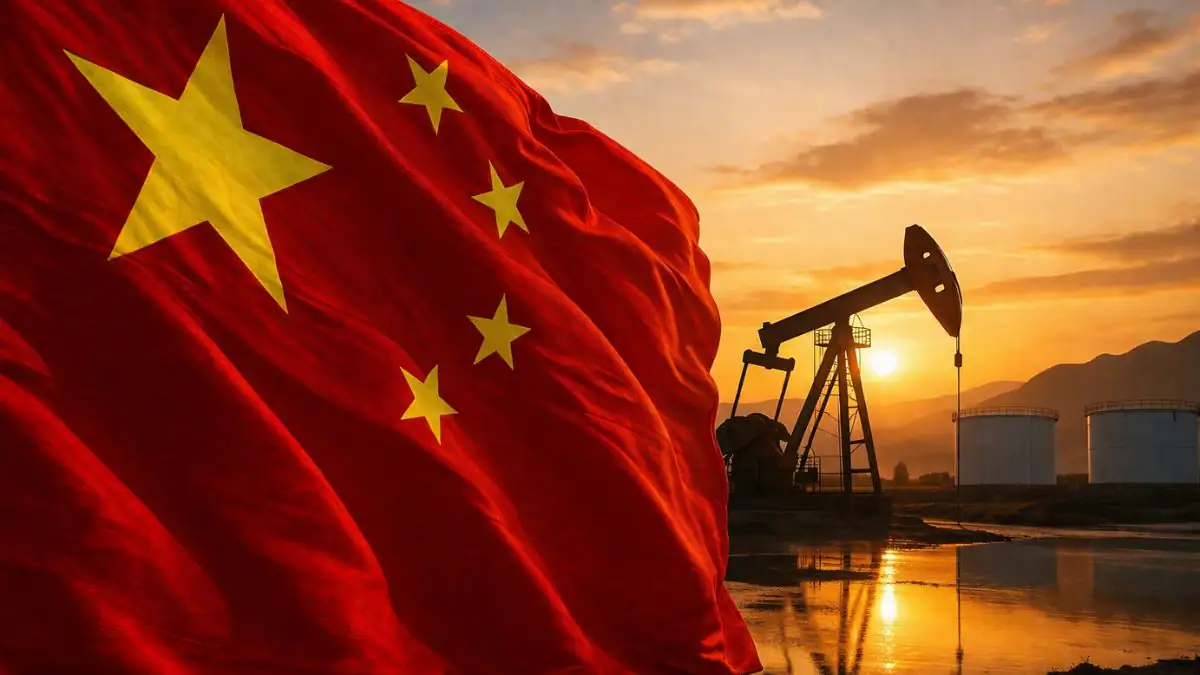
China’s longstanding image as the world’s most oil-dependent country is breaking away. The country is witnessing an unprecedented crude oil production surge that not only reflects an uptick but also China’s larger goal of reshaping its energy profile and ensuring energy security.
China’s crude oil output has climbed to nearly 4.8 million barrels per day, a Bloomberg report said, marking an all-time high. This is not a one-off oil production high. In fact, it reflects China’s major shift that took off way back in 2019, when China as a nation swung to action to aggressively boost its domestic oil exploration and production.
STORY CONTINUES BELOW THIS AD
While analysts point out that China remains the world’s largest oil importer, it is having a sprint against time to increasingly reduce its strategic vulnerability by pumping out more and more oil back home.
China’s oil production surge is policy-driven
China’s oil output has become less sensitive to global price cycles and more aligned with government-led energy security priorities since 2019, according to Oxford. This shift followed a directive from Chinese leadership to expand domestic oil and gas production, prompting state-owned firms to ramp up investment in upstream projects.
Capital expenditure by national oil companies surged after 2016 lows, leading to a delayed but sustained increase in output. Even during the pandemic, when global oil demand collapsed, China’s production continued to rise, highlighting the policy-driven nature of the expansion.
China outpacing sanctioned barrels
At the same time, China’s rising domestic output is putting its global sourcing into perspective. Even when combined, traditional discounted suppliers like Iran and Venezuela do not match China’s own production scale.
Iran’s output hovers around 3–3.5 million barrels per day, while Venezuela produces under 1 million barrels per day, meaning their combined supply is still broadly comparable to or below China’s current domestic output levels.
STORY CONTINUES BELOW THIS AD
This is significant as China has long relied on these sanctioned barrels to secure cheaper imports. Yet, as China pumps more at home, the relative importance of such external, geopolitically sensitive supplies is beginning to shrink, marking a subtle but important shift in the global oil balance.
Offshore boom and new growth regions
China’s production gains are being driven by a new set of oil provinces. According to Oxford, nearly 85 per cent of China’s oil output now comes from key regions such as Bohai Bay, the South China Sea, Xinjiang, and the Ordos Basin. This also explains why China has been aggressively assertive over sovereign control of the South China Sea, which is bordered by six other countries.
Offshore fields, especially Bohai Bay, have emerged as the largest contributors to incremental output, benefiting from relatively lower costs and favourable geology.
At the same time, onshore growth is being supported by shale and tight oil development in western regions. These gains are offsetting declines in older fields like Daqing and Shengli, which are being sustained through enhanced oil recovery techniques.
STORY CONTINUES BELOW THIS AD
Imports still high, but risks reduced
Despite rising domestic output, China continues to rely heavily on imports. China imported about 11.1 million barrels per day in 2024, according to the Center on Global Energy Policy at Columbia SIPA, accounting for roughly 74 per cent of its total oil consumption.
However, Beijing is actively managing this dependence. China has diversified its crude supply sources, increased purchases of discounted oil from sanctioned producers, and expanded its strategic petroleum reserves. The country now holds enough oil stocks to cover at least 96 days of imports, with the potential to extend this to over 180 days if storage is fully utilised.
Demand growth begins to slow
At the same time, China’s oil demand growth is moderating. According to Columbia SIPA, factors such as rising electric vehicle adoption, increased use of LNG trucks, and expansion of high-speed rail are reducing demand for gasoline and diesel.
These trends have already avoided an estimated 1.2 million barrels per day of additional oil demand since 2019, according to IEA estimates cited in the report. This shift means that even as production rises, the pressure from demand growth is easing.
STORY CONTINUES BELOW THIS AD
The latest data points to a more nuanced reality for China’s oil sector. The country remains heavily import-dependent, but rising domestic production, slowing demand growth, and expanding reserves are reducing its exposure to external shocks.
In effect, China is shifting from absolute dependence toward managed energy security, a transition that could have significant implications for global oil markets, trade flows, and geopolitical risk.
First Published:
April 17, 2026, 14:01 IST
HomeBusinessThe myth of China’s oil dependence is cracking: Record oil output signals a strategic shiftEnd of Article