
How to
Be Cultured Menu Art
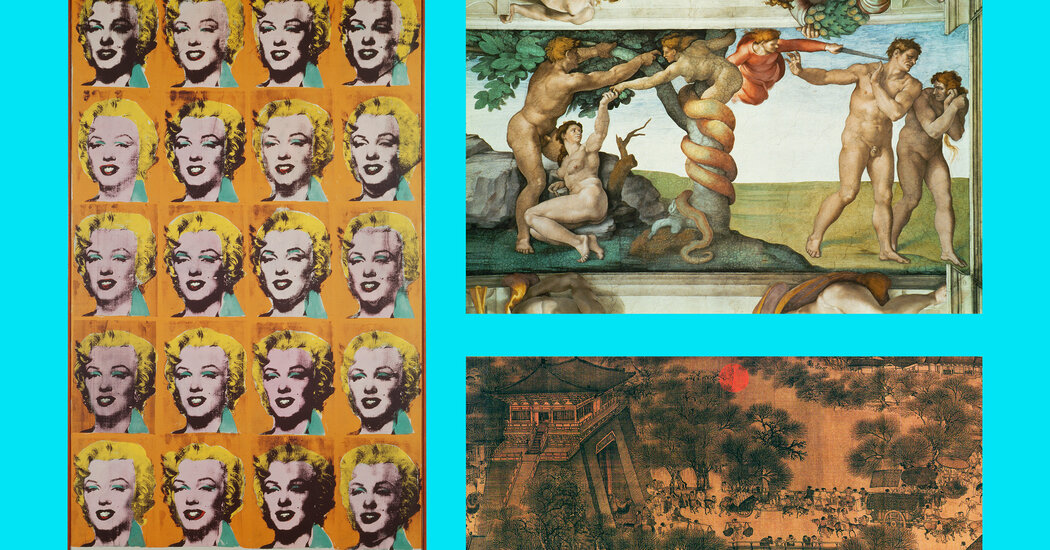
Scroll Painting
What it is: Believed to have developed during China’s Han dynasty (206 B.C.-A.D. 220), horizontal scroll paintings made from ink on paper or silk were designed to be viewed progressively as they unrolled.
Why it mattered: Almost as if they were watching a film, “viewers were physically activated as they looked,” says Anne Higonnet, 67, an art history professor at Barnard College and Columbia University.
How it developed: Scroll painting thrived in China and Japan from the 10th century A.D. onward, according to Higonnet; the ease of transporting them in rolls helped.
Famous examples: The Chinese painter Zhang Zeduan (1085-1145) captured daily life in intricate scrolls, while Wang Hui (1632-1717) revived the form of landscape scroll painting in the 17th century.
True Fresco
What it is: Egg tempera — pigment mixed with water and egg yolk — is applied to a wall coated with wet lime plaster. As the surface dries, it hardens, forming a protective barrier over the image.
Why it mattered: Fresco “encourages artists to imagine self-expression on an enormous, architectural scale,” Higonnet says. Plus: “The medium protected itself.”
How it developed: It was famously used in ancient Rome — notably in Pompeii — and revived during the Renaissance.
Famous examples: Michelangelo’s Sistine Chapel has to be deep cleaned “every once in a while — every 300 years,” Higonnet says.
Oil Paint
What it is: Made by suspending pigment in oil, the material replaced tempera in the mid-15th century as the medium of choice for European painters.
Why it mattered: Oil paint “allows for the absorption and the reflection of light, which helps create an illusion of depth,” explains Laura Hoptman, 64, the executive director of the Drawing Center in New York.
How it developed: “The first use of oil paint dates to the seventh century in Afghanistan, and it was also used in Greek and Roman times,” Hoptman says.
Famous examples: The 15th-century Flemish painter Jan van Eyck used it to create luminous altarpieces and portraits. The Venetian painters Titian and Tintoretto were among the first Italians to embrace the medium in the 16th century.
Canvas
What it is: Canvas — tightly woven and stretched linen or cotton — gradually replaced wood panels as the surface of choice for European painters over the course of the 15th century.
Why it mattered: “Paintings become lighter, less exposed to fluctuations in humidity and less fragile,” says Davide Gasparotto, 60, the senior curator of paintings at the Getty Museum in Los Angeles.
How it developed: Renaissance Venice was a hub for painting on canvas because the city’s humidity made it difficult to work with tempera on wood.
Famous examples: Early adopters included the Italian Renaissance artists Andrea Mantegna and Giovanni Bellini.
Linear Perspective
What it is: To create the illusion of three dimensions on a two-dimensional surface, artists place a vanishing point on the horizon line so that objects appear smaller the farther away they are from the viewer.
Why it mattered: The combination of canvas, oil paint and perspective enabled European artists to “create the most realistic reproduction of life,” Hoptman says.
How it developed: The Renaissance architect Filippo Brunelleschi is credited with advancing linear perspective in the early 15th century.
Famous examples: The use of linear perspective in Leonardo da Vinci’s “Last Supper” and Raphael’s “School of Athens” (1509-11) calls attention to the compositions’ central figures.
Commercially Available Paint
What it is: Paint was stored in animal bladders for more than 100 years, says Aimee Ng, 44, the chief curator of New York’s Frick Collection. But oil paint was not widely available in metal tubes until the mid-1800s.
Why it mattered: Because they no longer had to grind pigments or mix materials by hand, artists had more time to actually make paintings. Plus tubes kept paint fresh and made it easier to transport, allowing “artists like the Impressionists to go outdoors,” Ng says.
How it developed: The Industrial Revolution made it possible for pigments to be ground uniformly, produced at scale and distributed widely through rail networks.
Famous examples: Without commercially available paint, Vincent van Gogh wouldn’t have applied such thick daubs to “The Starry Night.” “You can only thickly apply paint when you have a lot of it,” says the curator and arts educator Sarah Urist Green, 46.
Acrylic Paint
What it is: A kind of paint made by suspending pigment in an emulsion of acrylic plastic and water. When it dries, it becomes water-resistant.
Why it mattered: Acrylic allowed for “more texture to appear on the surface” of the canvas, says Alexander Alberro, 56, an art history professor at Barnard College and Columbia University. “It’s cheaper and easier to use than oil.”
How it developed: Technicians created the material in the mid-1900s as they realized plastic could yield a paint that dried faster than oil.
Famous examples: Acrylic made painting accessible to the hobbyist. It also facilitated the bold, flat aesthetic of Pop Art. Proponents included the Abstract Expressionist Helen Frankenthaler and the British artist David Hockney.
Silk-Screen Painting
What it is: Ink is pushed through a stencil and a mesh screen onto canvas, enabling artists to render the same image in different colors.
Why it mattered: “It brings the photograph and the painterly together,” says Alberro.
How it developed: Originally employed for posters, signs and fabric designs in the early 1900s, the method was famously adopted by the Pop artist Andy Warhol in 1962.
Famous examples: Warhol used silk-screen painting to create his best-known works of Marilyn Monroe, Elvis Presley and Campbell’s Soup cans. Robert Rauschenberg mixed silk-screen and oil paint to create his “Retroactive” series, which contains images of John F. Kennedy, in 1963.
Barkcloth
What it is: Barkcloth is made by soaking the bark of a ficus tree in water and pounding it until it becomes a flat, pliable surface on which to paint.
Why it mattered: Barkcloth, unlike canvas, offers built-in textural interest. “The imperfections are part of what gives the painting character,” says Chika Okeke-Agulu, 59, a professor of art history at Princeton University.
How it developed: Having been used in Africa, Southeast Asia and Australia for thousands of years, barkcloth was revived at the Makerere University in Uganda in the 1960s and ’70s, when “artists were looking for non-Western techniques in the period of decolonization,” Okeke-Agulu says.
Famous examples: It’s mainly associated with the royal court of the Buganda Kingdom in modern-day Uganda, which used the material to make clothing and burial shrouds. More recently, contemporary artists like the British Kenyan painter Michael Armitage have embraced it as a painting surface in lieu of canvas.
These interviews have been edited and condensed.
American Land Art
Essential Museum Works
Is It Surreal?
Masks
Postwar Art
Conceptual Art Explained
Essential Pottery
Painting Movements
Intangible Art
What Is Performance Art?
Notorious Controversies