
The Tánaiste and Minister for Finance Simon Harris has said government responses to the energy crisis must be “fiscally responsible” amid warnings from the IMF about growing global indebtedness and the risk of higher public spending to offset rising fuel costs.
Mr Harris was signatory to a joint letter issued in Washington by 11 finance ministers in which they said they were “committed to managing the economic response to and recovery from this crisis in a coordinated, responsible and responsive way”.
The letter said: “With government balance sheets constrained, we commit to ensuring that any domestic responses must be fiscally responsible and targeted at those who most need support.”
The statement was issued by the finance ministers of Ireland, the UK, Australia, Japan, Sweden, Netherlands, Finland, Spain, Norway, Poland and New Zealand.
Welcoming the ceasefire and calling for the swift reopening of the Strait of Hormuz, ministers reaffirmed their commitment “to open and rules-based trade in energy products”.
They called on countries to avoid protectionist actions, including “unjustified export controls, stockpiling and other trade barriers in hydrocarbon and other supply chains affected by the crisis.”
In an interview with Financial Times, director of the IMF’s fiscal affairs department Rodrigo Valdés warned the EU against responding to the energy crisis by loosening its fiscal rules, saying member states should keep their “fiscal guardrails” in place.
“We think it will be very important to keep the rules in place for Europe and all countries,” Mr Valdés said.
“Given higher debt, given how markets have been behaving in the past few years, it’s important to keep those guardrails,” he added.
The IMF warned yesterday that in many parts of the world there had been “no meaningful progress in repairing budgets” in 2025 and that the window for “orderly fiscal adjustment” was narrowing.
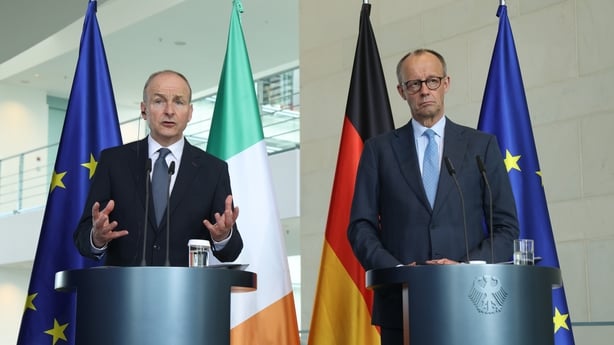
Micheál Martin and Friedrich Merz held a joint news conference in Berlin
During a joint news conference in Berlin with Taoiseach Micheál Martin, German Chancellor Friedrich Merz said: “We take the International Monetary Fund’s advice very seriously, both regarding the debt sustainability of European countries and developments in the capital markets, particularly with regard to government bonds.
“We can see that interest rates are rising slowly.
“We are also seeing this in Germany in the refinancing of our budget.
“We can see that the first rating agencies are beginning to issue a neutral outlook or a negative outlook, without actually downgrading at the moment.”
Standing beside the chancellor, Mr Martin said he agreed with the IMF’s general framework.
However, he said that “every member state government has to manage its political system, manage its politics and try to ease pressure on people and ease pressure on businesses.”
He said Ireland’s debt level had been on a downward trajectory in recent years “so we’re in a relatively resilient position”.
He added: “I use the word ‘relatively’ because, of course, as we discussed, this is very volatile and part of the government strategy all along was to hold back some resources in reserve if the situation in the Middle East deteriorates.”
The Taoiseach said Ireland was in a “reasonably robust” situation until the end of the year in terms of supply, but price had put huge pressure on people, with the war coming on top of Russia’s invasion of Ukraine and the Covid-19 pandemic.
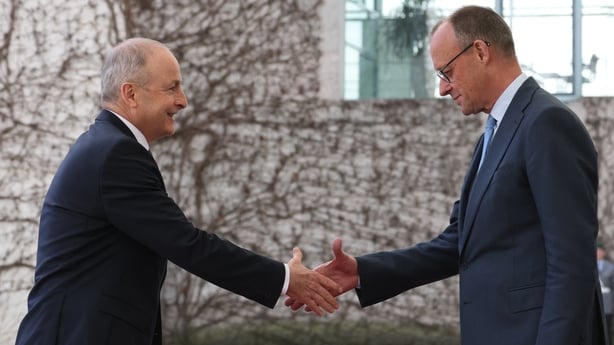
The Taoiseach and German Chancellor are discussing preparations for Ireland’s EU Council presidency
The Taoiseach is in the German capital meeting the German Chancellor as part of his programme of meetings with EU leaders ahead of Ireland’s Presidency of the EU Council.
The leaders are discussing preparations for Ireland’s presidency as well as bilateral relations and international issues.
Mr Martin is steadily meeting EU leaders individually ahead of Ireland assuming the presidency on 1 July.
Speaking at the conference, Mr Martin also said Ireland’s presidency of the EU Council will include a “strong focus on three overarching themes – competiveness, values and security”.
He added that “responding to the changed security landscape will also be a key focus of our presidency”, noting the war in Ukraine and the Middle East.
The Taoiseach said that “managing the disruption to energy supplies and the impacts of higher prices on our citizens and enterprises” is also a matter of “priorirty for governments across the European Union”.
“The chancellor and I took the opportunity to exchange notes on the measures we have been taking to manage that situation,” he added.
Next Wednesday, the European Commission will bring forward a fresh package of measures on fuel prices and leaders will address these on Thursday at an informal EU summit in Nicosia under the Cyprus presidency.
The two leaders share a determination to boost European competitiveness and to strengthen the EU’s single market.
But there are notable differences, including on how an EU-wide capital markets union should be supervised.
Following the meeting with Mr Merz, the Taoiseach will join other EU leaders on a video call convened by French President Emmanuel Macron to discuss online safety and the protection of children.