
Shift from “Taste” to “Price”
Changing Consumption Priorities Among Young People
Not a Choice, but a Calculation
“Survival Mode Meals” on the Rise
“Geojimap,” Group Purchases, and Shared Subscriptions
Saving on Food Becomes a
The number of people who agonize and make careful choices about every meal out, as if playing a “survival” game, is steadily increasing. With high prices persisting for a prolonged period, the dining habits of young people and office workers are changing rapidly. In particular, as the cost of eating out has risen to over 10,000 won per meal, people are now choosing meals based on “price” rather than preference or taste, engaging in so-called “survival-style dining.”

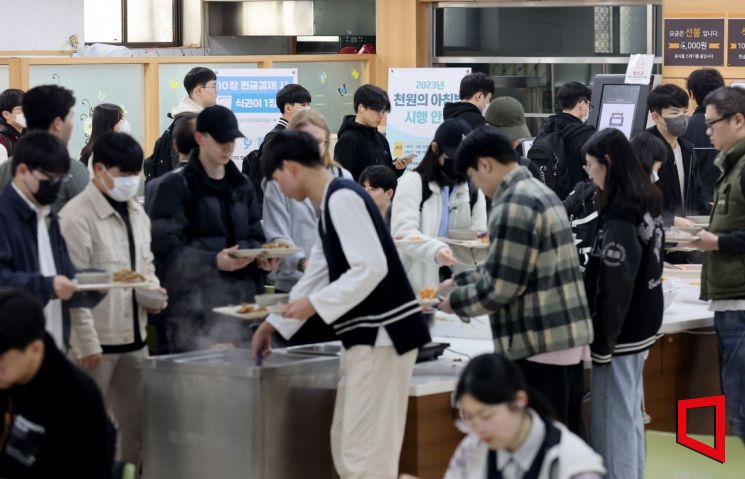
At universities, the use of the “1000 won breakfast” has increased, and long lines have become a daily routine at student cafeterias. Photo by Huh Younghan
According to the National Statistical Office’s KOSIS portal, the food service price index has risen by about 24.7% over the past five years. In Seoul, the price of naengmyeon and bibimbap has long exceeded 10,000 won. On top of that, prices for simple meals such as gimbap have also risen significantly, making the overall burden of food expenses heavier.
“Surviving on 5,000 won a Day”: Changing Scenes at University Campuses
The perceived cost of living among university students is steep. Because many students live alone and rely heavily on eating out, they are directly affected by rising food expenses. As a result, the use of the “1000 Won Breakfast” service is increasing on campuses, and long lines at student cafeterias have become commonplace. Some students keep their daily food expenses between 5,000 and 6,000 won by eating chicken breast, sweet potatoes, and protein drinks for their meals.

Kyung Hee University students are ordering the ‘Thousand-Won Breakfast’ offered for one thousand won. Photo by Dongju Yoon
Additionally, there are growing efforts to reduce fixed expenses by sharing convenience store “buy one get one free” promotional products or splitting OTT and AI service subscription fees. The frequency of dining out has also noticeably declined. More people are adjusting their consumption by reducing alcohol and delivery food purchases and choosing to eat at home or at lower-priced restaurants.
‘Geojimap’ and Group Purchases… Active Sharing of Tips to Save on Food Expenses
“Survival-style consumption” is appearing not only among university students but also among office workers. As the main criteria for lunchtime menu choices have shifted from “taste” to “price,” it has become standard to use the “under 10,000 won” filter first on popular map apps. Demand for convenience store ready meals and discounted lunchboxes at supermarkets has also risen. In particular, sales of ready meals during the morning commute have increased sharply, with more office workers choosing convenience stores over restaurants. Experts interpret this phenomenon not just as simple frugality, but as “survival dining.”

In the anonymous chat room “Geojibang,” which served as the origin of Zimap, know-how to reduce expenses is shared in real time, including free exhibition information, convenience store “buy one get one free” promotions, group purchases of ingredients, tips for using discount coupons, and methods for purchasing products nearing their expiration date. The Asia Business Daily
As the burden of food expenses grows, the culture of sharing information is spreading rapidly. The most prominent examples are “Geojimap” and “Geojibang.” Geojimap is a map service that compiles information on restaurants where meals cost under 10,000 won, and it is actively shared in university and office worker communities. The map lists restaurants organized by price, from those in the 2,000-won range up to 10,000 won, and includes user reviews, serving as a kind of “survival map.” Furthermore, in Geojibang, the anonymous chat room that inspired Geojimap, users share real-time tips for reducing expenses, such as information about free exhibitions, convenience store “buy one get one free” promotions, group purchases of ingredients, how to use discount coupons, and how to buy products nearing their expiration dates.
“Enduring, Not Enjoying”: The Standard for Consumption Has Changed
In reality, when household finances worsen, dining-out expenses are the first to be cut. According to the Ministry of Data and Statistics’ “2025 Social Survey,” 67.2% of household heads aged 19 and older said they would first cut spending on eating out if their financial situation deteriorated. This far exceeds the numbers for “clothing expenses” (43.1%), “food expenses” (40.4%), “culture and leisure expenses” (39.6%), and “alcohol and tobacco” (17.7%).

It shows that the burden of food expenses is directly affecting daily life overall. The Engel coefficient (the proportion of food expenses in total consumption) also exceeded 30%, reaching the highest level since the 1990s. Photo by Jo Yongjun
The rate of increase in the dining-out price index has continued to rise every year: 2.8% in 2021 (year-over-year), 7.6% in 2022, 6.0% in 2023, 3.0% in 2024, and 3.0% in 2025. As of January this year, the dining-out price index rose by 2.9% year-over-year (from 122.89 to 126.45). This is 0.9 percentage points higher than the overall consumer price inflation rate (2.0%). This demonstrates that the burden of food expenses is directly affecting all aspects of daily life. The Engel coefficient (the proportion of food expenses in total consumption) has also exceeded 30%, marking the highest level since the 1990s. This means that the burden of both food and dining-out expenses is increasing simultaneously.
However, such changes can lead to psychological stress, going beyond simple saving. As soaring prices are hitting young people—who have a weaker foundation for self-reliance—especially hard when it comes to meals, there are growing calls for practical measures. Kang Insu, a professor of economics at Sookmyung Women’s University, said, “With the weak won and growing external uncertainties such as instability in the Middle East, the hardships faced by young people could intensify,” adding, “The government needs to expand support policies such as the ‘1000 Won Breakfast’ program, taking these circumstances into account.”
Hot Picks Today
![Jensen Huang and Elon Musk Join Forces... Intel Signals 'Return of the King' in 2030 [Chip Talk]](https://www.newsbeep.com/ie/wp-content/uploads/2026/04/2026010715110782469_1767766267.jpg)
Jensen Huang and Elon Musk Join Forces… Intel…
Ultimately, today’s meals are no longer about “what to eat” but rather “how much one can endure on.” If high prices persist, this consumer pattern is likely to become even more entrenched.
This content was produced with the assistance of AI translation services.
© The Asia Business Daily(www.asiae.co.kr). All rights reserved.