
Massachusetts Institute of Technology (MIT) researchers have developed an AI-powered preview system that shows users exactly how a 3D printed object will look before a single layer is extruded, tackling one of the most persistent sources of waste in the fabrication process.
The study was led by senior author Stefanie Mueller, associate professor of EECS and Mechanical Engineering at MIT, with Maxine Perroni-Scharf as lead author. The team spans MIT, Princeton University, and the Gwangju Institute of Science and Technology, and was funded by an MIT Morningside Academy for Design Fellowship and an MIT MathWorks Fellowship.
The Problem With How 3D Printing Previews Work
Current slicer software prioritizes structural accuracy over aesthetics, leaving color, texture, gloss, and translucency largely to guesswork. The disconnect between digital preview and physical output drives repeated reprints, compounding material costs and extending production timelines in ways that affect hobbyists and professional fabricators alike.
“3D printing can be a very wasteful process. Some studies estimate that as much as a third of the material used goes straight to the landfill, often from prototypes the user ends of discarding. To make 3D printing more sustainable, we want to reduce the number of tries it takes to get the prototype you want. The user shouldn’t have to try out every printing material they have before they settle on a design,” says Maxine Perroni-Scharf.
How VisiPrint Works
The system, called VisiPrint, asks for just two inputs: a screenshot from the user’s slicer software, and a single image of the print material, sourced online or photographed from a printed sample. From there, two AI models take over.
A computer vision model extracts appearance-relevant features from the material sample, including color, gloss, and translucency. It passes those features to a generative AI model that reconstructs the object’s geometry while accounting for the specific slicing pattern the nozzle will follow during fabrication, the very details that most dramatically affect how a finished print looks.
The key development is a conditioning method that balances two complementary inputs: a depth map that preserves shape and shading, and an edge map that captures internal contours and structural boundaries. Getting that balance right was critical.
“If you don’t have the right balance of these two things, you could use up with bad geometry or an incorrect slicing pattern. We had to be careful to combine them in the right way,” Perroni-Scharf says.
The entire preview generates in roughly one minute, more than twice as fast as competing methods, and in user studies, nearly all participants rated VisiPrint’s output as more accurate in both overall appearance and textural similarity than any alternative approach.
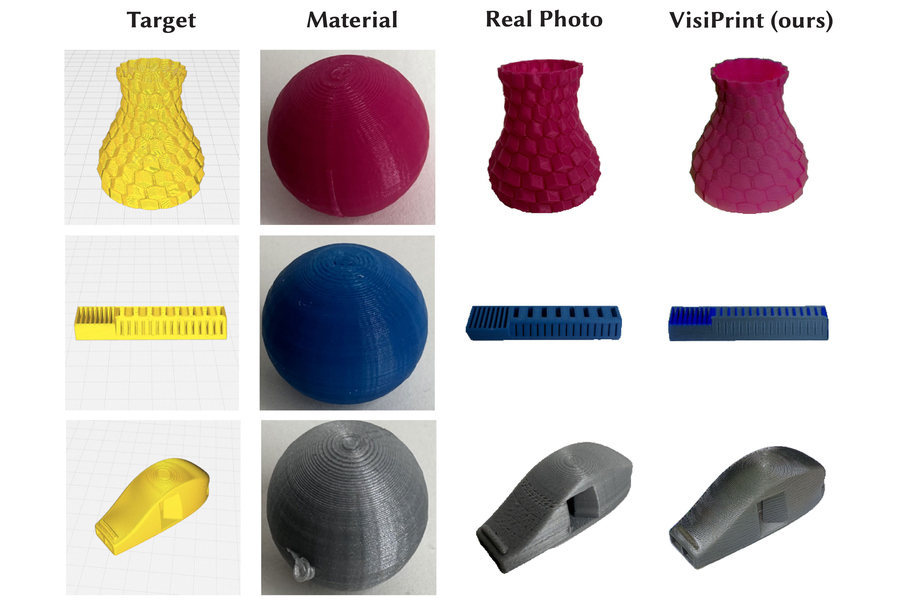 MIT researchers developed an easy-to-use tool that generates an accurate, aesthetics-first preview of how an object will look before it is 3D printed. Image via MIT.
VisiPrint’s Real-World Reach
The applications extend well beyond hobbyist prototyping. In dentistry, VisiPrint could help clinicians verify that temporary crowns and bridges visually match a patient’s existing teeth before committing to a print. In architecture, it could allow designers to assess the visual impact of scale models before fabrication. Anywhere that aesthetics carry weight alongside function, the tool offers a meaningful advantage.
VisiPrint is designed to complement, not replace, standard slicer previews. It does not evaluate printability, mechanical integrity, or failure likelihood. What it does is close the gap between what users see on screen and what they hold in their hands.
“‘What you see is what you get’ has been the main thing that made desktop publishing ‘happen’ in the 1980s, as it allowed users to get what they wanted at first try. It is time to get WYSIWYG for 3D printing as well. VisiPrint is a great step in this direction,” says Patrick Baudisch, a professor of computer science at the Hasso Plattner Institute.
Future development will focus on handling extremely fine surface details and expanding the tool’s optimization capabilities beyond material color, pushing toward a system that doesn’t just preview appearance, but actively helps users get it right the first time.
When AI Meets Appearance: A Growing Priority in 3D Printing
VisiPrint reflects the recognition that appearance is not secondary to function, but integral to it. As 3D printing moves deeper into fields like healthcare, dental, architecture, and consumer products, the gap between what a design looks like on screen and what emerges from the printer has become a measurable cost, in materials, time, and professional credibility. AI is increasingly the tool being deployed to close that gap, not just for geometry and printability, but for color, texture, translucency, and visual fidelity.
Several developments illustrate where this convergence is heading. Prague-based startup Additive Appearance released PrismSlicer, a slicing software for multi-material inkjet printing that incorporates a photorealistic rendering engine and predictive preview capability, allowing users to validate appearance digitally before committing to a print and reducing material waste in the process.
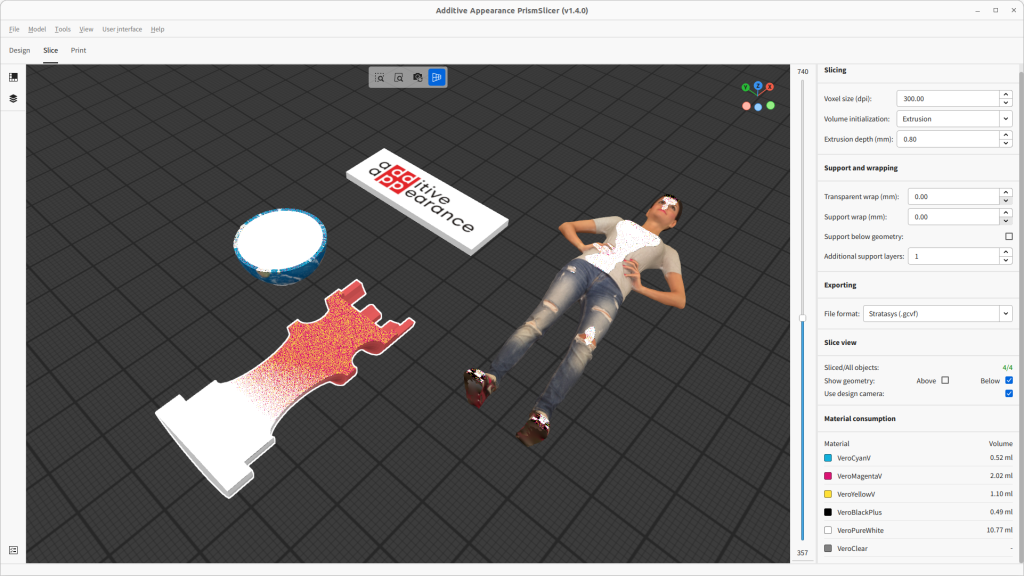 PrismSlicer Software. Image via Additive Appearance.
At MIT, the MechStyle generative AI system takes a parallel approach, letting users customize 3D models through text prompts or reference images while preserving structural integrity, balancing aesthetic exploration with durability analysis from the earliest stage of design.
Together, these efforts signal that the future of 3D printing software is not just about making objects printable, but making them look exactly as intended, the first time.
3D Printing Industry is inviting speakers for its 2026 Additive Manufacturing Applications (AMA) series, covering Energy, Healthcare, Automotive and Mobility, Aerospace, Space and Defense, and Software. Each online event focuses on real production deployments, qualification, and supply chain integration. Practitioners interested in contributing can complete the call for speakers form here.
To stay up to date with the latest 3D printing news, don’t forget to subscribe to the 3D Printing Industry newsletter or follow us on LinkedIn.
Explore the full Future of 3D Printing and Executive Survey series from 3D Printing Industry, featuring perspectives from CEOs, engineers, and industry leaders on the industrialization of additive manufacturing, 3D printing industry trends 2026, qualification, supply chains, and additive manufacturing industry analysis.
Featured image shows MIT researchers developed an easy-to-use tool that generates an accurate, aesthetics-first preview of how an object will look before it is 3D printed. Image via MIT.