
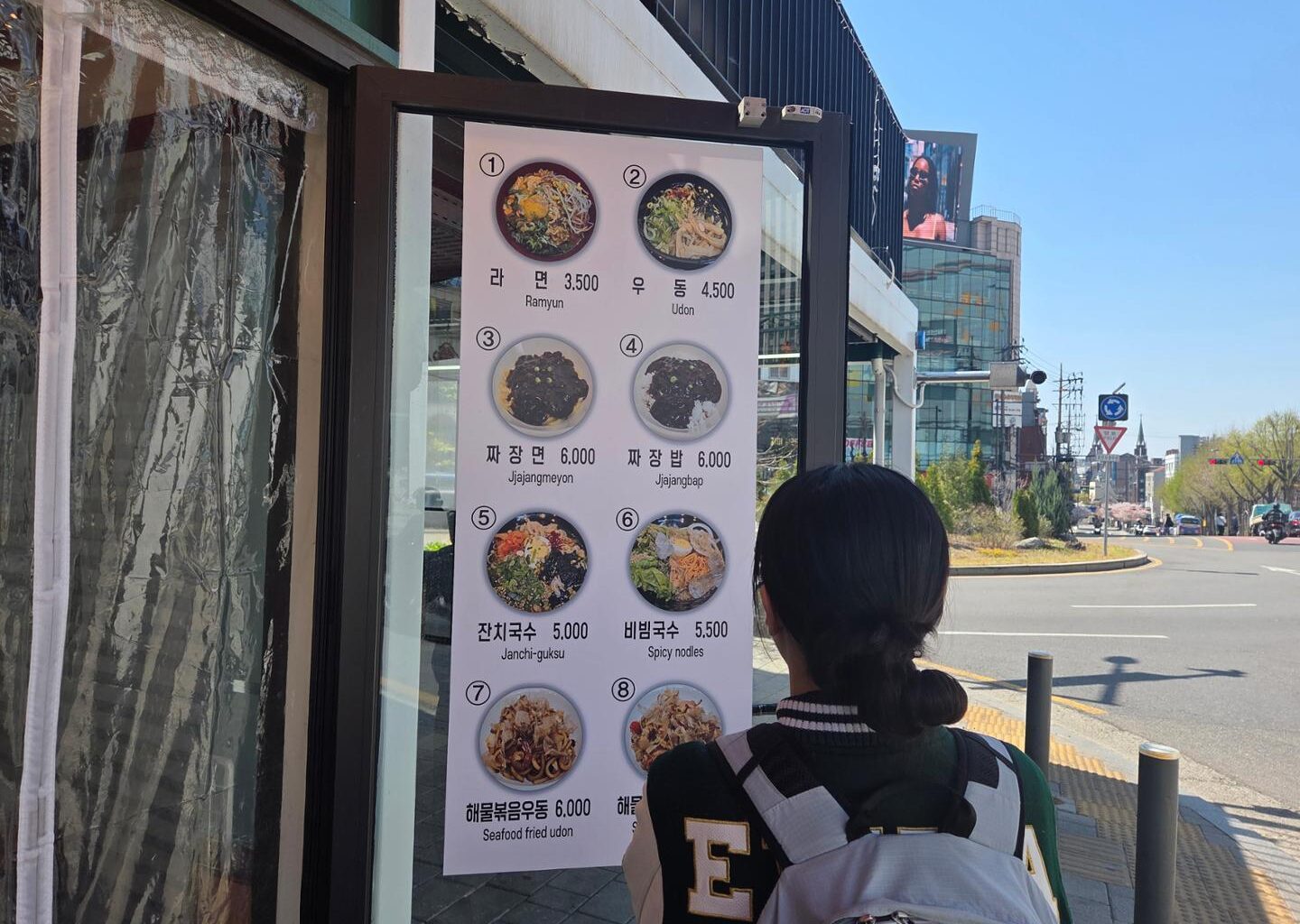
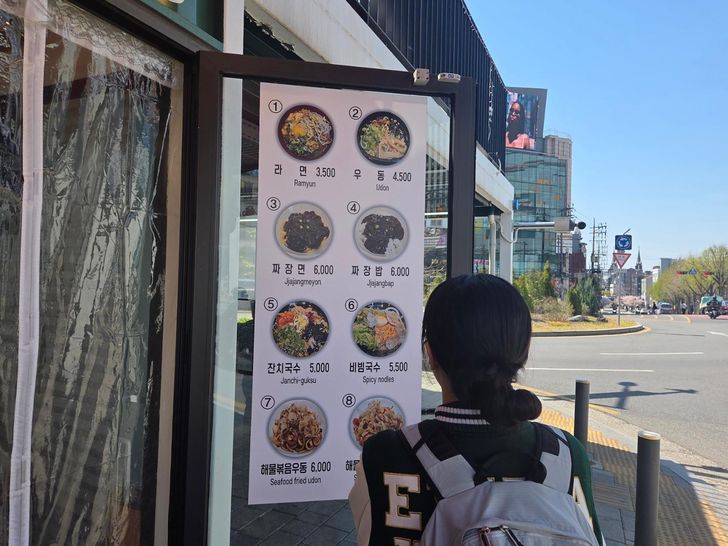
A university student examines a menu outside a restaurant in Seodaemun District, Seoul, April 7. Korea Times photo by Na Min-seo
Consumer prices in Korea have surged this year, driven by soaring food and raw material costs. The increase burdens consumers, with many saying the cost of living outpaces official inflation statistics, forcing young adults to cut spending.
In response, younger consumers are turning to extreme frugality, a survival strategy called “jjantech” — a portmanteau of the Korean words for “stingy” and “tech” — that replaces the previous generation’s “YOLO” (you only live once) consumption. Driven by a prolonged economic recession and high exchange rates, people in their 20s and 30s are turning to digital platforms like “rooms for beggars” (geojibang) and “map for beggars” (geojimap) to gamify their penny pinching.
On domestic mobile platforms such as KakaoTalk, participants share their daily expenses on public group chats and praise one another for completing the “no-spend challenge.”
“I purchased green tea teabags for 3,100 won ($2.10),” one user wrote. Another said, “Let’s brew and drink them two or three times.” When another user said, “I plan to spend 75,000 won for a marathon participation fee,” the room responded, “It’s free if you just walk.”
Han Su-min, 26, operates a chat room under the nickname “Beggar King.” Han relies on cheap instant coffee on her way to work to avoid franchise costs.
“Prices have skyrocketed, so the burden of living expenses has grown,” Han said. “I made the group chat to save money.”
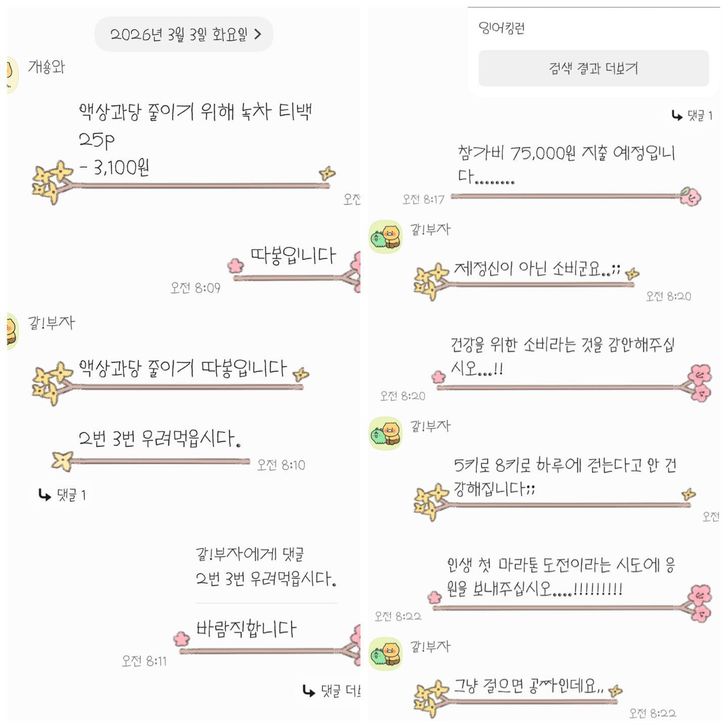
A KakaoTalk’ group chat known as “room for beggars” operated by office worker Han Su-min / Courtesy of Han Su-min
Minimizing daily expenses
For young adults, “jjantech” no longer carries much stigma. Many now see it as a survival strategy rather than a mere habit of thrift. As economic pressures mount, including a weak won and a prolonged downturn, young people are moving beyond ordinary frugality and into penny-pinching tactics just to make ends meet.
Kim Min-ah, 24-year-old college student, is one of them. She avoids social outings.
“Even the cost of bottled water is a waste, so I use the school water purifier, and I make do with gimbap (seaweed rice rolls) from a convenience store instead of eating out,” Kim said.
“If I go outside, money is slipping through my fingers, so I don’t even make appointments”.
Moon, a 24-year-old office worker, said, “Clothes are so expensive that I am still wearing clothes I bought when I was a college freshman.”
Graduate student Jeong Ye-eun, 24, walks up to 40 minutes to save transit fare. Job seeker Lee Ji-min, 25, skips visiting her parents in Gimhae, South Gyeongsang Province, to save the 100,000 won round-trip KTX train fare from Seoul.
“Even though I want to see my parents, I am holding back,” Lee said.
Meanwhile, 26-year-old Kim Se-rin logs 8,000 steps a day on the Seoul municipal walking app “Wrist Doctor 9988” to earn Seoul Pay points for food.
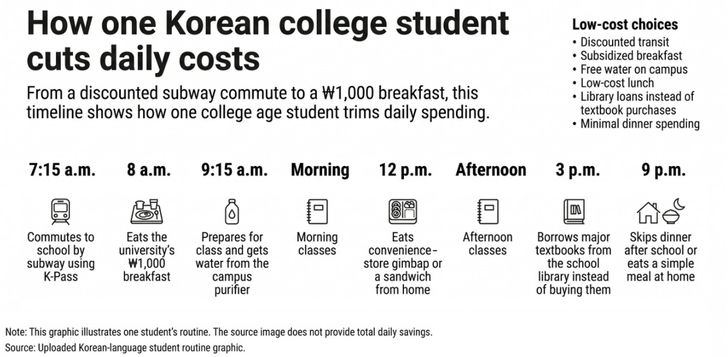
The image generated by artificial intelligence shows a Korean college student’s ultra-frugal routine.
Map for ultra-frugal spenders
The trend recently evolved into a dedicated platform known as the “map for beggars,” which tracks cheap eats under 8,000 won per meal — or 10,000 won in expensive districts like Gangnam and Yeouido. The crowdsourced map highlights highly cost-effective options, such as 5,000-won pork cutlets and 4,000-won Korean knife-cut noodle soup.
Sungshin Women’s University student Kim Tae-young, 22, uses the map daily to find alternatives to increasingly expensive school cafeterias. Developer Choi Sung-soo, 34, launched the app version on April 10, reporting 21,500 downloads in six days and 1.31 million cumulative web visits.
The map also unintentionally acts as free marketing for local independent restaurants. A 30-year-old university district restaurant owner surnamed Lee said the platform allows businesses to bypass high delivery app fees, which can reach 15 percent.
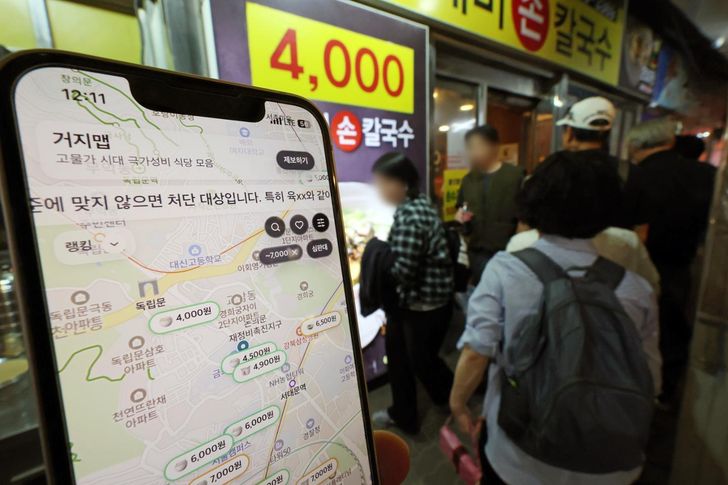
People wait in line at a restaurant included on the “map for beggars” in Yeongcheon Market, Seodaemun District, Seoul, April 14. Newsis
Experts warn this shift represents a fundamental change in consumer habits rather than a temporary fad. Inha University consumer science professor Lee Eun-hee said the trend will persist during the economic downturn as youth face growing income inequality.
However, Chung-Ang University sociology professor emeritus Lee Byung-hoon said that while the youth are coping with economic anxiety through humor, normalizing self-deprecating labels like “beggars” is concerning for the generation’s psychological well-being.
This article from the Hankook Ilbo, the sister publication of The Korea Times, is translated by a generative AI system and edited by The Korea Times.