
On This Week: Irish moments from history (April 20th – 26th)
Welcome to On This Week, where we delve into the standout stories from the years gone by, featuring standout news stories, major sporting events, and pop culture highlights that helped shape Irish life. Here’s your dose of Irish history from April 20th – 26th.
This week in Irish life and news
1916: Easter Rising wedding
Geraldine Dillon was the younger sister of Joseph Plunkett. In 1965, she was interviewed for the RTÉ Television project ‘Portraits 1916’, and described her wedding which took place on April 23rd 1916 – amid the In the interview she described what Joseph was like when he was younger, and revealed that he and his brothers George and Jack used to play war games which lead to him reading more and more about military strategy and tactics. Through Joseph, Geraldine got to know many of the leaders of the Rising, and shared her memories in the interview.
Geraldine was engaged to Thomas Dillon, a member of the Irish Volunteers. On Easter Sunday, April 23rd, there was meant to be a double wedding in the Plunkett household. Geraldine was to marry Thomas and Joseph was to marry his fiancé Grace Gifford. However the Easter Rising was due to take place on that very same day and as Geraldine recalls, Eoin McNeill’s countermanding order cancelling the manoeuvres changed everything.
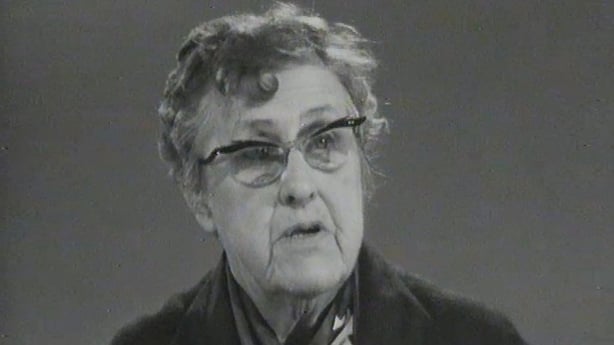
Geraldine Dillon shared her memories of 1916
Although Joseph and Grace did not marry that day, Joseph insisted that Geraldine and Thomas get married.The newly weds spent their wedding night in the Imperial Hotel opposite the GPO. Geraldine saw Joseph, who was staying in the Metropole Hotel, and discussed what was going to happen. She thought the Rising was not going ahead. Joseph explained they had to proceed with their plans.
We couldn’t go on on the run, that was disastrous before and it mustn’t be done again… We have to take the initiative and act first and do it at once.
From her room in the Imperial Hotel, Geraldine witnessed the takeover of the GPO on Easter Monday, April 24th, and not only did she see the Volunteers barricade the building but she also witnessed Pearse reading the Proclamation.
Soon after the Volunteers took over the GPO, Geraldine saw her brother out on the street. As part of his plans for the Rising, the streets all over the city were to be barricaded, limiting troop movement. A tram was commandeered in Talbot Street/North Earl Street to be used in such a barricade, but the Volunteers could not get the tram on its side. Geraldine remembers
Joe put a bomb on the tram and he shot it from a good distance off and the tram was wrecked.
This was the last time she saw Joseph. He was executed in Kilmainham Gaol on 4 May. He was given permission to marry Grace Gifford shortly before his death.
1980: Irish soldiers prepare for peacekeeping mission in Lebanon
On 22nd April 1984, the 47th Infantry Battalion prepared to take up peacekeeping duties with UNIFIL in Lebanon. As news of the deaths of two Irish soldiers in Lebanon reached Ireland, their comrades in the 47th Infantry Battalion continued to drill and prepare for their tour of duty with United Nations Interim Force in Lebanon (UNIFIL).
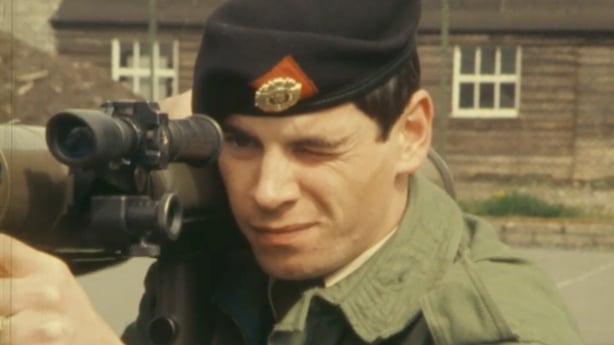
An Irish soldier preparing for the mission in Lebanon.
For the next six months, the Irish Defence Forces would work under challenging conditions in war torn Lebanon. For many of the soldiers this will be their first time in the Middle East.
The mood was positive among the soldiers who spoke to reporter Joe Little. One experienced soldier said they know what to expect. Carrying out their duties possibly while under fire would be a reality, but would present them with an opportunity to put their training to the test.
This report for ‘Frontline’ was broadcast on 22 April 1980.
1980: a draught Guinness drought
On this week in 1980, a strike at the St James’s Gate Brewery in Dublin meant pubs around Ireland were running out of Guinness. Guinness stocks in pubs were running low, with some Dubliners opting to drink Smithwick’s or whiskey, although one man suggests taking more drastic decision,
We’ll just have to give it up I’m afraid.
As this RTÉ News report broadcast on 23rd April 1980 revealed, in the west of Ireland the last deliveries of Guinness took place a week earlier and almost half of the pubs and hotels in Galway city were out of draught Guinness. Guinness drinkers were switching to beer or shorts although the more intrepid were participating in nightly pub crawls in search of a pint of draught.
No pints of the black stuff were available in many pubs around the country on this week in 1980
In Connemara pubs in villages such as Spiddal had completely run out of draught Guinness but customers were making do with bottled Guinness.
Publicans feared a loss of earnings and there were suggestions that a Guinness shortage will bring about a boom in poteen making.
Guinness said there is no shortage in Cork. However the local Murphy’s and Beamish stouts were doing well. Murphy’s in particular was finding it hard to cope with the increase in demand. The reporter in Galway was Jim Fahy. The reporter in Cork was Brendan O’Brien.
This week in arts and entertainment
1976: Marianne Faithfull’s Irish dreams
On April 24th 1976, singer, songwriter and actor Marianne Faithfull talked to Tom McGurk on the programme First House about her new album, chart success, country music, an upcoming tour and of course her long and loving connection with Ireland.
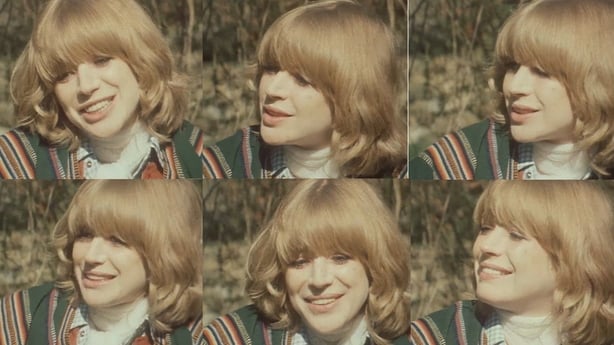
Marianne Faithfull on First House
‘Dreamin’ My Dreams’ was Marianne Faithfull’s sixth studio album, her first country record and her first record in ten years. The album was re-released two years later as ‘Faithless’.
1980: Rory Gallagher on his Irish tour
On April 24th 1980, the legendary Rory Gallagher was interviewed on the music show TX. Having just completed a national tour, Gallagher said he liked the idea of fans not having to travel too far to see him, and enjoyed playing in smaller venues around the country.
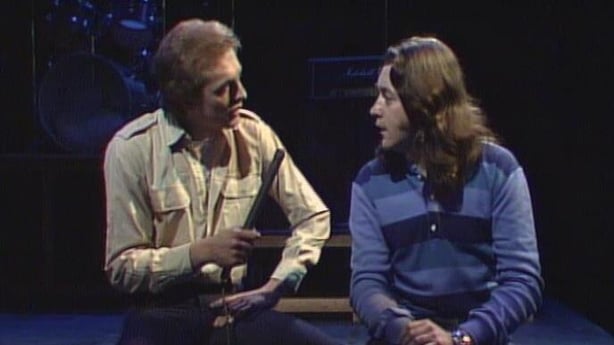
Dave Heffernan talks to Rory Gallagher
Rory Gallagher’s band lineup consisted of Ted McKenna on drums and Gerry McAvoy on bass alongside himself. He felt that this arrangement worked well for him.
I still like the tension of three musicians together.
He revealed that his current listening included Fats Domino, Waylon Jennings and Elvis Costello feature among many others, but said he “I never really restrict my listening to one style.”
The presenter was Dave Heffernan.
On this week in sport
1979: Sport for All Day defies the weather
Heavy rain didn’t dampen the spirits of those taking part in National Sport For All Day. Cospoir, The National Sports Council, coordinated National Sport For All Day held on 21 April 1979. A nationwide programme of events was planned for the day with a variety of sports and games on display. It was hoped that people, irrespective of age, will be influenced to bring sport into their lives.
As RTÉ News reported on April 22nd 1979, Dublin, the fun run was led by indoor mile record holder Eamonn Coghlan and the 1956 Olympic gold medalist Ronnie Delany. But in the Phoenix Park, many scheduled events were cancelled due to the very unfavourable weather.
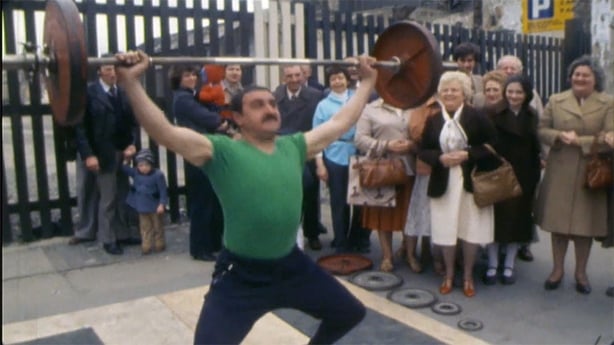
A weight lifter impresses the crowd on National Sport For All Day in 1979
The balloonist, hang gliders and skydivers were all grounded because of the elements, leaving the day to aficionados of radio-controlled model aeroplanes.
The weather was also unpleasant for joggers in Limerick, although Mayor of Limerick Bobby Byrne was on hand to start them off. The reporter was Nick Coffey.
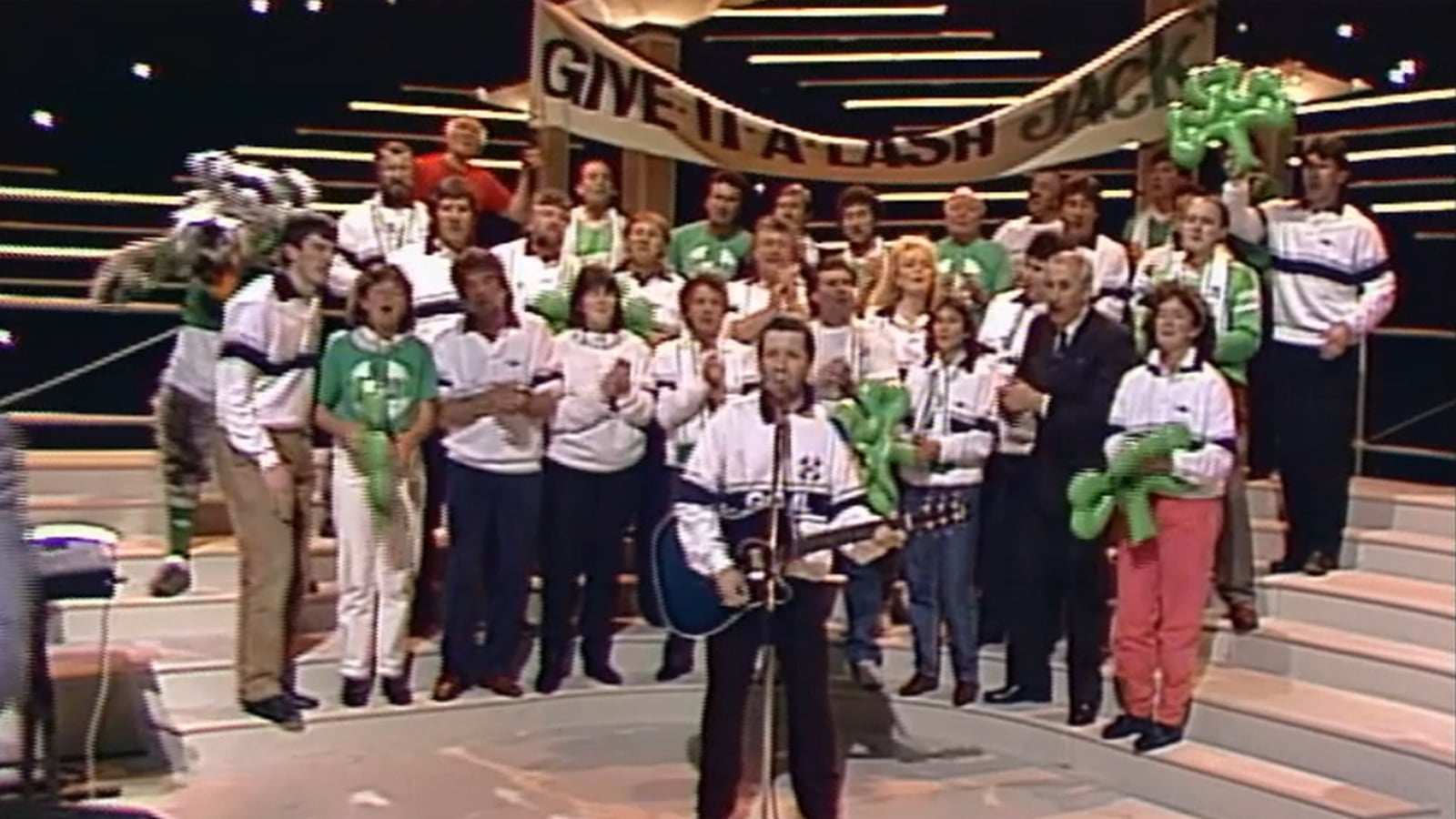
1990: ‘Give It A Lash Jack’ becomes an anthem
In early 1990 the Gay Byrne Radio Show ran a competition to find an anthem for the Republic of Ireland soccer team and supporters going to Italy for the 1990 World Cup Finals. The prize for the winning entry was £1000, donated by Arnold O’Byrne, Managing Director of Opal Ireland, sponsors of the Republic of Ireland team. The winning song also received radio play and a launch on ‘The Late Late Show’.
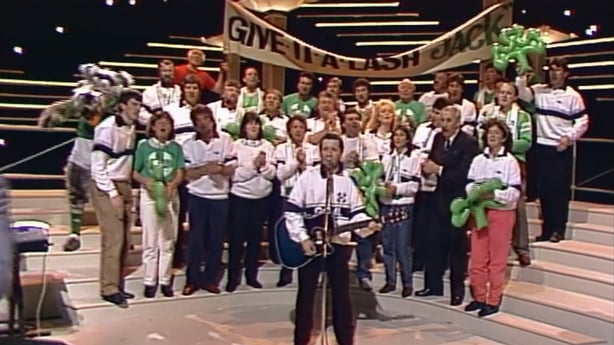
‘Give It A Lash Jack’ on the Late Late Show
Of the 354 competition entries, Dubliner Liam Harrison’s song ‘Give it a Lash Jack’ was declared the winner. The song made its television debut on April 20th 1990, with Liam Harrison backed by the Late Late Show’s resident pianist and musical director Frank McNamara and a collection of sports people and celebrities.
The studio audience was required to join, in but Gay Byrne stopped the song in mid flow to demand they rise to their feet to give greater participation.
This time I want to hear an audience joining in who are alive and breathing and wanting to be here.
When the song ended Byrne asked,
Is that a winner or is it not folks? Yes it is!
All proceeds from the sale of ‘Give It a Lash Jack’ by Liam Harrison and the GOAL Celebrities went to the famine relief agency GOAL.
By mid May 1990 ‘Give It a Lash Jack’ made it to top of the Irish charts, displacing Mick Lally’s ‘Byroads To Glenroe’. On 18 March 2011, during a ‘The Late Late Show’ interview, film director Jim Sheridan recalled a conversation he had with Bono and some famous people in which they debated what is the greatest Irish song ever written. They concluded it was… ‘Give it a Lash Jack’.
What was Number 1 in Ireland this week?
1994: ‘Streets of Philadelphia’ by Bruce Springsteen
The song from the soundtrack of the Oscar-winning film Philadelphia stayed at the top of the Irish charts for five weeks in March and April 1994.
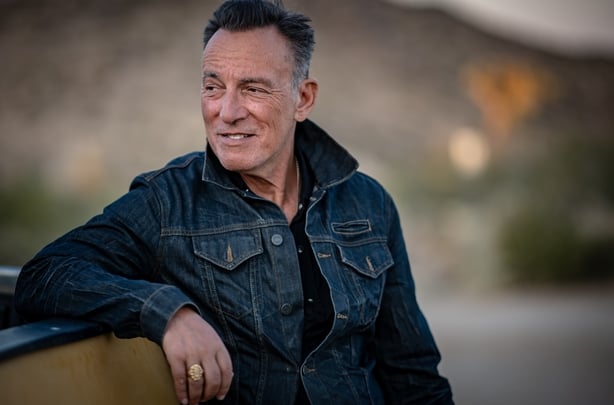
Springsteen topped the charts for five weeks.
2000: ‘Maniac 2000’ by Mark McCabe
The dancefloor classic was number one for a mind-boggling ten weeks in 2000.
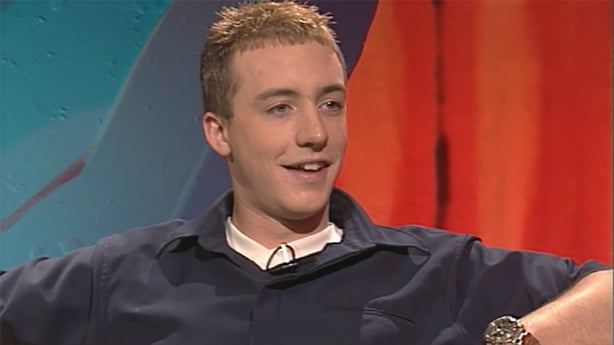
Mark McCabe in 2000
It is the second biggest-selling single of all time in Ireland.
2006: ‘Crazy’ by Gnarls Barkley
The duo comprised of producer Danger Mouse and singer CeeLo Green had their biggest hit twenty years ago, hitting number one in March before dropping out for a week and then returning to the top of the charts for seven weeks in April, May and June of 2006.
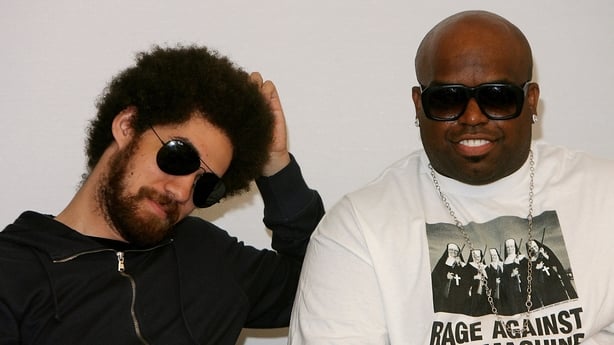
Chart toppers Gnarls Barkley
Famous Irish names celebrating birthdays this week
Glen Hansard
The Oscar-winning musician turns 56 on April 21st.
Lucy Kennedy
The writer and presenter turns 50 on April 21st.
Róisín Shortall
The co-founder of the Social Democrats turns 72 on April 25th