
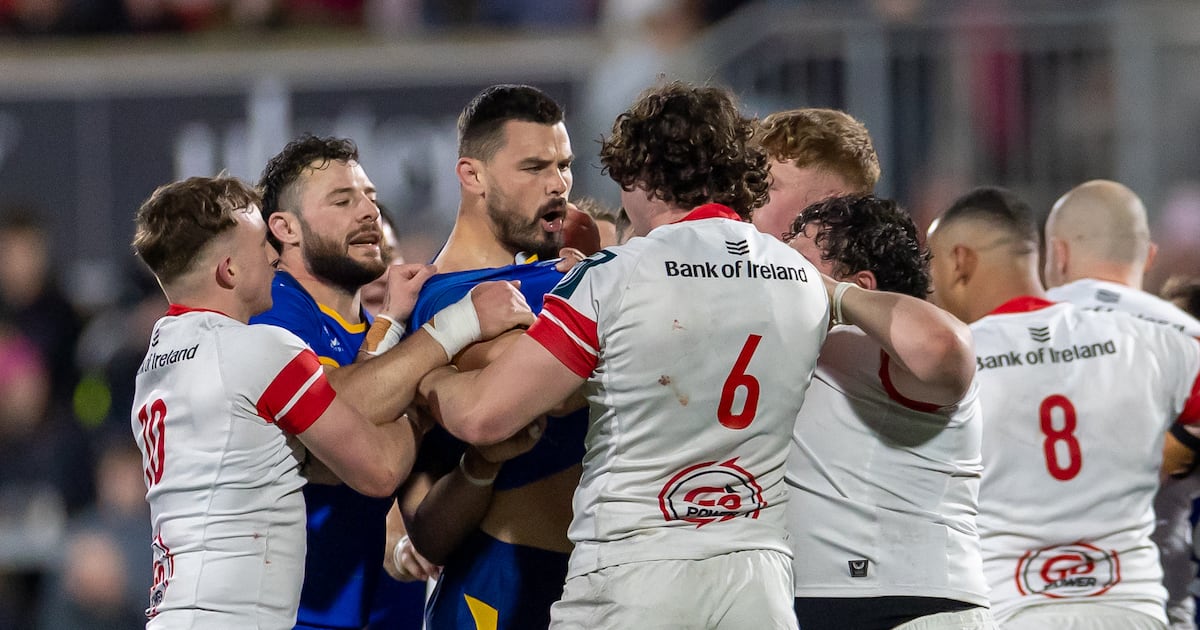
It could easily have been much more than a passing moment of great danger.
When Leinster’s Max Deegan upended the airborne Werner Kok, the collision increased the Ulster player’s velocity as he spun around, falling head first to the ground like a rag doll. He had no control over what would happen next and no way of breaking his fall.
Apart from Kok, nobody will have been more relieved at the outcome than Deegan. But the point remains – the Ulsterman was extremely fortunate not to land on his head.
It brought to mind the discussions around the straight, permanent red card. This is not a criticism of referee Andrew Brace. He followed the current procedure and Deegan left for the bin where the sanction was correctly upgraded to a 20-minute red card.
Dangerous foul play will be a hot topic when World Rugby meet again in June. That will be quite some discussion. France and other unions are adamant that the permanent card must still exist – and not just for offences that would merit police intervention if they happened anywhere else.
Just following on from the Aldegheri tweet from last week –
This from Deegan was the reddest of red cards. Don’t know why the referee goes yellow and bunker instead of just flashing red. pic.twitter.com/2kBrEcexP3
— Jim Demps (@jim_demps) April 18, 2026
One suggestion is that the bunker should be given powers to upgrade to a permanent red, but that raises the question of who is making the decision. There are clearly not enough qualified personnel to act as TMOs and the same problem exists for the bunker.
Overall, Brace refereed well. There is, however, one caveat. He failed to be tough on players who over-appealed and gave backchat. He warned players on several occasions without ever achieving the desired result. Strong refereeing means sanctioning players when necessary. Continuous warnings are meaningless – a waste of breath.
Brace was on first-name terms with many of the players, but their behaviour hardly returned the faux friendliness. He is not alone in using this modus operandi and it serves no purpose at all. All referees should sit down and have a serious rethink about how they address players and manage dissent. It is quite clear what they are doing is not working. It is broken and in need of urgent repair.
 Leinster have yet to fully find their mojo heading into a Champions Cup semi-final – when will it all click?
So, where did all this chumminess start? The English Premiership referees were certainly in at the start. For some illogical reason, nearly everyone considered this new idea to be a good one. When Irish referees ruled the roost they did not see any reason to use first names – in fact, the plan was not to do so. It was an important point of difference as they went from strength to strength.
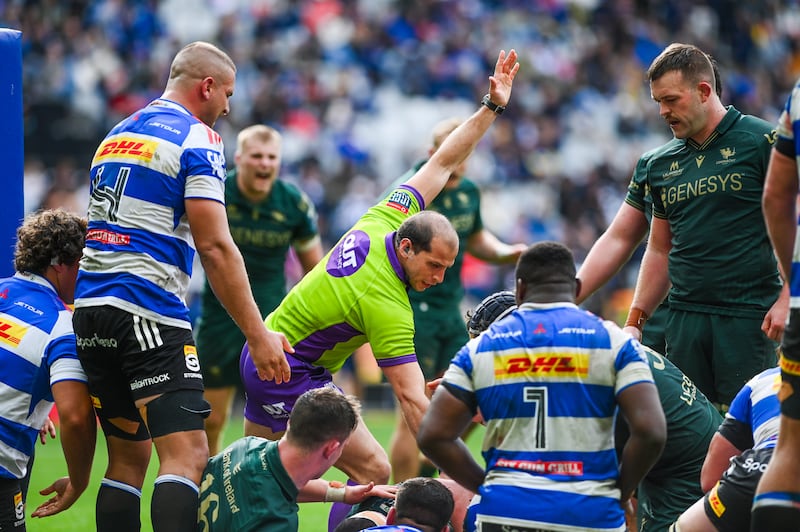 Federico Vedovelli did a fine job refereeing the URC match between Stormers and Connacht at DHL Stadium in Cape town. Photograph: Inpho/Steve Haag Sports/Darren Stewart
Connacht earned a magnificent victory over the Stormers in Cape Town. The match was refereed by Federico Vedovelli, who I have been critical of recently. In fairness to the Italian, this was a much better performance. He also dealt well with backchat. A stern warning to Stormers captain Ruhan Nel ensured the message was received.
The URC’s insistence on neutrality saw both Ben Whitehouse and Mike Adamson appointed to referee over the weekend, whereas these days they are more usually placed in the relative safety of the TMO booth. I had zero interest in watching Adamson, but did see Whitehouse in Benetton v Munster. He became the centre of attention – spectators and TV viewers were treated to seemingly non-stop referrals to the TMO before he finalised decisions. It bordered on the bizarre.
Another discussion for World Rugby’s meeting will revolve around the lineout. A long time ago, the scrum was a contest for possession. Not anymore, as we know. The lineout is now in grave danger of following it. Let’s have a look at what’s happening – not every time but all too frequently.
Firstly, the referee sets things up, carefully insisting there is only one receiver, and the hooker prepares to throw. As he releases the ball, several – usually three or four – leave the lineout. At this point, there’s a heck of a lot more than just one receiver.
So next, binding together, they drive into their catcher as he lands, thus propelling the maul forward. It is a huge advantage, very difficult to defend and has encouraged yet more mauling. It probably counts towards ball-in-play time, even though the ball is pretty much invisible while all this is going on. It is also forbidden in the law book, so the officials are usurping the written word and favouring teams with massive forwards and bomb squads.
The law is absolutely clear. No player can leave the lineout until it is over. The throw is just the start, not the end of proceedings. This is not a trial, rather a novel law interpretation which is clearly wrong and negates the lineout as a contest for possession. I have no idea why it has been allowed to infiltrate the game. One suggestion is that it’s very hard to referee it consistently. If that is true, it is preposterous. It is extremely easy to see. It cannot be too much to ask that the law is refereed.
The global trial of not calling crooked lineout throws, unless the opposition put up a jumper of their own, was introduced to encourage teams to compete. It has been an abject failure with the defending team all too often choosing not to contest possession, preferring to stay grounded to better contest the inevitable maul. It’s not too late to rescind the trial. Nobody can claim, with any credibility, that it’s doing what it says on the tin.