
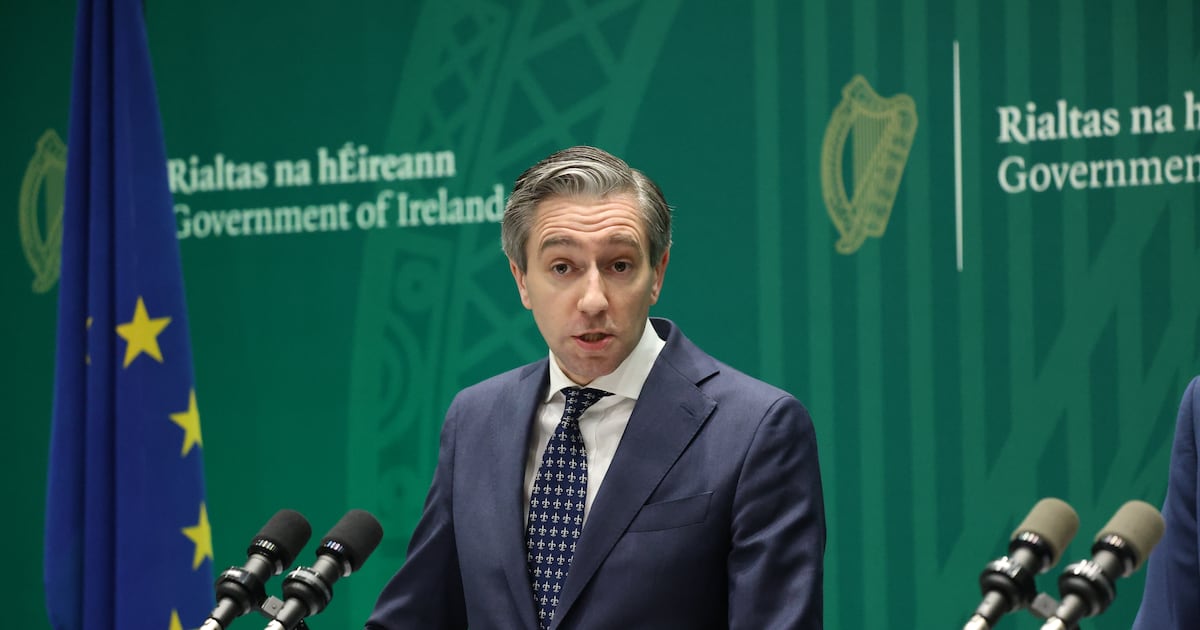
The Government’s planned special savings scheme should have tax-free products aimed at young adults, be simple in design and draw on examples from several countries, including the United Kingdom and Sweden, to ensure it is a success when launched next year, according to an Institute of International and European Affairs (IIEA) paper.
Personal investment accounts (PIA) must be easy to access, have tax obligations handled at source by providers rather than put the onus on individuals, have no minimum investment requirements for most products, and can be portable between providers, according to the paper, co-authored by IIEA chief economist Dan O’Brien and IIEA researcher Ciarán O’Donohoe.
The white paper, which has been developed in partnership with US financial services group BNY that administers billions of euros of assets in Dublin and Cork, also says consumers should be offered a wide variety of PIA products.
Minister for Finance Simon Harris said in late March that the planned Irish regime will carry an annual flat-rate tax to the value of assets held in the account above a tax-free threshold that is likely to be set in the budget later this year.
The Minister said this flat rate of tax could potentially serve as the sole form of taxation on investments made through the new account.
The aim is that all investments made within the account would receive consistent tax treatment and account providers would be required to administer the tax to help remove complexity for investors.
The Irish plan is in line with a push by the European Commission for EU member states to adopt tax-friendly models to encourage individuals to invest.
Irish households had €161.9 billion on deposit with banks at the end of 2025, mostly earning little or nothing by way of interest in current and on-demand deposit accounts.
 Has the fuel protest shown that the loudest lobby generally gets what they want?
“It is critical that simplicity is at the core of a PIA product for Ireland. To increase the levels of adoption with the general public, products should be as simple as possible, with minimal restrictions on access,” said the IIEA paper.
It said that it is “particularly important to enable more young people to invest” and that certain products should be specially designed for those aged between 18 and 25. “These products should be tax-free, and the Government could also explore matching investments up to a certain level,” it said.
Parents and guardians should also be incentivised to invest in their children’s future through tax-free specific products, similar to a junior savings account on offer in the United Kingdom.
The paper warned that many potential investors would be put off using a PIA product if there was a significant tax burden on them. “To remedy this, all providers of PIA products should be responsible for the tax reporting on their PIA products,” it said.
The document also said investments should carry an easy-to-understand risk ranking and that consumers should be given options to invest in products with an explicit Irish investment bias.