
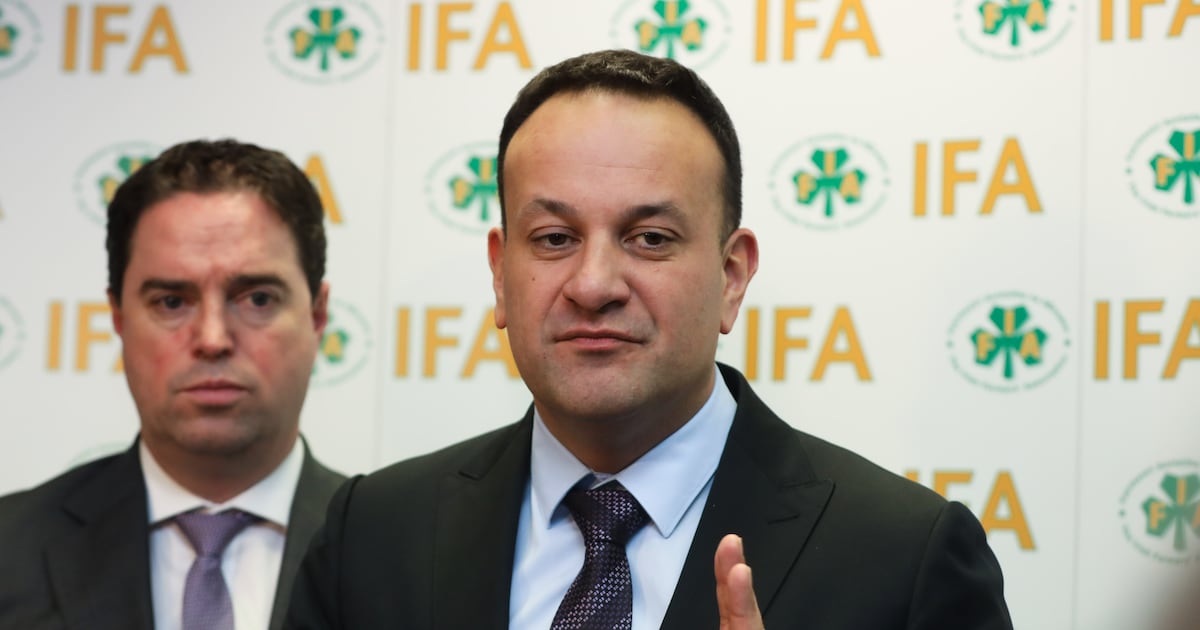
Former taoiseach Leo Varadkar has raised hackles among farmers by claiming urban Ireland is paying “all the bills” for rural communities.
“People in rural Ireland are very quick to tell people in urban Ireland that, you know, ‘we’re the real workers, we’re the ones paying all the bills, we’re the ones feeding the country’,” the former Fine Gael leader said on a podcast.
“I think maybe we need to be a little bit more blunt in urban Ireland and say ‘actually, that’s not the case’,” he added.
“We’re the ones paying all the bills and you’re the ones who are in receipt of a lot of subsidies and a lot of tax benefits that other people don’t get and maybe we need to sit around the table and have an honest discussion about some of that kind of stuff.”
Reaction in the farming world was as sharp as it was predictable.
Martin Heydon, Minister for Agriculture and himself a Fine Gael TD, said Varadkar’s remarks “lacked balance” and were unnecessarily divisive. “Farmers and the agri-food sector enhance us as a country both economically and socially, particularly in rural communities.”
Irish Farmers’ Association (IFA) president Francie Gorman said farmers have “given really good value” for the financial support they receive. “The idea that you can have a rural-based economy in Ireland and not have agriculture at the backbone of it, that just doesn’t stand up,” Gorman said.
Another agricultural figure, speaking on condition of anonymity, was more forceful, noting huge price volatility that could lead to some farmers making €80,000 one year “and then nothing” for the next two.
“What’s annoying people is the tone,” the person said, arguing Varadkar seemed to be implying the supply of food was a given, “like oxygen”, with no effort required to produce it.
“No one is disputing that pharma or tech contribute more to the economy. But it’s this dismissive attitude that these ‘bog-monsters’ have their hand out looking for more. I‘d like to see Leo milk 120 cows twice a day – every day.”
But is Varadkar correct to claim farmers receive disproportionate benefits from the public purse and, in effect, are not paying their way?
“Mr Varadkar’s two-way characterisation of farmers and others, eg PAYE workers, ignores the reality that most of those with very low farm incomes and a high dependence of their farm income on subsidies are also working off the farm, and are generally paying PAYE tax,” said Kevin Hanrahan, head of the rural economy development programme at Teagasc, the national body for agricultural research.
Citing 2020 Revenue Commissioners’ research on farm income, he added: “My take was that on average those households paying on farming incomes were generally earning as much if not more income from non-agricultural sources.”
Figures from Heydon’s department show farm and fishing sectors were subsidised by more than €2.18 billion in 2025, a flow of money that began when Ireland joined the then EEC in 1973.
The main source was the EU’s Common Agricultural Policy (Cap) but Dublin is a net contributor to the Brussels budget so this is no longer a one-way street.
Quite how much the Cap benefits Ireland is another matter but the basic argument is simple. “Food prices to all consumers – including urban ones – are lower by virtue of the support provided to farmers,” the IFA said.
Hanrahan said the agricultural contribution to national income was measured by the sector’s gross value-added. This was €6.77 billion in 2024, including €1.99 billion in net subsidies, so subsidies contributed almost 30 per cent.
But that was only part of the story, as it excludes the far larger €11.54 billion contribution of the agri-food and beverage sectors. These received no net subsidy and paid €112 million in tax on production. Combining agriculture and agri-food, the 2024 contribution of subsidies was in the region of 10 per cent.
As for the subsidy benefit to individuals, Hanrahan said this depended on the farms in question and the type of farming. Data showed average family farm income of €36,256 in 2024, with direct subsidy payments of €21,388, implying a subsidy share a little below 60 per cent.
Still, the level of subsidy dependence varied as some farmers received little or no support. “Examples are pig and poultry farms that produce lots of output and – in good years – lots of profit but which have little if any direct payments,” he said.
“The average dairy farm in 2024 had a family farm income of €108,672 and direct payment receipts of €24,445, a share of 22.5 per cent,” he added.
“Cattle-rearing farms [suckler farms] had an average family farm income of €13,788 in 2024 and total direct payment receipts of €17,743, implying that direct payments aka subsidies accounted for 129 per cent of farming income.”