
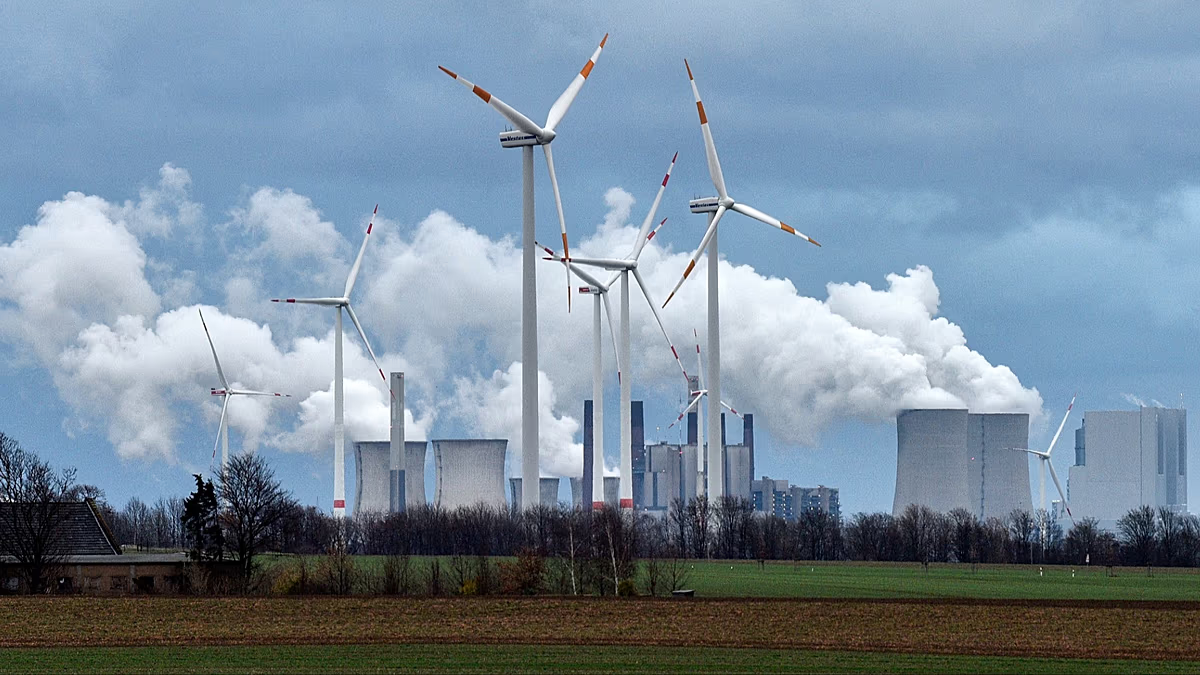
EU countries with the cleanest energy mix will be cushioned from the soaring price of oil and gas, as the war on Iran continues to highlight the true cost of fossil fuel reliance.

ADVERTISEMENT
ADVERTISEMENT
Within two days after strikes hit the Middle East, Dutch TTF (the benchmark for wholesale gas prices across Europe) prices spiked by 68 per cent to €52.8 per megawatt-hour, the highest level in two years.
At the beginning of this week (Monday 20 April) Dutch TTF was trading at a much lower €40.2 per MWh. The dip comes after signs of major de-escalation amid a two-week ceasefire, but it is still significantly higher than before the conflict began (€31.5 per MWh).
Much of the volatility is down to Iran’s stranglehold on the Strait of Hormuz, a 38km passage that carries around one-fifth of global oil and gas supplies. In March, liquified natural gas (LNG) exports to the EU dropped by 11 per cent.
This spurred the EU’s energy commissioner to recommend that countries fill their stocks steadily over the summer to “mitigate pressure on prices and avoid an end-of-summer rush”.
It has also paved the way for a rapid interest in home-grown renewables, which are increasingly being touted as a more stable investment in light of geopolitical tensions.
“There are no price spikes for sunlight and no embargoes on the wind,” UN Secretary-General António Guterres said last month.
Can clean energy shelter the EU from rising gas prices?
A new report by the Centre for Research on Energy and Clean Air (CREA) found that despite a sharp rise in prices and growing fears over dwindling supplies, the bloc remains “better protected” from price sensitivity than in 2022 – following Russia’s full-scale invasion of Ukraine.
This is mainly down to the boom in renewables, which hit new records in 2025, and could save the EU a staggering €5.8 billion in 2026 by displacing expensive gas.
Experts point out that this would be significantly higher if gas prices weren’t responsible for setting the energy price in many countries, due to the EU’s marginal pricing mechanism.
In 2025, every €1/MWh rise in gas price led to a €0.37 per MWh rise in electricity prices – an eight per cent reduction from 2022.
“This is directly linked to decoupling [the price of electricity] from gas and investments in clean energy, whose share towards electricity generation in the EU grew by 14 per cent in 2025, compared to 2022,” the report explains.
Which EU countries are the most sheltered from rising gas prices?
Every single EU member state has seen its sensitivity to gas price movements reduce in recent years, following an increase in clean energy.
But it is consumers in five EU countries particularly – Denmark, Finland, France, Sweden and Slovakia – that benefit from the highest clean energy share in their electricity mix. The report says that these nations will save €8.5 billion on their energy bills this year. This will reduce bills by 58 per cent compared to countries with the dirtiest mix (Poland, Italy, Greece, Estonia and the Netherlands).
The estimation is based on consumption remaining the same this year as in 2025, while accounting for higher prices and gas-price sensitivity.
Sweden came out victorious as the EU state with the least sensitivity to gas price shocks, according to data from 2025. On average, for every €1 rise in the price of gas, Sweden records a mere €0.04/MWh rise in wholesale electricity prices.
“While Sweden is one of the nine countries currently with gas storage significantly below the EU average, its lack of reliance on the source for power – with 99 per cent of its electricity met with clean energy – further insulates the electricity market from price shock,” the report states.
Spain and Portugal are also benefitting from accelerating investment in renewables, having seen a 21 per cent growth in clean energy in 2025 compared to 2022. This has largely been spearheaded by a 74 per cent boom in solar.
At the same time, both countries’ sensitivity to gas price shocks has dropped by 53 per cent. Last year, for every €1 rise in the price of gas, Spain and Portugal’s joint production zone saw a €0.089 rise in price per MWh, the third lowest in the bloc.
France has also witnessed a sharp reduction in its sensitivity to gas prices, chiefly due to a growth in clean energy that has seen its sensitivity to gas halve between 2022 and 2025.
Which countries are paying the price for their fossil fuel reliance?
The Netherlands, despite recording a 31 per cent increase in clean power generation, remains more sensitive to gas prices than 2022.
Despite the country’s solar and wind share in electricity being higher than the EU average, gas continues to be used as the single largest source of electricity in the country.
“Their sensitivity is also linked to being highly integrated in the European gas market – often as a price taker – and therefore susceptible to shocks transmitted by neighbours like Germany,” the report adds.
“Gas has traditionally played an outsized role in centralised electricity production in the Netherlands (22 per cent), with clean energy sources, specifically solar, playing a bigger role in decentralised electricity generation.”
For example, solar in the Netherlands is heavily used through daytime hours, but in the evening, other sources need to be ramped up – often requiring gas.
Poland is another anomaly to the overall EU trend. Despite registering a 48 per cent year-on-year growth in renewables since 2022, the country’s sensitivity to gas prices remains high.
This is mainly due to Poland pushing gas-powered electricity in an effort to replace and reduce coal, which remains essential to over half of the total electricity production in the country.
“Poland’s redirection towards gas, rather than clean energy sources, has seen power generation from the commodity rise by 132 per cent in 2025 compared to 2022,” the study explains.
“This increased dependency, which constituted 13 per cent of the total in 2025, has meant that sensitivity to gas prices has also risen by 87 per cent.”
For every €1 increase in the price of gas, Poland sees a €0.36 per MWh rise in electricity.
Hungary has also shown a greater sensitivity to gas prices compared to 2022, rising by 22 per cent year-on-year. While the country has witnessed a boom in solar, a lack of grid connection capacity means Hungary is still forced to rely on gas power to maintain stability.