
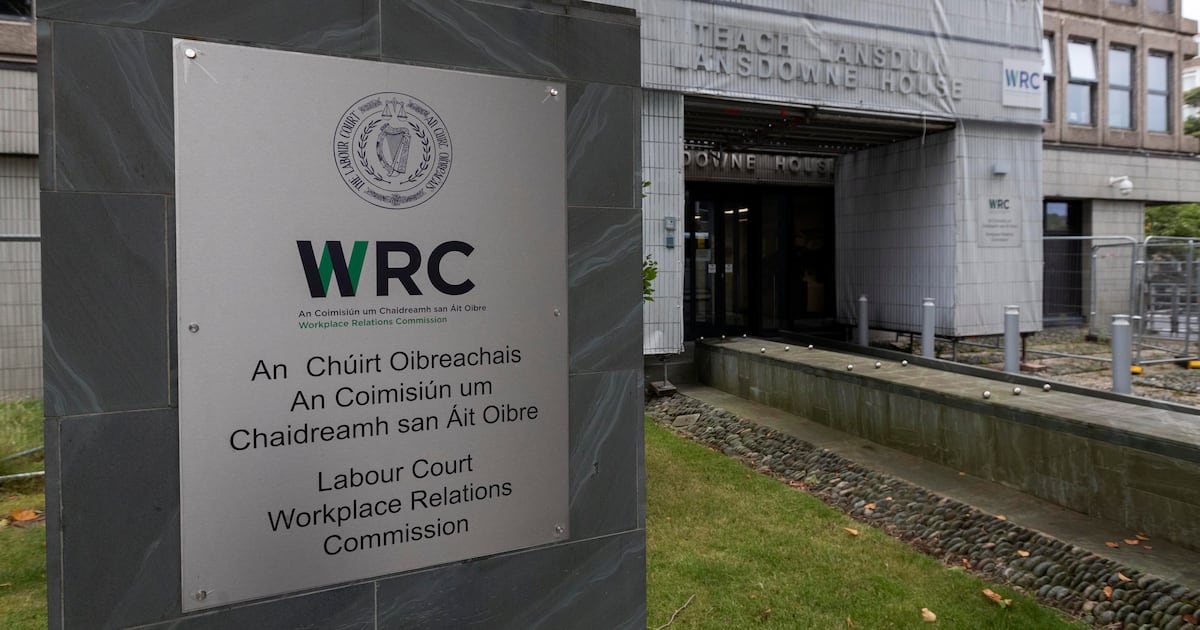
A visually impaired man was left “humiliated and exhausted” while experiencing “protracted” discrimination by his employer, the Department of Social Protection, which has been ordered to pay him €30,000.
Paul Hill, who has worked at the department as an assistant principal officer since 2012, was “not provided with reasonable accommodation” for 12 years by his employer, and “this constitutes discrimination”, the Workplace Relations Commission said in a ruling published on Wednesday.
Hill, whose visual impairment developed when he was 16, can experience significant glare and light sensitivity, which can cause difficulty seeing his work as well as eye strain, headaches and fatigue. This impairment is a disability within the meaning of the Employment Equality Act 1998, the WRC said.
The failure to provide reasonable accommodations left Hill unable to participate in training, having to work at weekends to complete tasks because of problems with technology and taking annual leave when he could not access his laptop.
He was told by the department’s IT section that his assistive-technology requirements were “outside the norm”.
Among the reasonable accommodations he needs are ZoomText, which enhances and magnifies text on screens, screen equipment, suitable office lighting and access to work and training materials in advance of meetings.
The WRC’s decision on his claim details extensive efforts made by Hill from 2012 to access the accommodations he was entitled.
His situation was recognised by senior officials, with a 2014 email from the department’s then deputy secretary general quoted in the ruling. Its subject line says: “Paul Hill: Disability access – PC and laptop issues” and the official tells three senior colleagues: “Folks, this is just terrible on a number of levels.”
She asks: “Any views on what we should put in place & where & how?” Noting the department had 7,000 employees, she said “we must have a variety of different scenarios” and that improved processes needed to be implemented.
Additional barriers to Hill included glare through windows due to inadequate blinds, lack of control over office lighting and problems with office lay-out. None of these had been adequately addressed by 2023 when, supported by the Association of Higher Civil and Public Servants (AHCPS), Hill lodged a complaint at the WRC under the Employment Equality Acts.
He told the WRC he had strived not be defined by his disability within the workplace, but had “been left feeling humiliated and exhausted”.
During adjudication, the WRC suggested a reasonable accommodation working group be established to look at Hill’s needs. A number of measures were implemented as a result, including the provision of hand-held digital magnifiers; provision of RG Bluetooth headsets; Zoomtext 2024 installed on his laptop; and touchscreen monitors installed on his office desk. A new learning and disability accessibility policy has been put in place.
Welcoming the ruling, Hill said: “I have spent more than 12 years seeking relatively straightforward supports to allow me to do my job.
“These are not complex or excessive measures, but basic adjustments that should have been in place from the beginning. While I welcome the outcome, it is difficult to reflect on the impact of having to fight for so long to have such rights recognised and upheld.”
Paul Malone, AHCPS deputy general secretary, said the ruling sent “a clear and unambiguous message to employers across the civil and public service” that providing reasonable accommodation for staff with disabilities is not optional.
“It is a legal and moral imperative,” he said, adding that Hill had pursued his rights “with courage and determination”.
Liam Herrick, chief commissioner with the Irish Human Rights and Equality Commission, which supported Hill at the WRC, said it was deeply concerning that it took more than a decade for these issues to be formally recognised and addressed.
“Workplace discrimination of this nature is unacceptable. This ruling is an important affirmation of rights and sends a clear message to employers that compliance cannot be delayed or treated as optional.”