
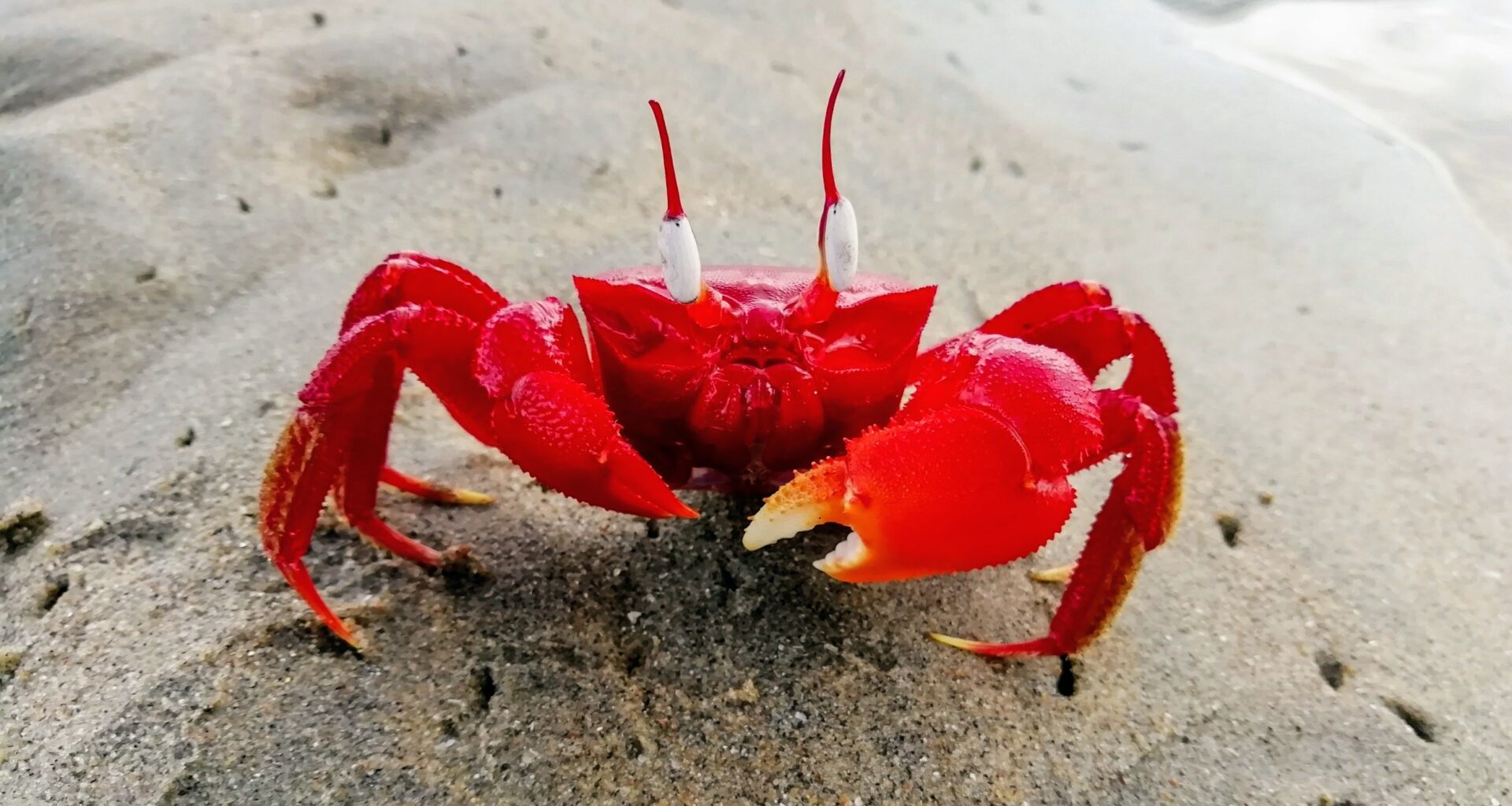
Ask anyone to describe how a crab moves, and you’ll get the same answer: sideways. It’s the signature feature – the thing that makes crabs unmistakably crabs.
But here’s a question that has actually been nagging biologists for decades: when did crabs start doing this, how often has it evolved, and what did it do for them as a group?

A new study published in eLife has taken the most comprehensive look at crab walking yet, and the answers it turned up are genuinely surprising.
Why crabs walk sideways
Biologists have studied crab anatomy in detail for decades. Still, their movement remained poorly measured. Most people assumed all crabs walked sideways, but that is not entirely true.
“Despite the rich information available on true crabs, data concerning their locomotor behaviors are sparse,” said study senior author Yuuki Kawabata, associate professor at Nagasaki University.
“Although most true crab species use sideways locomotion, there are some groups that walk forwards, which raises some interesting questions. When did their sideways locomotion originate, how many times over the years did it evolve, and how many times did it revert?”
These questions required careful observation across many species, something that had not been done at this scale before.
Filming dozens of crab species
The research team collected 50 crab species from different environments.
Some came from tidal zones, with others from aquariums and fish markets. Each species lived in a setup that matched its natural habitat, including sand, freshwater, or seawater.
Researchers placed each crab inside a circular arena. After a short-rest period, they removed a barrier and recorded the crab’s movement for ten minutes.
This simple setup allowed them to compare behavior under controlled conditions.
Measuring how crabs move
The team turned each recording into data. They tracked two points on each crab’s body frame-by-frame. Then they measured the direction of movement relative to the body.
The results showed a sharp divide. Out of 50 species, 35 walked sideways and 15 walked forward. Very few species showed mixed behaviour.
Statistical analysis confirmed this pattern. Crabs did not form a gradual range. Instead, they split into two distinct groups. A crab either walks sideways or it does not.
A clear pattern emerges
The researchers then mapped these results onto a large evolutionary tree built from genetic data. The pattern became clear.
Sideways walking appeared only once in crab evolution. It began in a group called Eubrachyura, which includes most modern crabs. Earlier groups retained forward movement.
This means every crab that walks sideways shares a common ancestor that lived about 200 million years ago.
“This single event contrasts starkly with carcinization, which has occurred repeatedly across decapod species. This highlights that while body shapes may converge multiple times, behavioral changes such as sideways walking can be rare,” said Kawabata.
Some crabs reverted
Evolution did not move in only one direction. The researchers found at least six cases where crabs returned to forward walking.
These include spider crabs, soldier crabs, and pea crabs. Each group adapted to different lifestyles that reduced the need for rapid escape.
Even though sideways walking offers clear benefits, it can be lost when conditions change.
The advantage of moving sideways
Sideways movement gives crabs a major advantage. They can move left or right at similar speeds without turning their bodies.
This ability makes their movement less predictable. A predator cannot easily guess which direction the crab will take.
Experiments with crab-like robots support this idea. Sideways movement proves faster and more efficient for a wide-bodied shape.
A boost in diversity
The evolutionary impact of sideways walking becomes clear when looking at species numbers. The group that adopted this movement includes thousands of species.
In contrast, related groups that kept forward walking include far fewer species. This suggests that sideways movement helped crabs expand into many environments.
“Sideways locomotion may have contributed significantly to the ecological success of true crabs,” said Kawabata.
Crabs spread across habitats
There are about 7,900 types of true crabs. This is a very large number compared to their close relatives, like Anomura and Astacidea, which have far fewer species.
These crabs live almost everywhere. You can find them on land, in rivers and lakes, and even in the deep ocean.
Also, the crab-like body shape has appeared many times in different animal groups over millions of years. This repeated pattern is called carcinisation.
When change makes sense
Crabs that returned to forward walking often rely on other strategies. Soldier crabs move in large groups. Spider crabs use camouflage. Pea crabs live inside other animals.
In these cases, speed matters less. Protection comes from behavior or environment rather than escape. This explains why sideways walking is not always necessary.
Many animals look like crabs but do not walk sideways. King crabs and coconut crabs are good examples.
This shows that body shape alone does not determine movement. Behaviour evolves under its own pressures. Looking like a crab does not guarantee moving like one.
A moment in time
The origin of sideways walking happened around 200 million years ago. This period followed a major mass extinction.
Such events reshape ecosystems and create new opportunities. A new movement style may have helped crabs take advantage of these open niches.
Still, scientists need more data to separate the effects of behavior and environment.
“To disentangle the relative roles of innovation and environmental change, we need further analyses of trait-dependent diversification, fossil-informed timelines and performance tests that link true crabs’ sideways movement to adaptive advantages,” said Kawabata.
A rare innovation
Sideways walking is uncommon in the animal world. Only a few other species show similar movement patterns.
This makes the crab example especially interesting. A single behavioral change had a large impact over millions of years.
“These current results highlight that sideways locomotion in true crabs is a rare but innovative trait that may have contributed to their ecological success,” noted Kawabata.
“Such innovations can open new adaptive opportunities and yet remain constrained by phylogenetic history and ecological contexts.”
The study is published in the journal eLife.
—–
Like what you read? Subscribe to our newsletter for engaging articles, exclusive content, and the latest updates.
Check us out on EarthSnap, a free app brought to you by Eric Ralls and Earth.com.
—–