
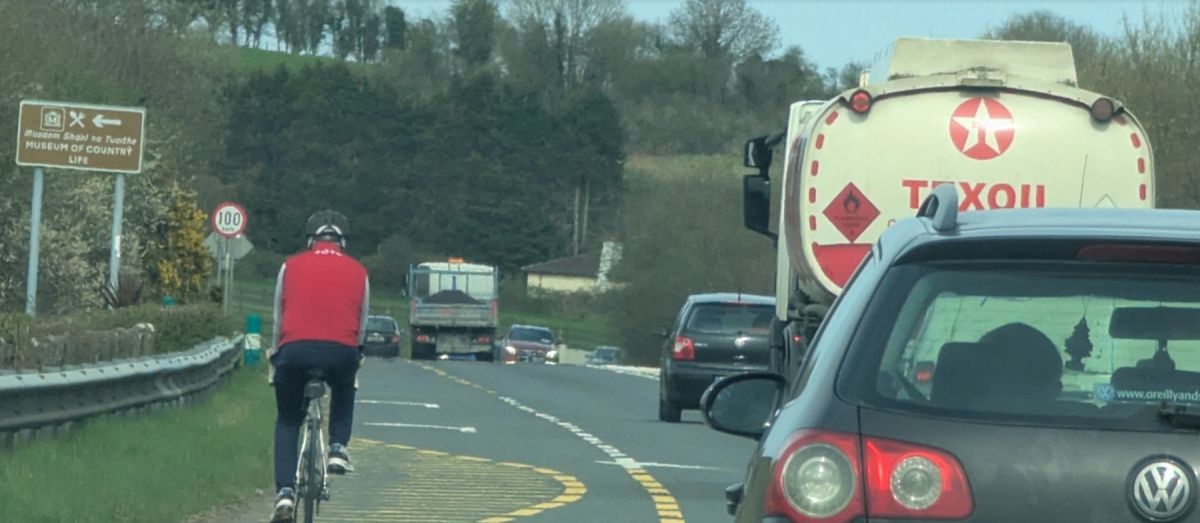
More than half of Cycling Ireland members surveyed experienced a close pass in which a motorist passed dangerously close on their last cycle, and 51.5% said they were involved in a collision or a serious near miss within the last 12 months.
The details are from a survey released today by the cycling sports body. Cycling Ireland said the online survey was published through its channels and social media, and there were 2,191 valid responses. The group said that respondents are “skewed towards experienced, male, older cyclists who are active Cycling Ireland members”. Of the respondents, 96.7% said they hold a valid driver’s license.
It said respondents were a “self-selecting sample and should not be read as representative of all people who cycle in Ireland. However, it does represent the core Cycling Ireland membership – the community most directly engaged in road cycling and most exposed to the safety challenges described in this report.”
On close passes, while a majority said that motorists pass them too closely on most rides, another 23% said they experience such dangerous passes weekly, and another 15% said they encounter them monthly. Only 7.4% of respondents said they experience closed passes “rarely”, and only 0.1% said they never do.

Other key responses show that a majority (55.5%) of respondents believe roads have become more dangerous year-on-year, and 65.3% rate current cycling infrastructure as “poor,” “very poor,” or “non-existent”.
Cycling Ireland said that respondents told them that only 11.2% of incidents are reported to An Garda Síochána or the PSNI. But even with this selectiveness, nearly 44% of those who do report expressing dissatisfaction with the outcome.
While single-vehicle crashes are common among sporting cyclists, among the over 51% who said they were involved in a collision or a serious near miss within the last 12 months, most who outlined what happened said they were referring to incidents with motorists.


The group said it has calculated an estimated annual health economic cost of approximately €7.5 million because people are cycling less frequently due to safety concerns.
Responding to the findings, Cycling Ireland said that it is calling for a coordinated awareness multi-stakeholder campaign targeting driver behaviour, including highlighting the dangers of close passing; an online reporting system, similar to the UK’s Operation Snap, to allow cyclists to submit camera footage of dangerous incidents; and proper resourcing of the Garda Road Policing unit, which it highlights has fallen from over 1,000 officers strong to just 650 members.
The sports body also said that there was an “urgent” need for segregated cycling lanes designed to “meet the needs of commuters and leisure riders alike.”
Ciarán Cannon, president of Cycling Ireland, said: “This report reflects the views of more than two thousand experienced cyclists. What we are hearing is consistent, widespread, and deeply worrying. These are people who understand the road, most of whom both drive and cycle, and they are telling us clearly that our roads are not safe enough. When more than half have experienced a serious incident in the past year, that is not a marginal issue; it is a systemic one.”
“The message from cyclists is clear and urgent. This is not just about individual incidents; it points to deeper problems in how our roads are designed, how behaviour is managed, and how incidents are reported and addressed. But the report also shows a community that is engaged, constructive, and ready to be part of the solution. The evidence is there. The question now is whether we are prepared to act on it,” he said.
Tim Farmer, chairperson of the Cycling Ireland Road Safety Commission, said: “Although this report paints a stark picture and provides evidence of the dangers we are seeing, especially on close passes and high incident rates. It shows the areas where small changes can make a significant difference. A whole-of-system approach will make our roads safer for all users. With improved planning and policing, we can achieve safer roads.”
Like this:
Like Loading…
Related