
Main PointsUS president Donald Trump on Thursday said the ceasefire between Israel and Lebanon would be extended by three weeks.Trump also said the US is going to work with Lebanon to help it “protect itself” from HizbullahTrump said “I don’t want to rush myself” on a deal with IranIDF and Hizbullah accuse each other of violating ceasefireUS–Iran peace talks that were slated to resume this week in Pakistan have been thrown into doubtOil prices resumed their rise this morningKey ReadsThe US Capitol police officer swept up in a January 6th conspiracy theoryAnalysis: Iran war has drained US supplies of critical and costly weaponsExplainer: Iran’s hardliners are winning out over pragmatists
Ronan McGreevy – 1 hour ago
Germany rallies to Spain’s defence
European allies have been pushing back against claims that the US is seeking the expulsion of Spain from NATO.
A German government spokesperson said on Friday that Spain’s NATO membership was not in question.
The spokesperson was responding to a journalist’s question about a Reuters report citing an internal Pentagon email which lists Spain’s suspension from the alliance as an option under consideration.
“Spain is a member of NATO. And I see no reason why that should change,” the spokesperson said during a regular news conference in Berlin.”
Spanish prime minister Pedro Sánchez said he brushed off a report that US officials are considering suspending his country from the alliance for its stance on the Iran war.
Spain doesn’t “work based on emails, but on official documents and positions issued by the US government,” Sánchez told reporters as European leaders gathered for a summit in Cyprus on Friday.
Ronan McGreevy – 1 hour ago
Could the US pull support for the UK territorial claim to the Falkland Islands?
The UK insisted the sovereignty of the Falkland Islands was “not in question” after reports the US administration could review its position on the South Atlantic territory in retaliation for Sir Keir Starmer’s lack of support for the war in Iran.
An internal Pentagon email set out options for Donald Trump’s administration to punish Nato allies for refusing to join the US-Israeli strikes against Iran.
The memo, first reported by Reuters, suggests reassessing US diplomatic support for “imperial possessions” such as the Falklands.
The potential for a shift in the US position has been considered in the Foreign Office although it has been treated as a “hypothetical scenario”.
Downing Street said the UK’s stance on the Falklands was not going to change.
“The Falkland Islands have previously voted overwhelmingly in favour of remaining a UK overseas territory, and we’ve always stood behind the islanders’ right to self-determination and the fact that sovereignty rests with the UK,” a No 10 spokesman said.
“The question of the Falkland Islands and the UK’s sovereignty and the islanders’ right to self-determination is not in question, and we’ve expressed that position clearly and consistently.”
The row is the latest sign of the strains in the US-UK relationship as the King and Queen prepare for their state visit on Monday.
The No 10 spokesman said: “We are absolutely confident the state visit will showcase the very best of the UK-US bilateral relationship, from security to our economic ties, and our people to people relationships.”
Argentina has long claimed sovereignty over the Falkland Islands and invaded them in 1982 before being defeated in a short but bloody war.
The US president is an ally of Argentina’s president Javier Milei and Mr Trump’s relationship with Sir Keir has deteriorated dramatically since the start of the Iran crisis.
The Prime Minister has refused to give the US free rein in its use of British military bases to conduct the bombing campaign against Iran.
Limited permission was granted for bases – including RAF Fairford in Gloucestershire and Diego Garcia in the British Indian Ocean Territory – to be used in defensive actions against Iran’s missile sites and installations threatening the Strait of Hormuz, but only after Tehran’s retaliatory actions began.
The US state department describes the Falklands as “administered by the United Kingdom, claimed by Argentina” and uses the Spanish name Islas Malvinas alongside the English name.
Ben Judah, who was a special adviser to former foreign secretary David Lammy, said “the Milei issue is actually a concern”.
Responding to the reports from the US, he said: “This was a then still hypothetical scenario I had concerns about when I was working in the Foreign Office on the UK’s overseas territories.”
He suggested converting them from overseas territories to overseas kingdoms, represented by MPs elected to Westminster.
“If this were already the case, His Majesty would be visiting Washington to see Trump this week as King of the Kingdom of the Falklands.”
The Pentagon email expressed frustration at Nato allies’ reluctance to grant access, basing and overflight (ABO) rights for the Iran war.
It suggested Spain could be suspended from the Nato alliance over its refusal to allow bases or airspace to be used to attack Iran.
Downing Street backs Spain’s membership of the “absolutely critical” alliance.
Tory leader Kemi Badenoch said the US stance was “absolute nonsense”.
She said: “We need to make sure that we back the Falklands. They are British territory.
“I don’t know what Donald Trump is talking about. This sounds like the sort of thing he was saying when it came to Greenland.”
Ronan McGreevy – 2 hours ago
Will oil price rises make staycations inevitable?
The plans of many holiday-makers are up in the air with war in the Middle East, airline upheaval, jet fuel supply fears and a fresh cost-of-living crisis casting a long shadow over the summer and beyond.
Uncertainty has seen many who routinely travel overseas hold off on bookings while many who come to Ireland from elsewhere are equally reticent to commit.
The unease has raised the prospect of a staycation once again for some and another challenging year for hoteliers who struggle to survive on domestic business alone.
Last weekend Aer Lingus started cutting hundreds of flights from its schedule because of “mandatory maintenance”, while Ryanair has been talking up the risk of fuel shortages.
Our consumer affairs correspondent Conor Pope has more.
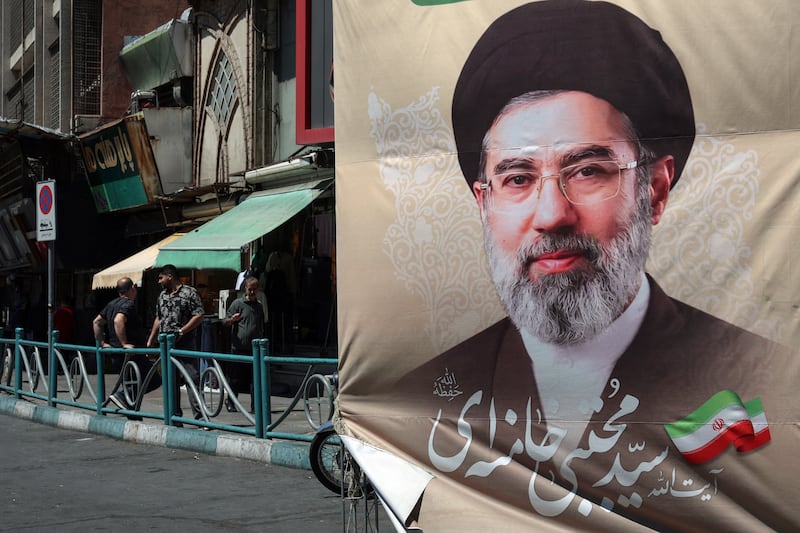 Iranians stand on a pavement along a street next to a billboard depicting Iran’s Supreme Leader Ayatollah Mojtaba Khamenei, in Tehran on April 24, 2026. (Photo by AFP via Getty Images) /
Ronan McGreevy – 3 hours ago
Islamabad waits for the talks that are not happening
For nearly a week, Pakistan’s capital has been waiting for peace talks between the US and Iran to take place there, and although there is no sign the two sides will meet, large parts of the city remain sealed off by authorities.
Key roads leading into Islamabad are shut down and a strict security cordon envelops the administrative centre, the so-called “Red Zone”.
In the adjacent “Blue Area”, cafes have run out of fruit, markets are deserted and with no service at bus terminals, weekend commuters are struggling to get home.
Government officials say the measures are not ending any time soon and that they are ever ready for delegates, including US president Donald Trump, to show up at a moment’s notice.
“We have been told that the talks could be held any day,” one official said.
The current lockdown is the second in two weeks. Islamabad was first sealed off for talks between US and Iranian delegations on April 11 that ended without a deal.
The city briefly reopened, then locked down again as Pakistan waits to host a second round that has yet to materialise.
For residents, uncertainty has become the hardest part. Islamabad is a city of transients, where many residents work during the week and return to family homes at the weekend. Now, that pattern has been interrupted – (Reuters)
Lebanese MP Najat Saliba praises Israel-Lebanon ceasefire extension
Lebanese MP Najat Saliba has praised the Israel-Lebanon ceasefire extension, saying it will help many people in the area.
Speaking to Newsday on the BBC World Service, Saliba said: “Everybody is relieved that the ceasefire is going to continue for another three weeks. This is going to help a lot of people go back to their homes, check out their homes and get going with their lives.”
When asked about how Hizbullah could respond to the ceasefire extension agreement, she said “we don’t expect things to go forward very smoothly”. But she added the Lebanese government is “very firm about going forward with the discussion in order for us to find a common ground that will relieve the people from all the bombing and killing”. – The Guardian
Norway should use wealth fund for aid, Refugee Council says
Norway should use some of the income from its $2.2 trillion (€1.8tn) sovereign wealth fund, the world’s largest, to help civilians suffering from the war in Iran, like it did for Ukraine, the head of the Norwegian Refugee Council aid group said.
The NRC is one of the world’s leading non-governmental aid organisations focused on displacement.
After Moscow’s 2022 full-scale invasion of Ukraine, Norway set up a long-term aid plan for Kyiv, with the backing of all parties in parliament, amounting to some $28 billion (€24bn) between 2023 and 2030, among Ukraine’s most generous backers per capita.
Jan Egeland, who was the top UN humanitarian official from 2003 to 2006 and a deputy Norwegian foreign minister in the 1990s, said Norway should do the same in the wake of the Iran war.
“Norway has now given enormous sums to Ukraine. And one of the arguments is that we earned a lot of money on oil and gas prices going through the roof. Why not say the same here?,” he told foreign reporters at NRC headquarters in Oslo.
“Let’s give to the Lebanese and the Iranians and the other victims of this war, direct and indirect, because the oil prices are now $100 (€85.55) per barrel.” – Reuters
Here are some of the latest images documenting the impact of the conflict in the Middle East:
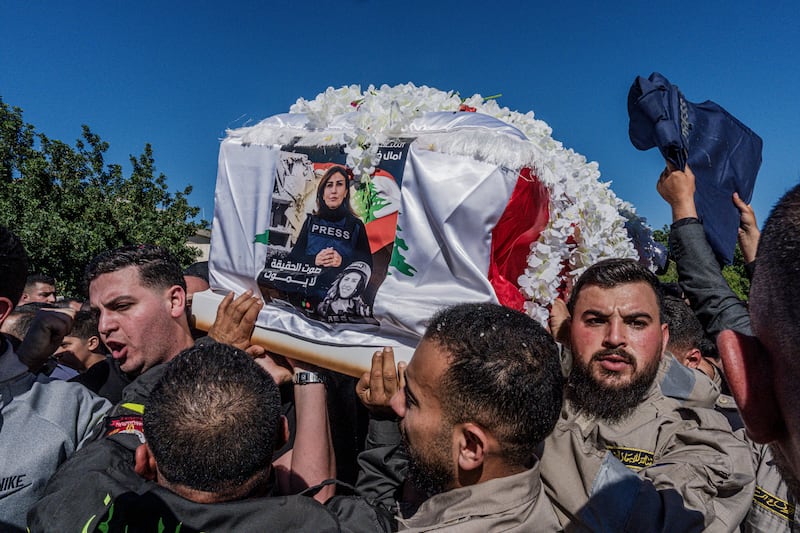 Mourners carry the coffin of Amal Khalil, a journalist who was killed by an Israeli strike, during her funeral procession in Baisariyeh, Lebanon, on Thursday. Photograph by Daniel Berehulak/The New York Times
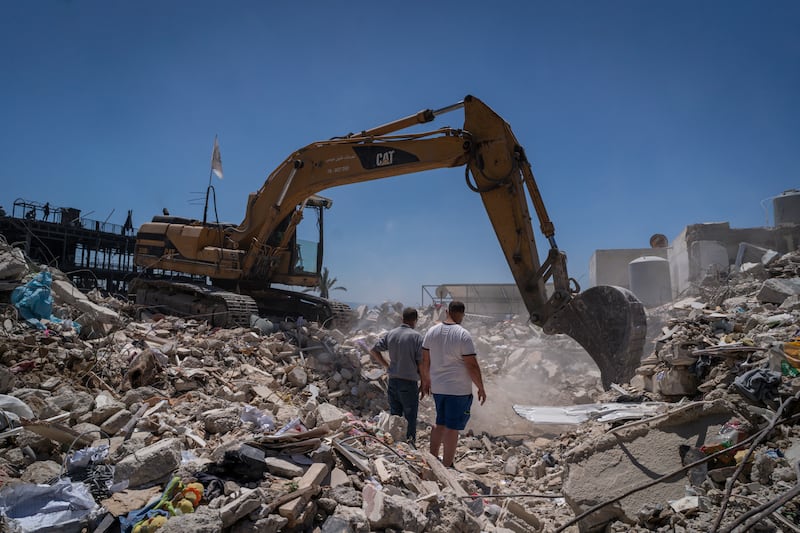 The aftermath of an Israeli airstrike where 30 people died in Tyre, Lebanon, is pictured on Thursday. Photograph by Adri Salido/Getty Images
 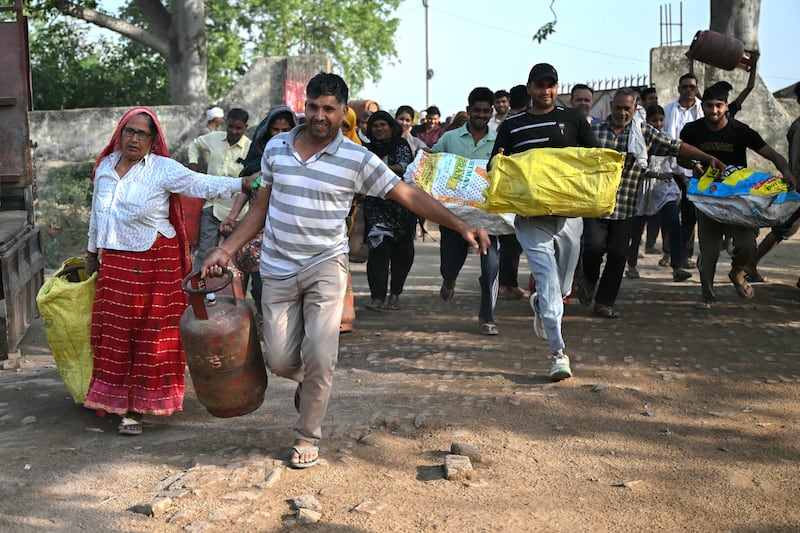 People carrying empty LPG (liquefied petroleum gas) cylinders run to stand in a queue before buying refilled gas cylinders in a village on the outskirts of Jewar, India, on Friday. Photograph by Arun Sankar/AFP via Getty Images
 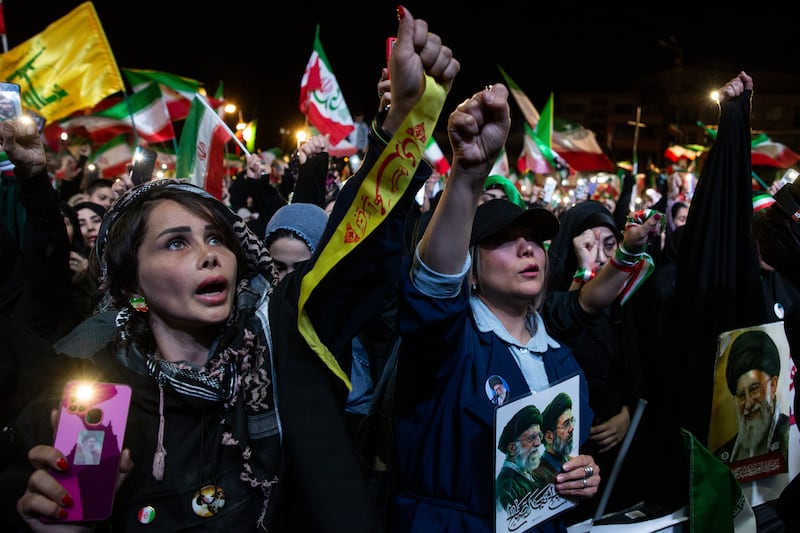 Women chant at a pro-government demonstration in Enghelab Square in Tehran, Iran, on Wednesday. Photograph by Arash Khamooshi/The New York Times
Hegseth to host Iran press conference
US defence secretary Pete Hegseth and chair of the joint chiefs of staff Dan Caine, the highest-ranking military officer in the United States, will host a press conference on Operation Epic Fury, the bombing of Iran, at 1pm Irish time. We will bring you updates from the event later.
German business sentiment falls in April to lowest level since 2020
German business morale fell more than expected in April, as the Iran war made companies more pessimistic and threatened the long-awaited recovery of Europe’s biggest economy.
The Ifo institute said on Friday its business climate index fell to 84.4 in April from 86.3 in March, posting the lowest reading since May 2020.
Analysts polled by Reuters had forecast a slight decline to 85.5.
“The Iran crisis is hitting the German economy hard,” said Clemens Fuest, president of the Ifo institute
Assessments of the current situation fell to 85.4 from 86.7 in the previous month, while expectations declined to 83.3 from 85.9 in March. – Reuters
Taoiseach says US military personnel landing in Shannon Airport were ‘commercial flights’
Taoiseach Micheál Martin has said, unlike many other European countries, Ireland did not host any US military bases on its territory, reports Europe Correspondent Jack Power.
Aircraft carrying US military personnel landing in Shannon Airport were “commercial flights”, he said.
Martin was responding to reporting in The Irish Times showing the number of US troops travelling through Ireland has increased by almost 80 per cent before and during US attacks on Iran.
Soldiers transiting through the airport in Co Clare are typically armed with personnel weapons. Foreign governments are required to seek prior permission to transport weapons through Ireland.
“We don’t have a [US] military base, good, bad or indifferent, never have had, unlike other European member states who do,” Martin said. “We do not have military bases in Ireland, [we] need to make that point very clearly.”
The Taoiseach was speaking on Friday morning in Nicosia, Cyprus, where he was attending the second day of an EU leaders’ summit.
“For years American soldiers coming back from bases in Europe or elsewhere have come through Shannon. So I think we need to be cautious in terms of interpreting those figures and we need to get a more comprehensive assessment of that,” Martin said.
Many of the troops involved in the war in Iran had travelled to the region aboard US “aircraft carriers and so on”, he said.
“We have very clear frameworks in terms of both planes that transit through Shannon and land in Shannon for refueling on the way back to America or to various other locations, and also in terms of overflights,” he said.
Message from the Editor
 Irish Times Editor Ruadhán Mac Cormaic
Thanks for reading. If you’re interested in world news, The Irish Times has the largest network of foreign correspondents of any Irish news organisation.
Our team provides sharp reporting, in-depth analysis and thought-provoking commentary. Receive our Global Briefing newsletter in your inbox every morning to enjoy Denis Staunton’s guide to understanding world events; what’s happening, why it matters and how it affects you.
At The Irish Times, our journalism is free of any personal, political or commercial control. Unlike most publishers, we have no shareholders to satisfy, no media baron owner in the background telling us what we can and cannot publish.
We are owned by a Trust that mandates us to uphold a set of public-interest values. Those values describe a worldview that is outward-looking, tolerant, curious, interested in divergent views and attentive to the needs of minorities.
Our watchwords are fairness and accuracy. Our goal is to enable you to make informed and independent judgments. And any profit we make goes towards supporting our journalism.
Ruadhán Mac Cormaic
Editor
To join Ireland’s biggest community of news subscribers, sign up hereIran’s ‘eye for an eye’ warning to US over oil strikes
Iran’s deputy president has warned the US of “an eye for an eye” over oil strikes, the Mehr news agency has reported.
According to the outlet, Esmaeil Saqab Esfahani said: “If the enemy makes another mistake, our strategy will be an eye for an eye. If any of our oil wells are hit, one of the oil [facilities] of the countries from whose soil we are attacked will be targeted.”
He added that Tehran’s negotiation team has “grabbed the enemy’s collar at the negotiating table”.
Esfahani also said Iranians shouldn’t worry about their energy supply as the “necessary arrangements” have been made.
This comes after US president Donald Trump has repeatedly threatened to strike oil plants in the area, as well as threatening to “obliterate” Iran’s power stations and fresh water plants. – The Guardian
Hapag-Lloyd says one ship has crossed Strait of Hormuz
A Hapag-Lloyd spokesperson said on Friday that one of its ships has crossed the Strait of Hormuz but did not have any information on the circumstance or timing.
The spokesperson for the German company said that four out of initially six ships now remain in the Gulf, after one ship’s charter agreement expired, meaning it no longer belongs to the Hapag-Lloyd fleet. – Reuters
Iran deal must include nuclear experts, says EU foreign chief
The EU’s foreign chief has said that talks with Iran should include nuclear experts, otherwise “we will end up with a more dangerous Iran”.
Speaking on Friday ahead of an informal summit of EU leaders in Cyprus, EU’s foreign chief Kaja Kallas said: “If … there are no nuclear experts around the table, then we will end up with an agreement that is weaker than the JCPOA was.”
(The JCPOA refers to the Joint Comprehensive Plan of Action, more commonly known as the Iran nuclear deal, an international agreement to limit the Iranian nuclear programme in return for relief from sanctions.)
Kallas continued: “And (if) the problems in the region, missile programmes, their support to proxies, also hybrid and cyber activities in Europe are not addressed, we will end up with a more dangerous Iran.” – The Guardian
Europe’s relationship with Israel must be put under microscope – Taoiseach 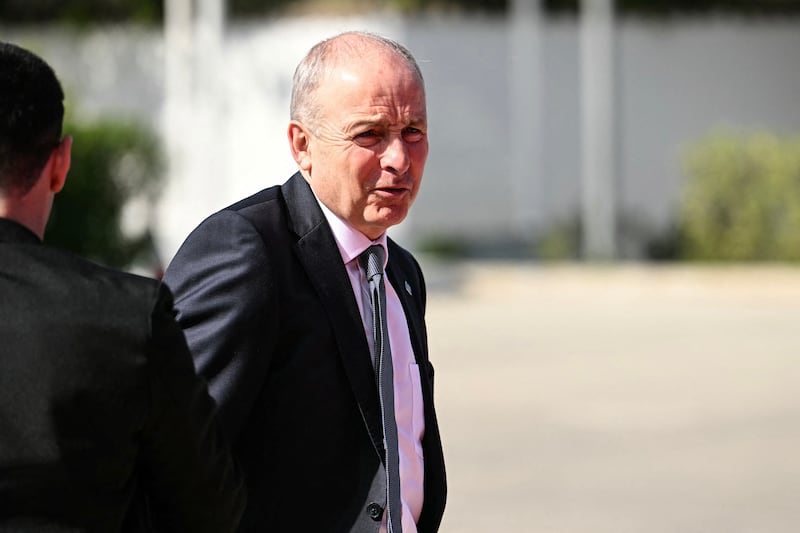 Taoiseach Micheál Martin arrives for an informal meeting of the European Council in Nicosia on Friday. Photograph by Nicolas Tucat/AFP via Getty Images
Taoiseach Micheál Martin said Europe’s relationship with Israel had to be put under microscope, in light of its “reckless” bombing of civilian infrastructure in Lebanon, reports Europe Correspondent Jack Power.
EU leaders are meeting for the second day of a summit in Cyprus where the war in Iran and the resulting energy crisis is high on the agenda.
Speaking on Friday morning in Nicosia, the capital of the Mediterranean island, Martin said Israel’s attacks on civilian infrastructure in Lebanon during the war it launched against Hizbullah militants was “absolutely disproportionate” and “unacceptable”.
“There has been a lot of displacement of civilian populations, significant consequences can flow from that, but fundamentally we welcome the fact now that there’s a ceasefire that has been extended in Lebanon,” he sad.
However, the Taoiseach said the international community “can’t be overly confident” that the further three-week halt to the fighting between Israel and Hizbullah militants would hold up.
Martin said he told his fellow EU leaders there had to be further scrutiny of the union’s relationship with Israel, “notwithstanding the provocations from Hizbullah and the continuing firing of rockets by Hizbullah into Israel, which has to stop”.
US troop numbers passing through Shannon soar 80%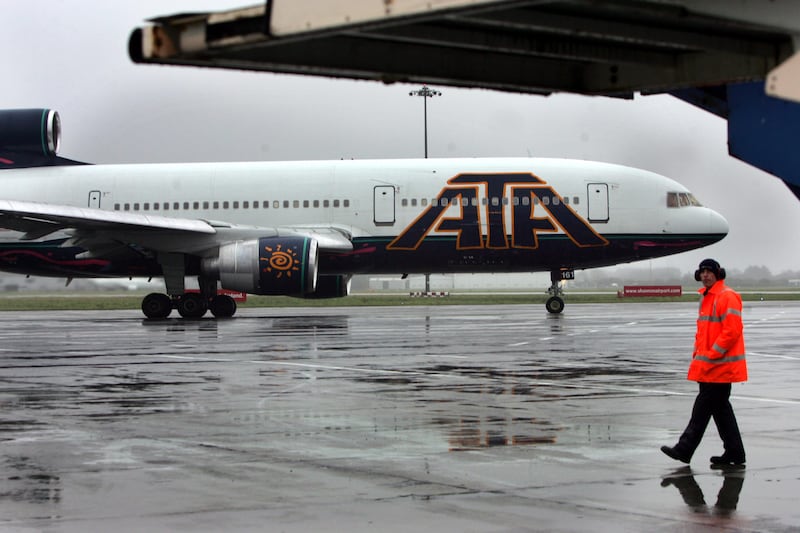 An American Transair Boeing 757 troop charter aircraft at Shannon Airport in December 2006. Photograph: Matt Kavanagh
The number of United States troops travelling through Ireland has increased by almost 80 per cent before and during US attacks on Iran, figures obtained by The Irish Times show.
In January, 2,012 troops passed through Shannon Airport. The following month, as the US and Israel prepared for war, that figure rose to 2,602. In March, after the start of the conflict, it increased to 3,604.
In total, 8,218 US troops transited through Shannon, according to figures provided by Shannon Airport Group. The March figure represents a 79 per cent increase on the numbers arriving in January.
Read the full report by Conor Gallagher and Mark Weiss here.
China rejects Trump accusation that intercepted Iran ship was ‘gift from China’
China’s foreign ministry has rejected an accusation by US president Donald Trump that an Iranian-flagged cargo ship intercepted by US forces was a “gift from China”.
Trump on Tuesday told CNBC the ship was “a gift from China, perhaps, I don’t know”.
China’s foreign ministry rejected the comments. “China opposes any accusations and associations that lack a factual basis,” ministry spokesperson Guo Jiakun told reporters in Beijing on Friday.
“Normal international trade relations between countries should not be subject to interference and disruption,” he added.
The container ship Touska, which was boarded and seized by US forces on Sunday, is likely to have what Washington deems dual-use items that could be used by the military on board, maritime security sources said on Monday. – Reuters
FTSE 100 opens lower
The London stock market is dropping in early trading, as investors digest the lack of progress towards ending the Iran war.
The FTSE 100 share index is down 48 points, or 0.46 per cent, at 10,408 points. Mondi (-5.8%) is the top faller, after the packaging group warned this morning that the Middle East conflict was pushing up its costs.
Mondi is lifting its prices to offset higher costs amid ongoing tough trading that has seen it close factories and cut jobs across Europe. The group – headquartered in Surrey, England – said 450 jobs were being axed this year after plans announced earlier this month to shut another three factories in Hungary, Poland and Germany. – The Guardian and PA
Iran war has drained US supplies of critical and costly weapons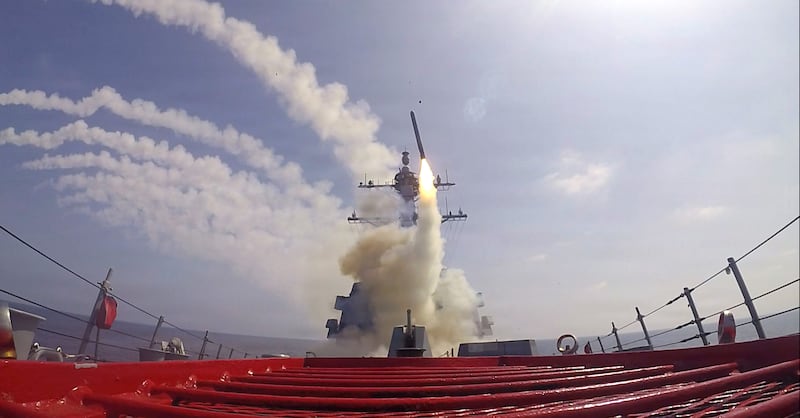 The US military has fired off more than 1,000 Tomahawk cruise missiles, roughly 10 times the number it currently buys each year. Photograph: US Navy via Getty Images
Since the Iran war began in late February, the United States has burned through around 1,100 of its long-range stealth cruise missiles built for a war with China, close to the total number remaining in the US stockpile. The military has fired off more than 1,000 Tomahawk cruise missiles, roughly 10 times the number it currently buys each year.
The Pentagon used more than 1,200 Patriot interceptor missiles in the war, at more than $4 million (€3.4bn) a pop, and more than 1,000 “precision strike” and ground-based missiles, leaving inventories worrisomely low, according to internal US defense department estimates and congressional officials.
The Iran war has significantly drained much of the US military’s global supply of munitions, and forced the Pentagon to rush bombs, missiles and other hardware to the Middle East from commands in Asia and Europe. The drawdowns have left these regional commands less ready to confront potential adversaries such as Russia and China, and it has forced the United States to find ways to scale up production to address the depletions, Trump administration and congressional officials say.
Read the full report here.
Japan’s Nikkei closes at record high
Japan’s Nikkei set a closing record high on Friday, capping a third consecutive weekly gain, as enthusiasm over technology sector earnings offset uncertainty over a potential peace deal in the Middle East.
The benchmark Nikkei 225 Index rose 0.97 per cent to close at an unprecedented 59,716.18. The gauge rose 2.1 per cent on the week. The broader Topix eked out a 0.01 per cent advance to end at 3,716.59.
The Nikkei briefly broke through the psychologically key 60,000 mark for the first time on Thursday, more than recouping all its losses since the war broke out in Iran almost two months ago and spread around the region.
South Korea has secured 74.62 million barrels of crude oil for May, equivalent to about 87 per cent of its average monthly imports last year, the presidential Blue House said on Friday, as Seoul seeks to stabilise energy supplies amid conflct in the Middle East.
The country has also reduced its reliance on crude imports from the Middle East to 56 per cent, down from from 69 per cent, by increasing shipments from the United States and Africa, presidential chief of staff Kang Hoon-sik said.
Kang said the government viewed stronger-than-expected first quarter economic growth as evidence of Seoul’s resilience despite geopolitical risks from the Middle East conflict, citing robust gains in semiconductor production and exports as well as swift government efforts to cushion energy supply disruptions. – Reuters
IDF and Hizbullah accuse each other of violating ceasefire
The Israel Defense Forces (IDF) and Hizbullah have accused each other of violating ceasefire agreements.
The IDF earlier said it had intercepted several projectiles launched from Lebanon, with sirens sounding in the Shtula area. Then, Hizbullah said on Telegram it targeted the area in a rocket attack.
⭕️ OVERNIGHT RECAP: Northern Israel
▪️Sirens sounded in Shtula following launches from Lebanon. The IDF intercepted the rockets & struck the launcher used to fire, along with an additional ready-to-launch launcher.
▪️3 Hezbollah terrorists were eliminated after unsuccessfully…
— Israel Defense Forces (@IDF) April 24, 2026
Writing on X, the IDF said three members of Hizbullah were “eliminated” following “blatant violations of the ceasefire understandings”.
Last night, Hizbullah said it had fired rockets at northern Israel in response to an Israeli “violation of the ceasefire”. – The Guardian
How Tucker Carlson soured on Donald Trump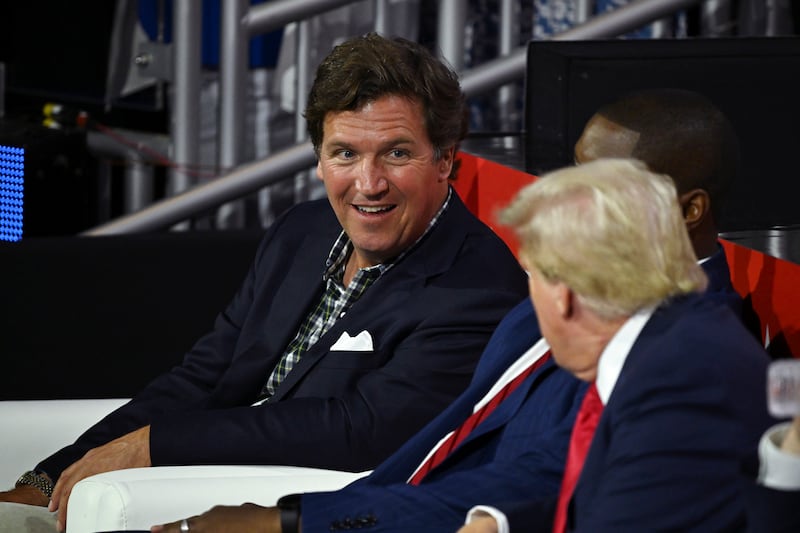 Tucker Carlson, pictured with Donald Trump in 2024, has said he will long be ‘tormented’ by his role in helping Trump return to the White House. Photograph by Kenny Holston/The New York Times
Conservative broadcaster Tucker Carlson has expressed remorse for supporting Donald Trump, saying he will long be “tormented” by his role in helping Trump return to the White House.
Washington Correspondent Keith Duggan has taken a look at how Carlson, who worked at Fox News from 2009 to 2023, soured on Trump. He writes:
Within the hierarchy of the Maga voices of influence, it was akin to a papal renunciation. For weeks, Tucker Carlson’s frustration with president Donald Trump’s “war of choice” with Iran had been simmering. But in his Monday podcast, while in conversation with his brother Buckley, also a disenchanted Trumpian with an endless array of Brooks Brothers plaid and gingham, Carlson reviewed, in long-lens elegy, his entire relationship with Trump.
He’d called the entire project wrong, he admitted, and issued a rueful apology for his role in helping to unleash a political force he has now come to see as ruinous and volatile.
“You and I and everyone who supported him … we’re implicated in this, for sure,” Carlson told his brother in a funereal tone towards the end of a two-hour broadcast.
Read the full analysis here.
Pentagon email floats suspending Spain from Nato over Iran rift
An internal Pentagon email outlines options for the United States to punish Nato allies it believes failed to support US operations in the war with Iran, including suspending Spain from the alliance and reviewing the US position on Britain’s claim to the Falkland Islands, a US official told Reuters.
The policy options are detailed in a note expressing frustration at some allies’ perceived reluctance or refusal to grant the United States access, basing and overflight rights – known as ABO – for the Iran war, said the official, who spoke on condition of anonymity to describe the email.
The email stated that ABO is “just the absolute baseline for Nato”, according to the official, who added that the options were circulating at high levels in the Pentagon.
One option in the email envisions suspending “difficult” countries from important or prestigious positions at Nato, the official said.
Read the full report here.
Iranian team can attend World Cup, says Rubio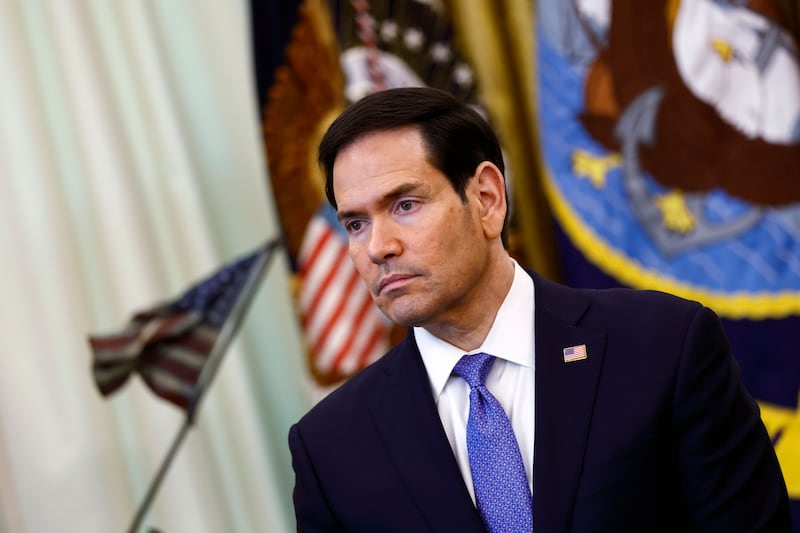 US secretary of state Marco Rubio listens as US president Donald Trump speaks to the media in the Oval Office at the White House on Thursday. Photograph by Will Oliver/EPA
Iran’s soccer team would be allowed to enter the United States to play in the World Cup this summer, but the Trump administration would deny entry to Iranians with ties to the country’s military, secretary of state Marco Rubio said on Thursday.
The United States is co-hosting the 48-team World Cup this year with Canada and Mexico, starting on June 11th. The Iranian team qualified for the tournament last year but its participation was thrown into considerable doubt after the United States and Israel launched their war against Iran in February.
During an event at the White House on Thursday, Rubio and US president Donald Trump both suggested that Iranian soccer players coming to the United States for the tournament would be welcome.
“Nothing from the US has told them they can’t come,” Rubio told reporters. “If they decide not to come on their own, it’s because they decided not to come.”
But Rubio said that anyone with ties to Iran’s Revolutionary Guard would not be allowed in.
“What they can’t bring is a bunch of IRGC terrorists into our country and pretend that they are journalists and athletic trainers,” he said, using an acronym for the Iranian paramilitary organisation.
“We would not want to affect the athletes,” Trump quickly added. – The New York Times
Russia could attack Nato members, says Tusk
Poland’s prime minister questioned whether the US would be “loyal” to its Nato commitment to defend Europe in the event of a Russian attack, and urged the EU to become a “real alliance” in protecting the continent.
Donald Tusk told the Financial Times that Europe’s “biggest, most important question is if the United States is ready to be as loyal as it is described in our [Nato] treaties”, as he warned that Russia could attack an alliance member in “months”.
There is growing uncertainty on the topic in Europe after US president Donald Trump’s threats and oscillating commitment to the continent’s defence.
“For the whole eastern flank, my neighbours . . . the question is if Nato is still an organisation ready, politically and also logistically, to react, for example against Russia if they try to attack,” Tusk said.
Global shares swing between gains and losses
Global shares swung between gains and losses on Friday and oil prices resumed their rise, as a shaky ceasefire in the Middle East war and stalled US-Iran peace talks gave investors little to cheer and dampened the market mood.
Futures pointed to a dour opening in Europe, as Euro Stoxx 50 futures slid 0.7 per cent and FTSE futures lost 0.76 per cent, while DAX futures eased 0.25 per cent.
MSCI’s broadest index of Asia-Pacific shares outside Japan reversed early losses to rise 0.46 per cent and was set to end the week with a roughly 1 per cent gain. Japan’s Nikkei added 0.85 per cent, stocks in South Korea and China fell, while those in Hong Kong were little changed.
Nasdaq futures gained 0.4 per cent while S&P 500 futures were flat.
The mixed showing underscored the tense market mood as investors this week seesawed between hope for an imminent end to the war and fear that it might not come soon. – Reuters
A US-sanctioned supertanker laden with Iranian oil appeared to be attempting to cross the Strait of Hormuz on Friday, with traffic through the waterway otherwise at a virtual standstill.
The Yuri, carrying two million barrels of crude loaded from Kharg Island, reappeared on ship-tracking platforms Kpler and Vortexa off Sirri Island earlier this week, after having stopped signalling its location for days. The tanker then began heading toward Hormuz late Thursday, and has just sailed past Larak Island.
The progress of the very-large crude carrier suggests that Tehran is still keen to test Washington’s resolve to maintain its blockade of the strait. American forces intercepted two Iranian oil tankers earlier this week, while the US Central Command said in a social-media post that 33 vessels had been redirected since the start of its blockade.
Iran has also been seeking to strengthen its grip on the strait, shooting at commercial ships and seizing at least two vessels. – Bloomberg
Israel-Lebanon ceasefire extended by three weeks
The ceasefire between Israel and Lebanon has been extended for three weeks following a meeting at the White House brokered by US president Donald Trump, who said he was prepared to wait for “the best deal” to end his conflict with Iran.
Fighting between Israel and Iranian-backed Hizbullah militants in Lebanon has been one of a number of sticking points to resolving the wider eight-week regional conflict, along with Iran’s nuclear ambitions and control of the crucial Strait of Hormuz.
Trump said he was in no rush to reach a peace agreement and wanted it to be “everlasting”, while continuing to assert that the US had a clear upper hand in the naval stand-off in the Strait.
A day after Iran flaunted its tightened grip over the key shipping corridor, Trump dismissed the threat posed by Iran’s “little wise-guy ships” and said he believed Tehran was hamstrung from making a deal because its leadership was in turmoil.
On Thursday, he said the US navy has orders to “shoot and kill” Iranian boats laying mines in the strait and the US could knock out in a day any refurbishing of weapons that Iran may have made during a ceasefire in place since April 8th. But navigation in the passage remained effectively blocked, and the Iranian capture of two huge cargo ships was a reminder that the US struggles to keep control of the strait and Tehran continued to cause trouble for oil markets and pose major strains to the global economy.
The US president later said that he had “total control over the strait of Hormuz”, adding that Iran’s leadership was so hobbled by infighting that it was unclear who was in charge.
But Trump’s claim seemed questionable in the face of the seizure of two container ships by Iranian commandos and a US report warning it could take six months to clear the strait of mines.
Trump’s comments on Thursday came after US special forces boarded a stateless oil tanker in the Indian Ocean, which the Pentagon claimed was carrying Iranian crude oil.
The military operation took place hours after Iran’s seizure of the two container ships, with the two sides continuing to impose competing blockades on the strait, keeping global oil prices at about $100 (€85.60) a barrel. – Reuters