
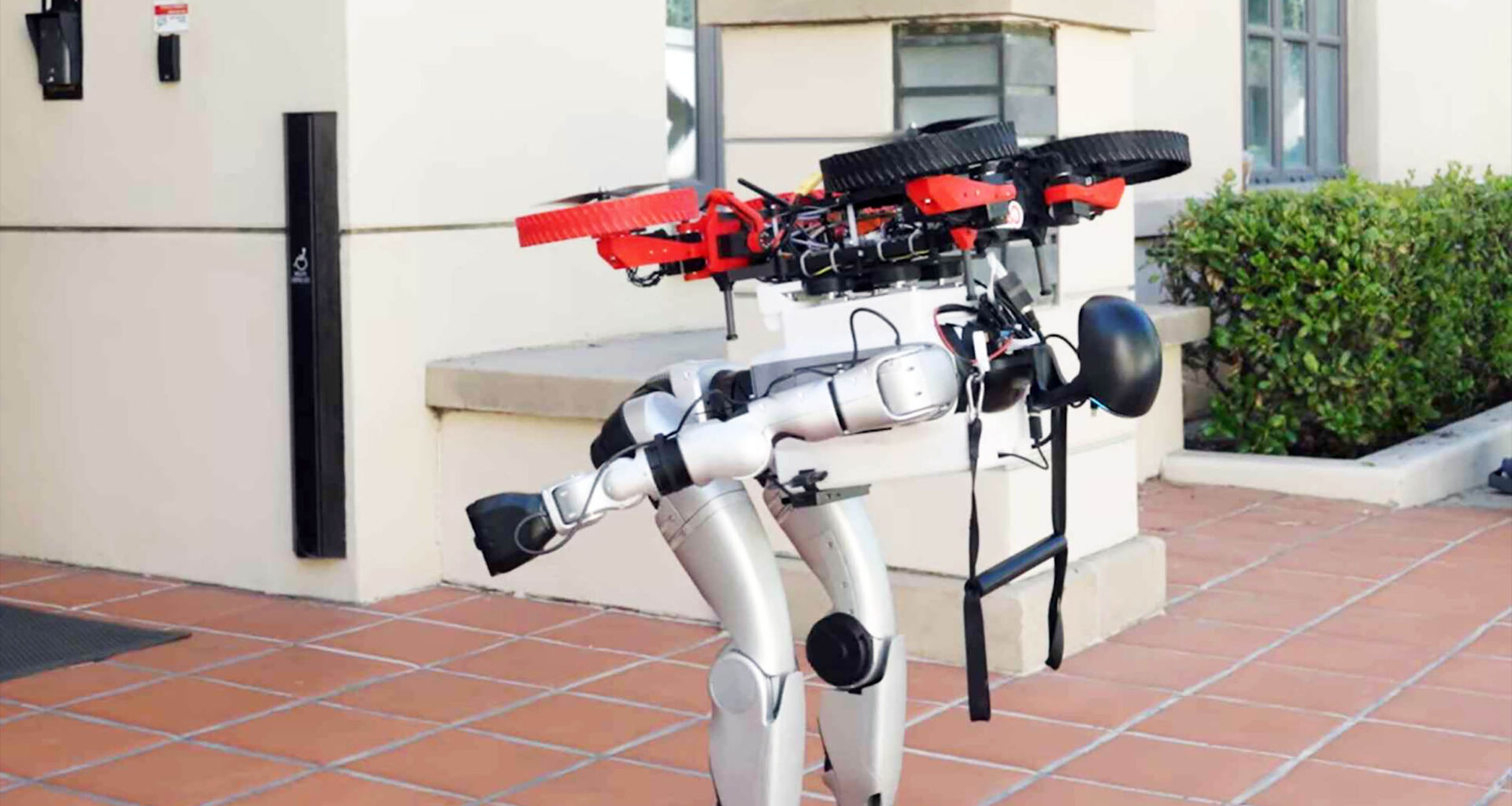
Late last year in Pasadena, a robot walked across the California Institute of Technology (CIT) campus with a second robot secured on its back. The two machines moved as a coordinated robot duo called X1, built for missions that are too risky or chaotic for people.
In a three year project, engineers at Caltech and Abu Dhabi’s Technology Innovation Institute (TII) turned the piggyback robots into a multirobot system.

That term means a tightly coordinated team in which each machine focuses on the tasks it can do most effectively.
How the X1 robot duo works
The work was led by Aaron Ames, a mechanical engineer and director of Caltech’s Center for Autonomous Systems and Technologies (CAST).
His research centers on autonomous robots, machines that plan and move without direct human commands, and on keeping their walking stable in messy environments.
At the core of X1 is a modified Unitree G1 humanoid that walks on two legs and can carry heavy gear.
On its back rides a morphing robot, a device that changes shape depending on the demands of the mission.
Beyond M4 and the humanoid, the project pulls in specialists from Abu Dhabi and Boston to make the pieces work together.
At the Technology Innovation Institute, engineers refine secure computing, tools that guard robot hardware, and Northeastern researchers tune mechanisms that let M4 change configuration.
In a recent report, collaborators described how M4 carries cameras, lidar, and range finders on board to sense its surroundings.
Those sensors let the pair localize themselves without joystick control and plan routes through cluttered areas.
X1 robot team built for rescue
During a demonstration, the X1 system started inside a campus lab, walked through a library, and reached an elevated outdoor spot near Caltech Hall.
That path gave the humanoid tight hallways, doorways, and steps to manage before it ever released its aerial partner.
At the edge of the open area, the humanoid bent so the M4 robot could lift off from its back in drone mode.
After landing, M4 folded its rotors into wheels, drove to a campus pond, then flew over the water to complete the mission.
The test followed a rescue style script, with X1 acting as a rapid first responder that could survey the scene before human crews arrived.
“Right now, robots can fly, robots can drive, and robots can walk,” said Aaron Ames, director of Caltech’s Center for Autonomous Systems and Technologies.
Walking, wheels, and wings
Single purpose robots struggle when the ground gets rough, the stairs get steep, or a route suddenly requires flight instead of rolling.
In the M4 study, researchers showed that the robot can roll, fly, crouch, and balance across obstacles that defeat simpler machines.
That flexibility is sometimes called locomotion plasticity, the ability of a robot to switch movement styles when conditions change.
M4 was designed around this idea, then scaled so it could carry computers and sensors heavy enough for truly autonomous missions.
Most humanoid robots still rely on recorded human motion for skills like walking and climbing, which limits how they cope with unfamiliar situations.
Ames’s group combines physics based models with machine learning, computer methods that infer patterns in data, so X1 can adjust when the terrain changes.
X1 uses that flexibility by letting the humanoid cover long stretches on foot while M4 saves energy for short bursts of driving and flight.
“The challenge is how to bring different robots to work together so, basically, they become one system,” said Mory Gharib, a professor at Caltech.
From lab demo to real emergencies
For now, X1 runs scripted missions, yet the team is working on safety critical control, methods that keep behavior safe even when sensors glitch.
That means proving not only that the robots can reach a destination, but that they will avoid risky moves when conditions are noisy.
Before machines like X1 roll into a disaster zone, the team wants to convince regulators and the public that such robots can be trusted.
That means demonstrating long runs without crashes, clear ways to audit decisions, and emergency stops that humans can trigger if something goes wrong.
At the Technology Innovation Institute, engineers provide secure onboard computers and flight controllers so the M4 drone can make fast decisions locally.
That capability matters when networks fail and operators want reliable autonomous navigation, movement planned by the robot instead of a human pilot.
If systems like X1 mature, they could someday scout damaged buildings or carry supplies through flooded streets without putting people at risk.
That mix of legs, wheels, and rotors hints at future first responders that decide for themselves when to walk, drive, or fly.
—–
Like what you read? Subscribe to our newsletter for engaging articles, exclusive content, and the latest updates.
Check us out on EarthSnap, a free app brought to you by Eric Ralls and Earth.com.
—–