
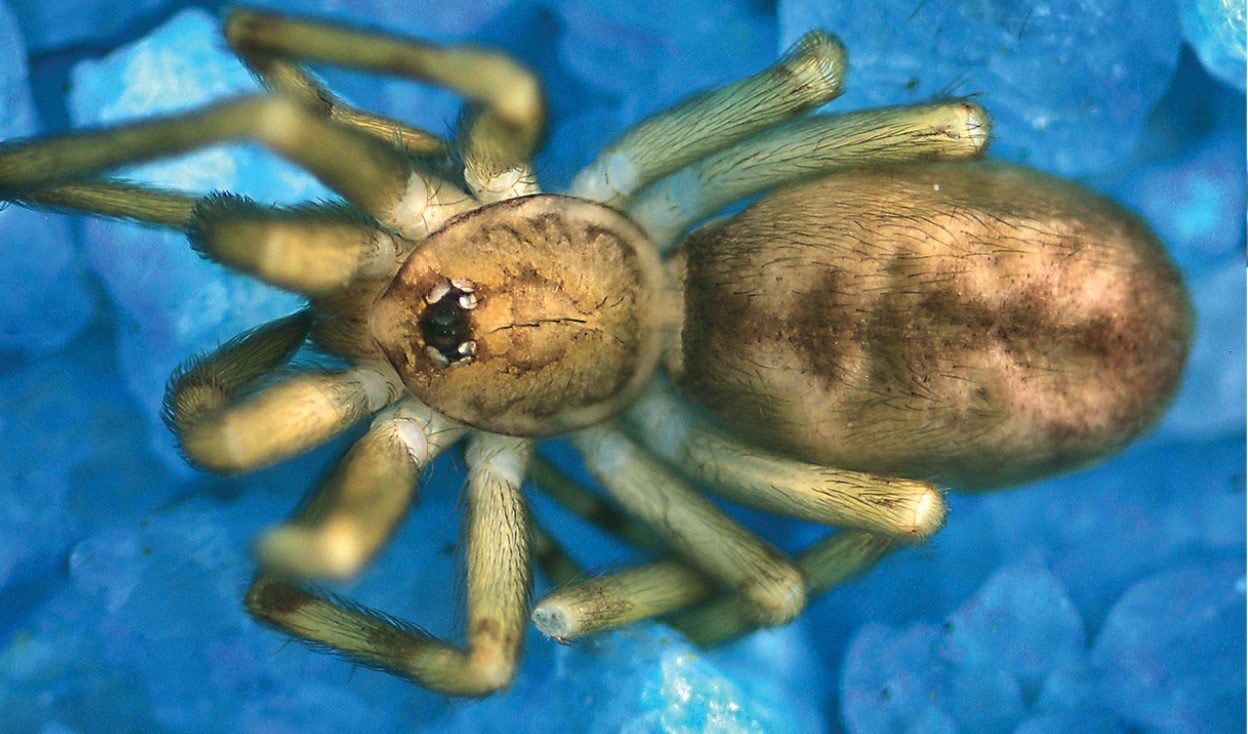
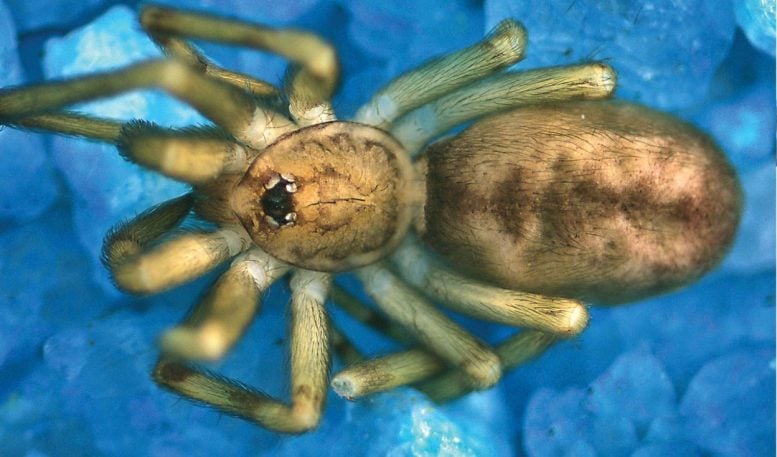
 Pikelinia floydmuraria, male paratype. Credit: Leonardo Delgado-Santa
Scientists discovered a tiny wall-dwelling spider that preys on common urban pests and may aid natural pest control. Its resemblance to a distant Galapagos species suggests a possible evolutionary link.
Researchers from several South American institutions have expanded understanding of the Pikelinia spider genus with the discovery of a new crevice weaver species, Pikelinia floydmuraria.
The name honors the iconic rock band Pink Floyd while also reflecting the spider’s preferred habitat. “Muraria,” derived from the Latin word for “wall,” points to its tendency to live within building walls and references the band’s album The Wall. The findings were published in the open-access journal Zoosytematics and Evolution.
Although these spiders are only 3 to 4 millimeters long (about 0.12 to 0.16 inches), they may play an important role in controlling household pests. Analyses of the diet of P. floydmuraria and a related Pikelinia population in Armenia, Colombia, showed that they mainly consume Hymenoptera (such as ants), Diptera (flies and mosquitoes), and Coleoptera (beetles).
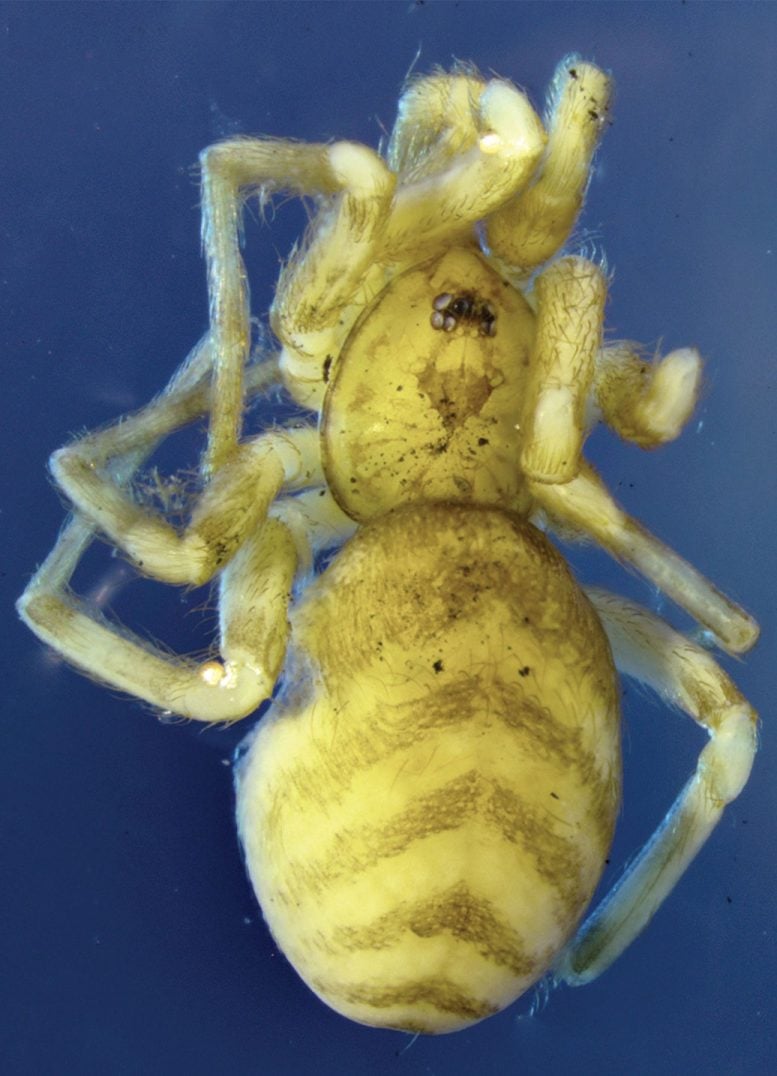 Pikelinia fasciata, female from Galapagos A. Habitus (dorsal view). Credit: Andrea C. Roman.
Researchers observed these spiders capturing and eating ants up to six times larger than their prosoma (body). The study also found that they regularly target common urban pests, including mosquitoes (Culicidae) and houseflies (Muscidae).
By placing their webs near artificial lights, the spiders appear to take advantage of insects attracted to light, allowing them to trap prey more effectively and contribute to a healthier urban ecosystem.
 A photo of the wall where these spiders live in Armenia, Quindío. Credit: Leonardo Delgado-Santa.Urban Ecology, Evolutionary Links, and Future Research
Beyond identifying the new Colombian species, the study also sheds light on a related spider from the Galapagos Islands. For the first time, scientists fully described and illustrated the female internal genitalia of Pikelinia fasciata, a species native to the Galapagos that was first identified in 1902.
Strong similarities between the Galapagos species and the newly identified Colombian spider, including nearly identical male palpal structures, suggest they may be closely related despite being separated by the Pacific Ocean. It is still unclear whether these similarities result from shared ancestry or from adapting to similar environments.
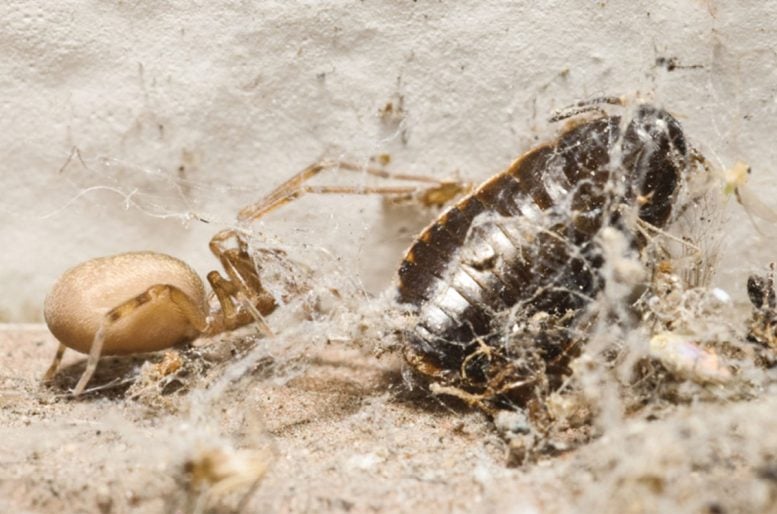 Pikelinia floydmuraria from Tolima, female juvenile, attacking a cockroach on the web. Credit: Julio C. González-Gómez.
The discovery of P. floydmuraria represents only the second documented Pikelinia species in Colombia. Researchers recommend further molecular studies and DNA-based dietary analysis to clarify its evolutionary history, determine its geographic origins, and better understand its role as a natural controller of urban pests.
Reference: “Another web in the wall: A new Pikelinia Mello-Leitão, 1946 (Araneae, Filistatidae) from Colombia, with notes on its diet and description of the female genitalia of P. fasciata (Banks, 1902)” by Osvaldo Villarreal, Leonardo Delgado-Santa, Julio C. González-Gómez, Germán A. Rodríguez-Castro, Andrea C. Román, Esteban Agudelo and Luís F. García, 18 February 2026, Zoosystematics and Evolution.
DOI: 10.3897/zse.102.175423
Never miss a breakthrough: Join the SciTechDaily newsletter.
Follow us on Google and Google News.