
On days like these, when the light is no longer washed out and becomes directional again, the shadows sharpening, it’s hard to remember the monotone grey of winter. For that, I’m relieved. Last week I walked through Derrycassan Wood in Longford, on the shores of Lough Gowna, its surface reflecting the clouds above. Thousands of trees were knocked down during last year’s Storm Éowyn, and Coillte has yet to clear them up. The wreckage – lengths of trunks lying like pogo sticks on the ground, sediment flowing into small streams – gives an apocalyptic feel to what is otherwise a magical place.
But it’s the perfect time of year to walk through the woods alone if, like me, you like company. Life was everywhere that afternoon: a blackcap outcompeting a nearby blackbird for singer of the year; above, a mewing buzzard attracting the attention of two irate crows; all around, the sounds of chiffchaff, treecreepers and woodpeckers.
The ravaging of the wood by Storm Éowyn has opened up spaces and let the light in. At a turn in the wood, the deep violet-blue of bluebells spreads far into the light between the standing trees. These are the native kind whose Irish name, coinnle corra – tapered candles – perfectly describes their shape.
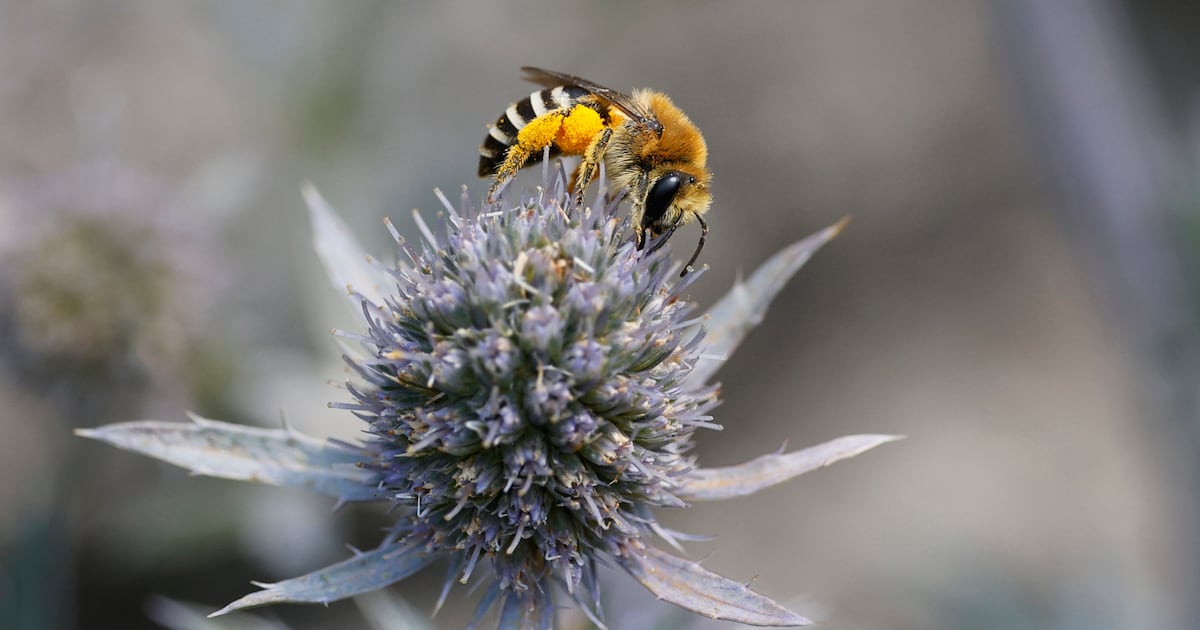
On the south-facing bank below, multiple small holes penetrate the thin layer of green Connemara marble-coloured moss. It was as if someone had taken a pencil and prodded down, creating a keyhole into the dark beneath. These are the entrances to burrows dug by solitary bees.
Bees might conjure flying through the air and feeding on flowers, but most wild bees spend part of their lives in the soil. In Ireland, most of our 80 solitary bee species burrow into the ground to nest. Sandy banks, clay-rich verges, coastal sand dunes and even back gardens where, as Dr Una Fitzpatrick of the National Biodiversity Data Centre has written, “tiny little volcanoes of soil” can suddenly appear.
What happens inside these spaces is extraordinary. Working entirely on her own, the female mining bee digs a tunnel with her tiny front legs, sometimes descending as deep as a metre into the earth. Inside she builds individual cells along the tunnel’s length and provisions each one with a ball of pollen and nectar. In this, she lays one egg, seals the cell and moves on.
We can’t fully protect pollinators if we ignore what is happening underground
The larvae live in the darkness, spending the winter underground and feeding on the ball of food left by their mother, now dead. The following spring they will scramble up the tunnel and emerge into the sun as adults, ready to find a mate and breed. It is a life born underground, in the dark; their time outside is spent alone.
Some solitary bees nest in existing cavities rather than digging, and can be extraordinarily particular about which ones. The plushly named gold-fringed mason bee, Osmia aurulenta, will only use empty snail shells on coastal sand dunes. If a male finds an empty shell, he will establish a territory around it to attract females. One bee species, one type of snail shell, one specific habitat. It’s a high-stakes game, and one the bee is currently losing.
Although they don’t make honey or form colonies, solitary ground-nesting bees aren’t peripheral creatures. They’re extremely important pollinators. And yet, as Prof Dara Stanley of University College Dublin says, we know remarkably little about the underground part of their lives. These two worlds – the world of soils and the world of pollinators – have been operating independently, but are deeply connected.
Stanley is a lead researcher on ProPollSoil, an EU Horizon Europe project launched last autumn with a budget of €7.7 million and 20 partner organisations across Europe. Its focus is on the relationship between soil health and pollinator health, which is timely given that, under the Nature Restoration Law, all EU member states are now required to monitor pollinators in a co-ordinated way.
Stanley is animated about one finding that could reframe how we think about soil. Just like earthworms, solitary bees are soil engineers, but where earthworms need moist soil and go deeper into the summer to find it, solitary bees do the opposite – they prefer drier soils and are most active digging in summer. Soil science has long included earthworms in its understanding of healthy soil structure, but has almost never included pollinators. This is what ProPollSoil sets out to change.
The citizen science part of the project is asking something simple of us all: if you find any signs of ground-nesting bee activity – small holes, bees flying low and entering the soil, or clusters of nest entrances close together – take a photograph, including the bee, and upload it to the project site. You don’t need to know or identify the species. Keep an eye out for south-facing banks, disturbed soil in gardens, the edges of paths and tracks – anywhere that looks like a patch of bare ground with a hole in it.
We can’t fully protect pollinators if we ignore what is happening underground. One third of Ireland’s wild bee species could go extinct by 2030 – that’s just four years away. Scientists know why this is – they’re starving, homeless and being poisoned by chemicals. Intensive tillage, compaction from heavy machinery, drainage works, the widespread loss of bare-earth habitats to hard surfaces and dense vegetation: all of these alter the conditions that ground-nesting bees depend on, and yet they have rarely been factored in to pollinator conservation policy.
Bees have been digging, nesting and hibernating in the soil for millions of years. They urgently need our attention. If you want to help, visit propollsoil.eu, or go to iNaturalist and search for the EuroBeeSoil project.