
Back to Article List
A strange star sits at the peak of the W in Cassiopeia: Gamma Cas, a binary with a secret only recently uncovered.

Look north to spot the W shape of Cassiopeia near the horizon this evening. The star at the central peak of the W is Gamma Cas. Credit: Stellarium
Looking for a sky event this week? Check out our full Sky This Week column.
April 25: The Moon meets Regulus
Let’s look north this evening to examine a strange star: Gamma (γ) Cassiopeiae, which sits at the central peak of the famous W in Cassiopeia the Queen.
Shining at magnitude 2.2, although it is quite bright, this sun has no official name bestowed by the International Astronomical Union. Sitting some 549 light-years away, Gamma Cas is a massive B-type star some five times hotter than our own Sun. But it has an additional distinction as the first known Be-type star, a rapidly rotating star that is flinging away its own atmosphere to form a disk of glowing hydrogen. Emission (light) from this hydrogen is what earns Be stars the “e” in their name.
But there’s an additional mystery here. Astronomers have known for several decades that Gamma Cas emits copious X-rays some 40 times more intense than stars with similar masses. But it wasn’t until recently that they were able to determine why. A paper published this spring in Astronomy & Astrophysics used extremely high-precision observations of the light coming from the star to unravel the truth. Gamma Cas has long been known to have a much lower-mass companion. The new observations show that the X-rays are not coming from Gamma Cas itself, but from this companion, a magnetic white dwarf. As material from Gamma Cas’ hydrogen disk flows toward the white dwarf, it forms a disk around this object as well. Some of the material from that disk follows magnetic field lines to its poles, where it glows so hotly that it produces the X-rays we see.

This illustration shows the Gamma Cas system. The massive Be star is at center, while its smaller, white dwarf companion at lower right. Material flowing from the Be star’s disk onto the white dwarf creates the bright X-rays we see coming from the system. Credit: ESA/Y. Nazé
Sunrise: 6:06 A.M.
Sunset: 7:50 P.M.
Moonrise: 3:03 P.M.
Moonset: 3:42 A.M.
Moon Phase: Waxing gibbous (80%)
*Times for sunrise, sunset, moonrise, and moonset are given in local time from 40° N 90° W. The Moon’s illumination is given at 10 P.M. local time from the same location.
Comet 10P/Tempel, also called Tempel 2, is continuing to brighten in the early-morning sky. Rising around midnight and visible until the sky streaks with dawn, two hours before sunrise on April 27 you’ll find the comet some 35° high in the southeast, near the tail feathers of Aquila the Eagle and not far from globular cluster NGC 6712.
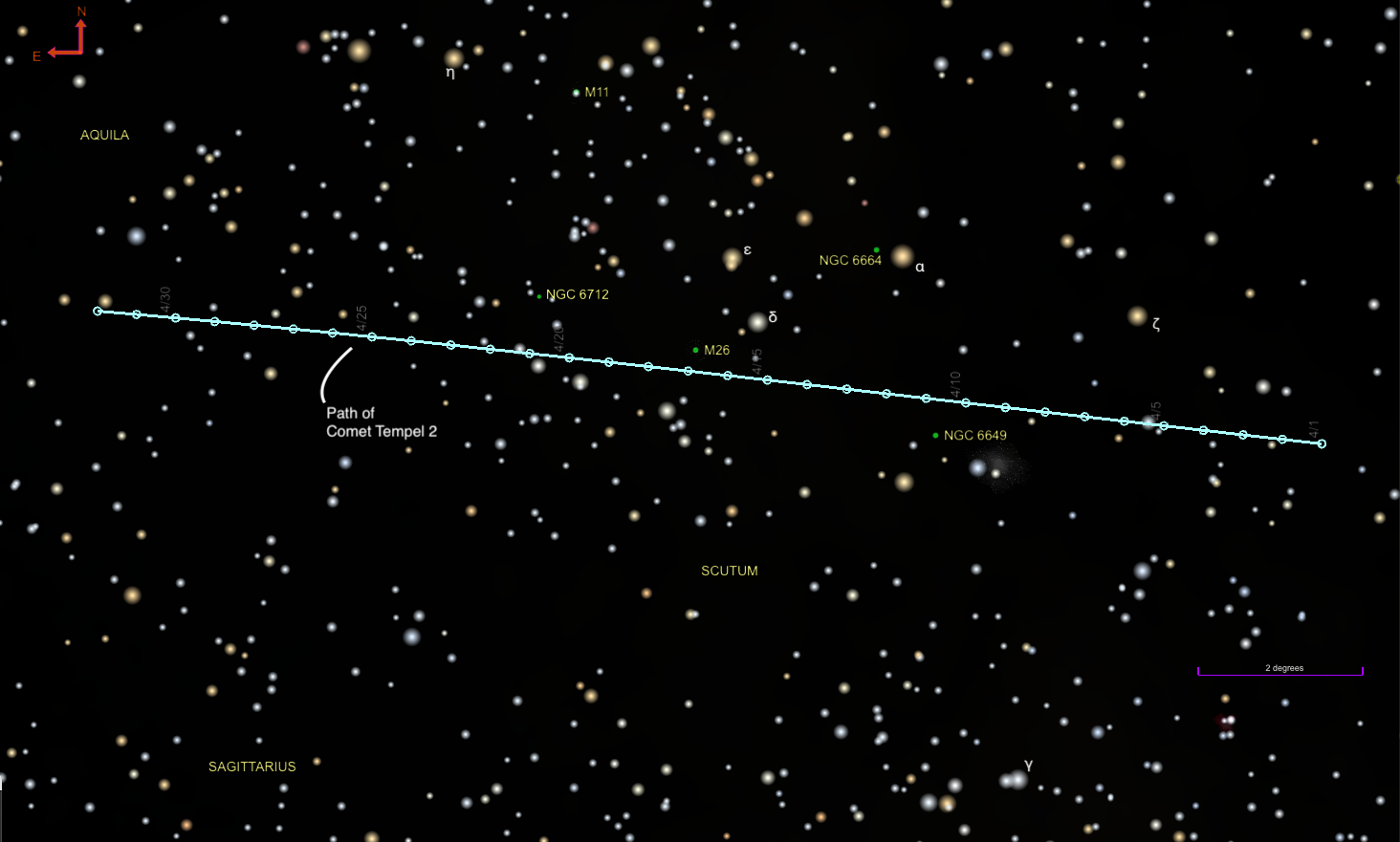
Comet Tempel 2 is settling in for a long summer stay. This month, it’s in Scutum the Shield, passing near several deep-sky objects. Credit: Alison Klesman (via TheSkyX)
Recently recorded around magnitude 11, Tempel 2 is located just over 4° south of Lambda (λ) Aquilae this morning. The comet is also only 3° from NGC 6712, which lies to Tempel 2’s west. Binoculars may show both fuzzballs in a single field of view, while a telescope will allow you to zoom in on one at a time.
At magnitude 8.2, NGC 6712 will be brighter. It spans roughly 7’ and is a somewhat diffuse cluster with a concentrated core that fizzles into separate stars as you reach the outskirts. Compare its shape, size, and brightness profile to that of the comet. Which one is larger? Which one is brighter in the center, and how do their appearances differ?