
122
New Delhi: Remarks by BJP leader Ram Madhav at a Washington event suggesting that India had stopped buying Russian oil, a claim he later described as factually incorrect, have drawn attention to the gap between political articulation and actual trade data.
As per data analysed by The Sunday Guardian, India has not structurally reduced its purchases of Russian crude oil over the past six months. Instead, imports have moved in response to pricing incentives within the limits imposed by sanctions enforcement, logistics and policy shifts, according to data from the Centre for Research on Energy and Clean Air, an independent research organisation that tracks global fossil fuel trade and sanctions impact, and corroborating trade reports.
The data shows a cyclical pattern rather than a sustained decline.
You Might Be Interested In
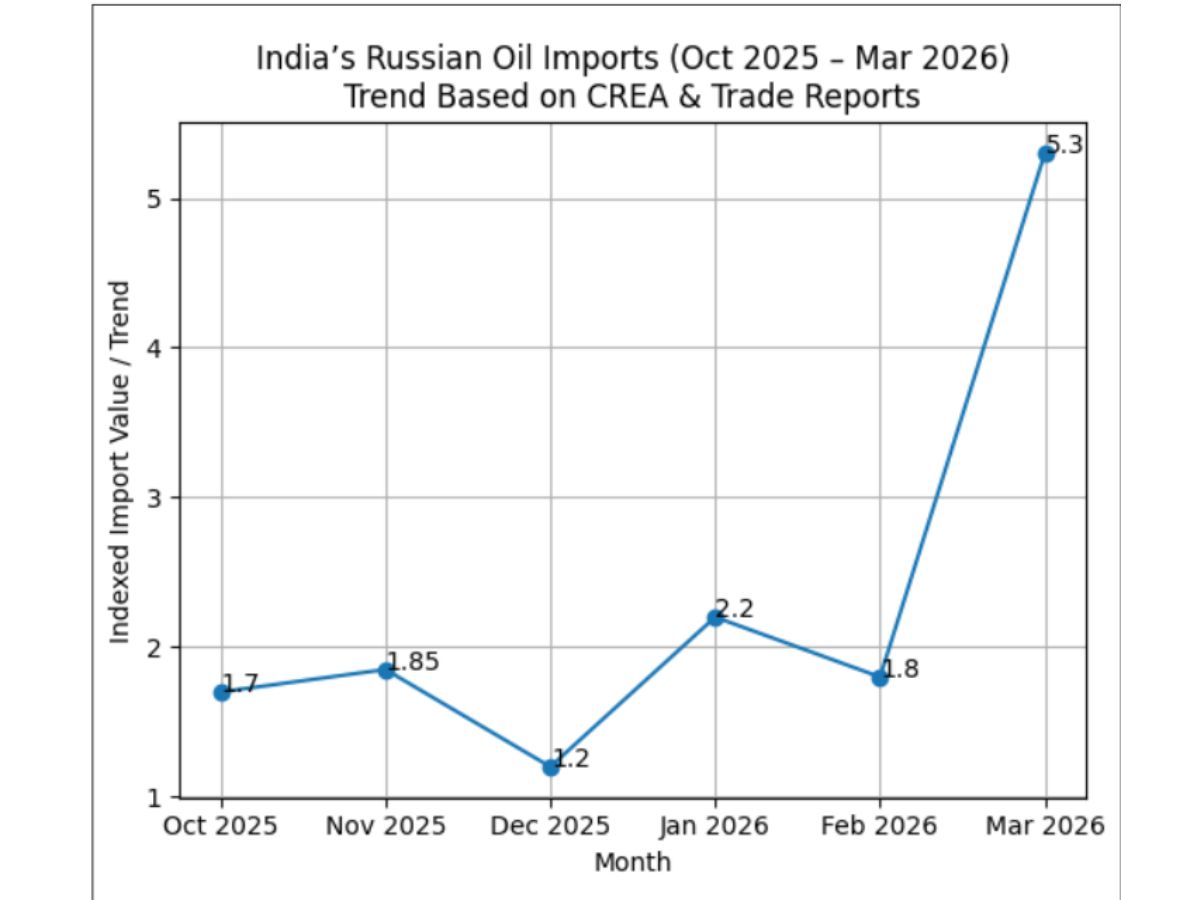
Imports were strong in October and rose to a local peak in November 2025, with volumes estimated at around 1.8–1.9 million barrels per day as refiners front-loaded purchases ahead of tightening compliance conditions.
The trend reversed sharply in December. Imports fell significantly as state-owned refiners curtailed purchases amid rising compliance risks, payment constraints and logistical disruptions, marking the clearest point of external pressure on flows.
January saw a partial recovery rather than a continued slide. Imports stabilised at roughly EUR 2.2 billion, indicating that refiners had begun adapting to the new constraints even before conditions eased fully.
The slowdown persisted into February, which marked the low point in the cycle. Imports dropped to about EUR 1.8 billion, and India slipped to the third-largest buyer of Russian crude behind China and Turkey. Despite this, Russia remained India’s single largest crude supplier with roughly a fifth of total imports, underscoring that demand did not collapse even at the trough.
The pattern shifted decisively in March 2026. India’s crude imports from Russia surged to about EUR 5.3 billion, more than doubling month-on-month and restoring its position as the second-largest buyer after China.
The surge followed a one-month waiver issued by the United States allowing cargoes already at sea and shipments on previously sanctioned vessels to be delivered. The move effectively released constrained volumes into the market. Higher global oil prices amid geopolitical tensions in West Asia amplified the value of imports, while renewed arbitrage opportunities encouraged refiners to increase intake.
State-owned refiners, which had reduced purchases in late 2025, returned aggressively, contributing to the scale of the rebound.
The six-month sequence points to a system governed by constraints rather than alignment. Imports contracted when compliance risks and logistical barriers intensified, and expanded when those constraints eased, and price advantages re-emerged.
In fact, India’s role extends beyond consumption. A portion of imported Russian crude is refined into products such as diesel and aviation fuel and exported to global markets. In March, refineries using Russian crude, including those in India, exported an estimated EUR 830 million worth of petroleum products to sanctioning economies, including the European Union, the United States and Australia. Because sanctions target crude origin rather than refined products, these flows remain legally permissible.
Shipping patterns have also adapted, sources told this newspaper. A growing share of Russian oil has been transported on vessels operating outside Western insurance frameworks, enabling continued trade despite restrictions.
In comparison, China has maintained steady large-scale purchases of Russian crude primarily for domestic use, while European Union countries have significantly reduced direct imports. India occupies a distinct position as both a major buyer and a refining hub that redistributes fuel into global markets.
The data suggests sanctions have altered trade routes and introduced friction, but have not eliminated demand. Instead, flows have been rerouted, with India remaining a central participant.
The March spike underscores the sensitivity of oil trade to policy intervention. While price differentials remain the primary driver of purchasing decisions, CREA’s analysis indicates that regulatory changes, such as temporary waivers, can rapidly reshape volumes by unlocking previously constrained supply.
Taken together, the six-month trend shows that India’s Russian oil imports are driven by economic optimisation within a constrained system. Purchases declined under pressure but did not cease, and rebounded sharply once policy and logistical conditions allowed, contradicting any narrative of a sustained withdrawal from Russian crude