
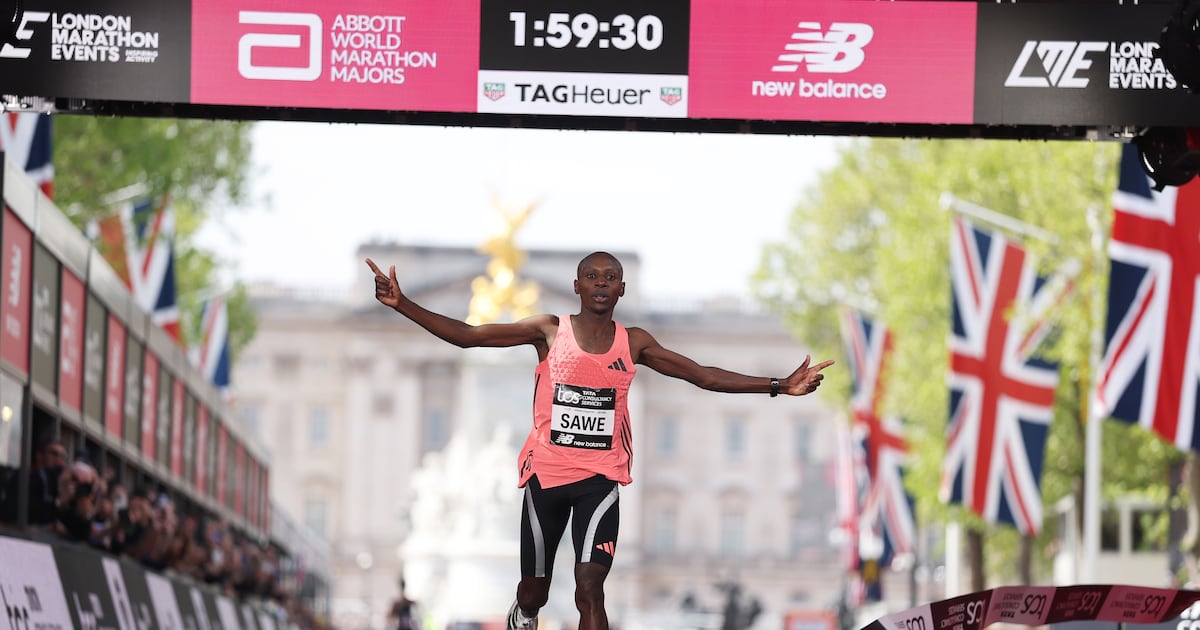
They call Sabastian Sawe the silent assassin. But it was impossible to ignore the beautiful destruction on the streets of London as the 30-year-old Kenyan became the first athlete to shatter the two-hour barrier in an official race.
As Sawe crossed the line on the Mall, the clock showed that he had run 26.2 miles in a staggering 1 hour, 59 minutes and 30 seconds – 65 seconds faster than the previous best set by Kelvin Kiptum in 2023.
The world record had not just been destroyed, it had been obliterated. He came. He Sawe. He conquered. “I am feeling good, I am so happy,” said Sawe. “It is a day to remember.”
Sawe’s team had insisted their man was in shape, and that he would be helped by wearing the latest pair of Adidas Adios Pro 3 supershoes, which weigh in at just 97 grammes – lighter than a baby kitten – and will retail for about £450. But no one expected this.
Not long behind him was Ethiopia’s Yomif Kejelcha, who was 11 seconds back in his debut marathon. His time would have also shattered the world record. Uganda’s Jacob Kiplimo, who came third in 2:00:28, was also inside it too.
There was an Irish record to be broken as well by Peter Lynch from Kilkenny City Harriers, who clocked 2:06:08 to finish ninth. The 28-year-old shattered his previous best of 2:09:36 to break Fearghal Curtin’s national record of 2:07:54 which was set last year.
[ Peter Lynch knocks almost two seconds off Irish marathon record in LondonOpens in new window ]
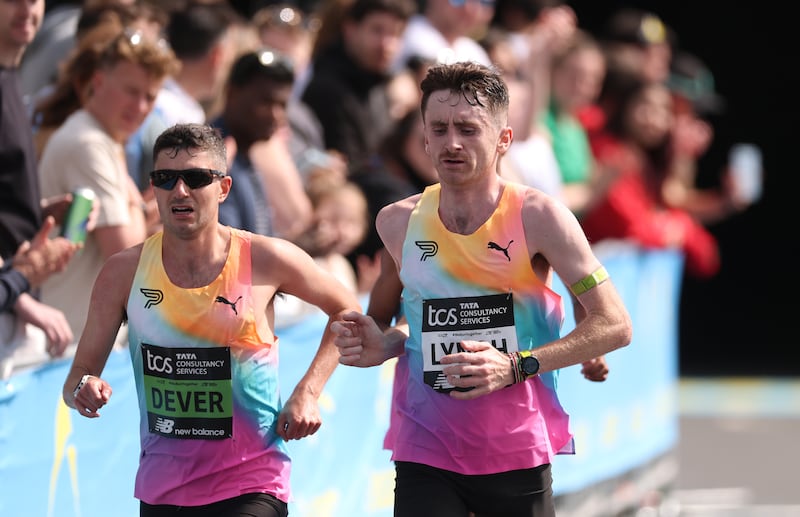 Patrick Dever of Team Great Britain and Peter Lynch of Team Ireland compete during the London Marathon. Photograph: Warren Little/Getty
Lynch also won the unofficial European battle in London, pulling clear of Brits Mahamed Mahamed and New York Marathon third-placer Dever in the final two kilometres.
For the elite racers, the weather at the start was almost perfect for fast times: 11 degrees, sunny, and with a gentle tailwind over the crucial last few miles. And six men – including the favourites, Sawe and Kiplimo – were determined to take advantage.
They hit the 10km mark, just before Cutty Sark, in 28 mins and 25 seconds, a shade under world-record pace, and were through halfway in 60:29 secs, 12 seconds down.
At this point the men’s race looked like being fast but not record-breaking. When the last pacemaker dropped out, though, Sawe and Kejelcha suddenly charged clear at a drinks station, surprising Kiplimo, who found himself unable to fight back.
By now they were pouring the pace on. Between 30-35km they ran an astonishing 13:54 5km. To put into context, the time is just 12 seconds slower than the world record for a 5km parkrun, set by the Irish international runner Nick Griggs.
Sawe and Kejelcha were still together in the last mile, and with Kejelcha having won a silver medal over 10,000m at last year’s World Championships, he might have been expected to have the quicker kick.
Instead it was Sawe who was the fresher and along Birdcage Walk he put on another surge that finally broke his rival – and, staggeringly, the world record.
Incredibly, Sawe’s time for the second half of the race was just 59:01. And for good measure his overall finishing time was also 10 seconds faster than Eliud Kipchoge had run in a special unofficial marathon in Vienna in 2019.
Naturally there will be questions about whether we can trust Sawe’s record, given the chequered history of Kenyans failing doping tests in recent years. It should be noted, however, that before the Berlin marathon in September, Sawe’s sponsors, Adidas, paid the Athletics Integrity Unit £50,000 to test him as many times as possible because they wanted to show he was clean.
Not only was Sawe tested 25 times in a few weeks, but his samples were also scrutinised with top-end analysis, including isotope ratio mass spectrometry testing, which is much better at detecting tiny levels of banned drugs. A similar protocol was in place for London, although it is understood that he was not tested as many times.
The women’s race turned into a three-way sprint down the Mall, with the Ethiopian Tigst Assefa defending her title after kicking from home in sight of Buckingham Palace. Her time of 2:15:41 was a women’s only-word world record, which applies to races with only women’s pace makers but is nearly five minutes slower than the official women’s world record.
In second place, 12 seconds back, was Kenya’s Hellen Obiri, while her compatriot Joyciline Jepkosgei finished third. – Guardian